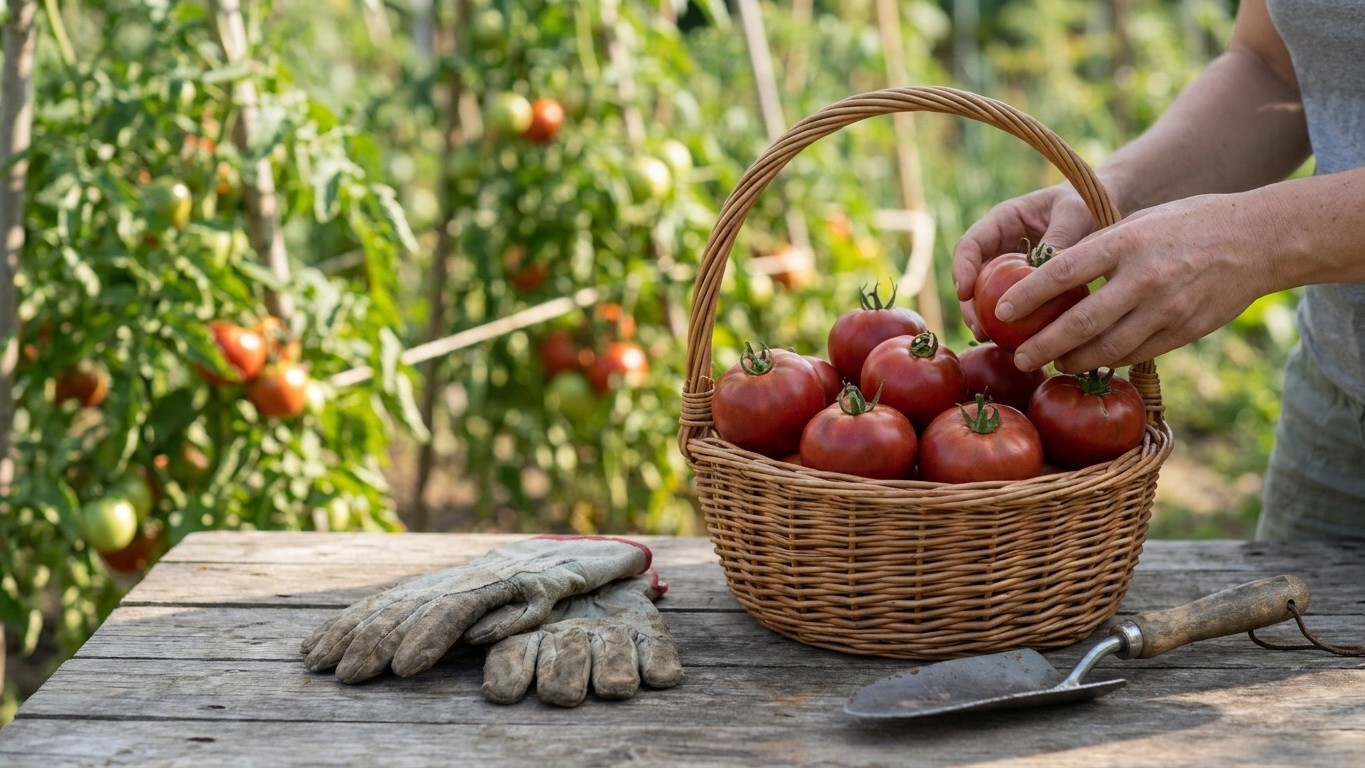

Marbonne is a French-bred slicing tomato grown for smooth, uniformly round, deep red fruit on a tall indeterminate vine, and seed catalogues put it at about 69 days from transplant to first ripe fruit, not from the day you sow the seed. That window clears the frost-free season almost everywhere in the continental United States with room to spare, and it clears most of southern Canada too if you start the plants under cover. Before you commit to a planting date, check your local frost-free window against the variety’s maturity arithmetic, then pick your transplant date from that, not from the calendar on the seed packet.
What Marbonne actually is

Marbonne belongs to the standard red slicer category rather than a specialty type. The fruit runs medium to large, round and slightly flattened, with the smooth red skin and dense flesh that make it a knife-and-plate tomato rather than a paste or cherry type. Seed catalogues list it at 69 days from transplant, and that figure is worth repeating because growers routinely confuse it with days from sowing, which pushes the real harvest a month or more later than expected once you count the four to eight weeks a seedling spends indoors first. Catalogue figures also shift a week or two either way depending on how warm the season runs, so treat 70 to 75 as a planning range, not a guarantee.
The vine is indeterminate, meaning it keeps growing and setting new trusses until frost or disease stops it, rather than stopping at a fixed height and ripening one flush like a determinate bush type. That habit decides most of the work: staking, ongoing feeding, and a harvest that trickles in over weeks instead of arriving all at once. If you already grow a different indeterminate slicer, the maintenance pattern will feel familiar. Anyone comparing options across the broader Tomato Varieties catalogue will find Marbonne sits closer to a classic all-purpose beefsteak-style slicer than to a specialty paste or salad type.
What Marbonne is good for
Marbonne is built like the tomatoes people slice rather than cook. The flesh is dense enough to hold a clean edge under a knife, and the round, slightly flattened shape gives you wide, even slices instead of odd wedges — the same reason a beefsteak-style tomato ends up on a sandwich or a burger rather than in a saucepan. That density comes with enough retained juice to make the fruit eat well raw, on a plate with salt and oil, where you want texture and moisture rather than a tomato that collapses.
That same juiciness is a limitation the other way. Paste tomatoes cook down fast because they carry little water and few seed cavities, so a pan reduces on its own. A slicer like Marbonne has more water and more open locules, so turning it into sauce means longer simmering to drive off that liquid, or draining and seeding the fruit first if you want a thick result without babysitting the stove. It is not a bad cooking tomato, but it will not behave like a San Marzano if you skip that step.
The catalogue description for Marbonne calls out exceptional flavor and appearance, which tells you the breeder considers this fruit a standout within its type, but it does not specify whether that flavor leans sweet, acidic, or balanced, and nothing more detailed than that has been published. Given the red color and slicer build, expect the classic fresh-tomato profile rather than anything unusual, but treat the specifics as undocumented until you grow it and taste for yourself.
In short: plan on Marbonne for the cutting board, the sandwich, and the salad bowl, and treat sauce-making as a secondary use that takes more stovetop time than a dedicated paste variety would.
Where it ripens in time, and where it is a gamble
The arithmetic that decides whether Marbonne finishes a crop is simple: take the frost-free window, subtract the two or so weeks the soil needs to warm before a tomato transplant will actually grow rather than sulk, subtract the 69 days to first fruit, and whatever is left is your picking margin. A margin under 30 days means you get one flush of ripe fruit and a cool year takes even that.
The tight end
At Whitehorse, the reference station for the Yukon, the numbers run out before the season does: a mid-June set-out and a late-August first ripe leave the margin two days short of the first frost, meaning the fruit would still be green when the cold arrives. Rankin Inlet, standing in for Nunavut, does slightly better on paper with a three-day margin off an early-July set-out and early-September first fruit, but three days is one flush at best, and a cool summer erases it entirely. In both places the accumulated summer warmth, not just the frost date, is too low for a tomato regardless of how the frost timing falls, which is covered in the next section.
The workable middle
Yellowknife (Northwest Territories), Calgary (Alberta), Winnipeg (Manitoba) and Saskatoon (Saskatchewan) all post margins between roughly 33 and 40 days once you run an early-June set-out against a mid-August to early-August first ripe. That is enough time on the calendar for more than a single flush, but three of the four are still rated a greenhouse or tunnel crop on heat alone, a distinction the next section explains.
The comfortable end
Seattle (Washington) and Charleston (South Carolina) post margins over 150 days from spring set-out windows to first ripe fruit in early June, and Jacksonville (Florida), Houston (Texas), Las Vegas (Nevada) and New Orleans (Louisiana) all clear 180 days or more, some with a first ripe fruit in late April. That kind of margin means the frost date is never the limiting factor. It also means a grower in those states can stagger two separate sowings, which matters for reasons covered in the next section.
| Territory (station) | Verdict | Margin | Set out | First ripe |
|---|---|---|---|---|
| Yukon (Whitehorse) | impossible in the open | -2 days | mid June | late August |
| Nunavut (Rankin Inlet) | risky | 3 days | early July | early September |
| Saskatchewan (Saskatoon) | greenhouse | 40 days | early June | early August |
| Manitoba (Winnipeg) | greenhouse | 39 days | early June | mid August |
| Texas (Houston) | comfortable | 192 days | mid February to mid March | late May |
| Louisiana (New Orleans) | comfortable | 229 days | early to late February | early May |
The two ways a season goes wrong
A long frost-free window on paper does not guarantee a finished crop, and Marbonne’s mid-season maturity of 69 days is caught by both failure modes depending on where you garden.
Not enough accumulated warmth
In the northern Territories, a tomato needs a running total of warm days, not just a frost-free stretch, to push fruit from flower to ripe. Yellowknife and Calgary both show workable margins of over 30 days, yet both are still rated a greenhouse or tunnel crop because the season’s accumulated heat runs well under what a tomato needs to finish reliably in the open, whatever the frost date says. Winnipeg and Saskatoon sit closer to the line, described as marginal rather than impossible, and an early variety paired with black plastic mulch to warm the root zone can be the difference between a crop and a disappointment there. Nights below roughly 50°F also stop new flowers from setting fruit even when the plant itself survives, which is why a long cool autumn can add weeks to the calendar without adding a single new tomato.
Too much heat, not too little season
In South Carolina, Florida, Texas, Nevada and Louisiana the problem inverts. Once temperatures climb above roughly 86°F, tomato pollen goes sterile and blossoms drop without setting fruit, a stretch that runs from late spring into early autumn depending on the state. Growers in those states plant a spring crop timed to finish before that heat window closes, then a second, autumn crop timed to start setting fruit again once temperatures fall back under that threshold. That is why the set-out windows for Houston, Las Vegas and New Orleans in the table above all sit in winter or earliest spring rather than in the middle of the year. For Marbonne specifically, the 70 to 69 day maturity fits neatly inside either the spring or the autumn slot in those climates, but not inside a single summer-long planting.
What it resists, and what it does not
Marbonne carries High resistance to Fusarium Wilt races 1, which means the plant strongly suppresses that particular soilborne fungus in fields where it has been a recurring problem. High resistance is not immunity, and a heavily contaminated bed can still produce some symptoms, but it is a meaningfully stronger rating than the intermediate grade seed catalogues use for varieties that only slow a disease down rather than largely stopping it.
The catalogue lists a second high rating, against tomato mosaic virus, and then stops: no resistance to the other diseases that commonly hit tomatoes: no listed protection against Verticillium wilt, late blight, early blight, or root-knot nematodes. That gap matters in practice more than the two resistances it does carry, because a grower who reads “disease resistant” on the tag and stops there is unprotected against everything except one specific fungus. Rotate tomatoes out of any bed that has grown them for the past two or three seasons, keep foliage dry with drip irrigation rather than overhead watering, and stake plants to keep leaves off the soil where blight spores splash up during rain. None of that is specific to Marbonne, but none of it is optional either, given how little those two resistances actually cover.
Growing it without the usual mistakes
Because Marbonne is indeterminate, it needs a different plan from a determinate bush that ripens in one flush and can be left to sprawl in a cage. A vine left unsupported will collapse under its own weight by midsummer, tangling fruit into the soil where it rots and slugs find it first.
Support and spacing
Set stakes or cattle-panel trellis at planting time rather than after the vine has already flopped, since driving a stake through an established root ball sets the plant back for weeks. Prune to one or two main leaders and pull the rest of the suckers as they appear, which keeps airflow moving through the canopy and gives the fungal risks described above less of a foothold. Space plants far enough apart that mature foliage from neighboring vines doesn’t touch, since that overlap is exactly where blight and mildew move fastest.
Feeding and the timing mistake this variety invites
Feed steadily through early fruit set, then stop feeding nitrogen once the plant is carrying a full load of trusses, because extra nitrogen at that stage pushes leafy growth at the expense of ripening fruit, a mistake that shows up more on an indeterminate vine than a determinate one simply because there’s more vine to overfeed. The timing mistake specific to Marbonne’s maturity is starting too early: because 69 days sounds fast, growers set transplants out ahead of the local frost-safe window to chase an early harvest, and a late cold snap on a plant already stressed by cold soil costs more time than it saves. A grower comparing this variety against something with a bigger fruit and a similar risk profile might look at the Firebird Tomato, or against a different color class entirely with the Marnero Tomato.
- Stake or cage at transplant time, not after the vine has sprawled
- Prune to one or two leaders on this indeterminate habit
- Hold off nitrogen once fruit trusses are set
- Water consistently to avoid the cracking that smooth-skinned slicers show under irregular moisture
- Wait for the local frost-safe window rather than chasing the fast maturity figure
Common questions
Is Marbonne a determinate or indeterminate tomato?
Indeterminate. The vine keeps growing and setting new fruit trusses until frost or disease stops it, which is why it needs ongoing staking and feeding rather than the one-and-done cage a determinate bush type gets.
Can I grow Marbonne in a short-season climate like the Yukon or Nunavut?
Only under cover. The frost margin alone rules out an open-ground crop in both places, and even where the margin looks workable further south in Canada, low accumulated summer warmth means a greenhouse or high tunnel is what actually finishes the crop, not just extending the frost-free window.
Why are my Marbonne flowers dropping without setting fruit?
Two opposite causes produce the same symptom. In a hot climate, temperatures above roughly 86°F sterilize the pollen and blossoms drop without setting. In a cool climate or late in the season, nights below roughly 50°F have the same effect. Check which end of the thermometer you’re actually dealing with before changing anything else.
Does Marbonne resist cracking or blossom end rot?
No, and the catalogue doesn’t claim it does. Its one listed resistance is to Fusarium wilt. Cracking and blossom end rot are both watering problems on this variety as on any smooth-skinned slicer, and consistent soil moisture prevents both more reliably than any trait bred into the plant.