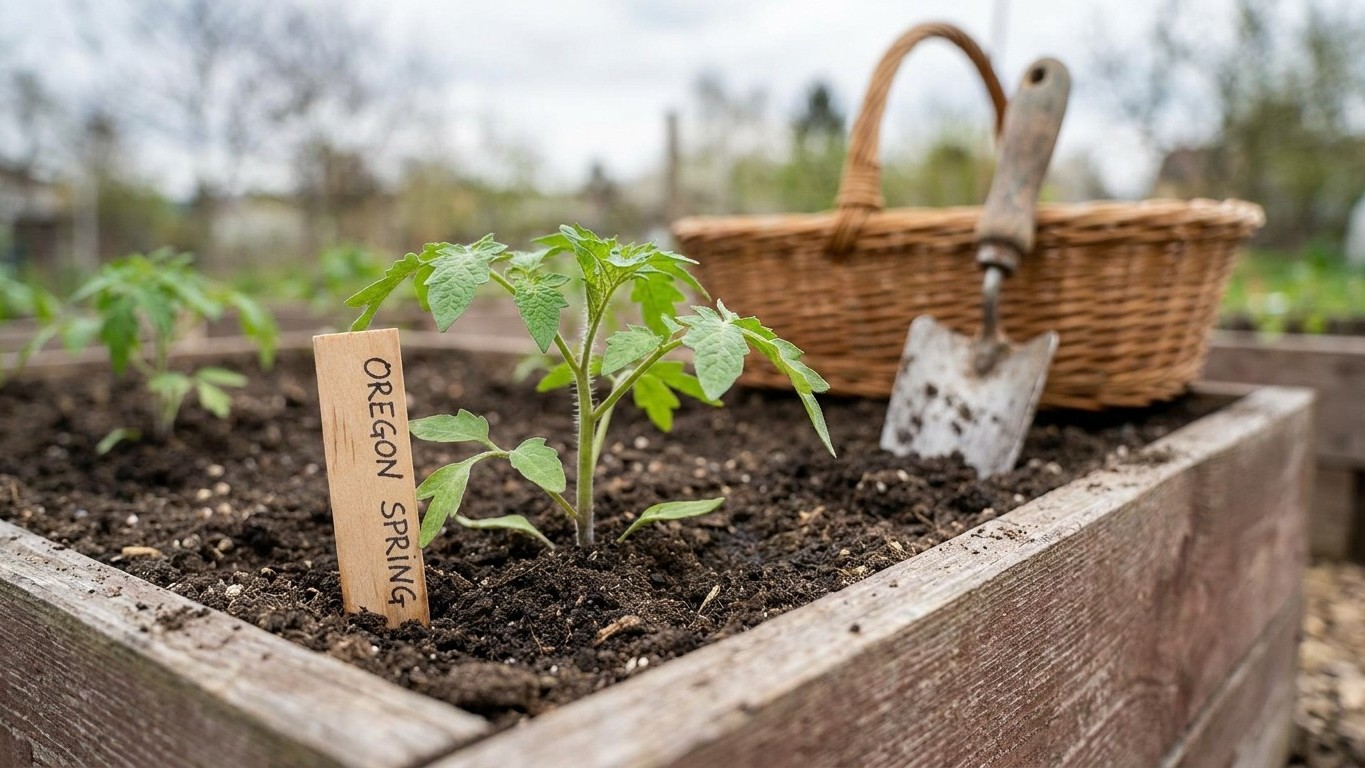

Oregon Spring is a determinate slicing tomato bred for cool, short summers, and it ripens in about 70 days from transplant. That speed and its unusual tolerance for setting fruit in cool weather are the two things that decide whether it belongs in your garden. Check your local frost-free window against that 58-day count before you buy the packet.
What Oregon Spring actually is

Oregon Spring is a determinate tomato, meaning the plant grows to a fixed size, sets most of its fruit in a fairly concentrated window, and then tapers off rather than producing steadily until frost. It takes about 70 days from transplant to first ripe fruit, with that count starting the day you set the plant in the ground, not the day you sowed the seed indoors. Sowing to transplant typically adds five to seven weeks on its own, so the seed packet’s 70 days is only half the story if you are counting from a seed tray.
The fruit is medium-sized, red when ripe, round to slightly flattened, and meaty with a small seed cavity, which is what makes it a slicer rather than a sauce tomato. What sets the variety apart is not the fruit but the plant’s behavior in cold conditions. Oregon Spring was bred at Oregon State University specifically to set fruit at temperatures that stop most other tomatoes cold, which is why it shows up so often in short-season Pacific Northwest gardens rather than in southern seed racks.
Because it is determinate and compact, it suits a cage or a short stake rather than the tall trellis a rangy indeterminate needs.
What Oregon Spring is good for
The meaty flesh and small seed cavity already noted are what put this tomato in the slicing category rather than the paste category, and that distinction matters more than it sounds like it should. A paste tomato has thick walls and very little of the watery gel that surrounds tomato seeds, so it collapses into sauce on the stove without needing a long simmer to drive off liquid. A slicing tomato like Oregon Spring carries more of that gel and juice relative to its flesh, so cooking it down takes longer and yields a thinner result unless you strain or reduce it further. That’s not a flaw, it’s just what the fruit is built for: raw eating, where the juice is part of the appeal rather than something to cook away.
Practically, this means Oregon Spring belongs on a sandwich, cut into a salad, or laid out on a plate with salt, where the ratio of juice to flesh is a feature. It is not the tomato to reach for if the goal is a thick sauce or a paste for canning, since you’ll spend extra stove time reducing liquid that a paste variety wouldn’t have contributed in the first place. Nothing about the tomato’s actual taste, sweetness, or acidity has been documented here, so none of that can be promised; what can be said is that the category implies a texture and juiciness suited to fresh use rather than cooking down.
The determinate habit adds a practical wrinkle: because the plant sets fruit in a concentrated window rather than trickling it out over the season, you’ll likely have a run of ripe slicers all at once. That’s convenient for a stretch of BLTs or a batch of salads, but it also means there’s no slow, steady trickle of fruit to plan a weekly sauce project around.
Where it ripens in time, and where it is a gamble
The arithmetic is the same everywhere: take the local frost-free window, subtract roughly two weeks for the soil to warm enough to set transplants out, subtract the 70 days Oregon Spring needs to reach first ripe fruit, and what’s left is your picking window before the first fall frost ends the season. Where that leftover number is small, one cool week can erase the whole crop.
At the tight end, Whitehorse in the Yukon shows a margin of negative three days: plants set out in mid-June there are only reaching first ripe fruit around late August, and the first frost arrives before that fruit finishes, which makes an open-ground crop mathematically impossible without protection. Rankin Inlet in Nunavut is only slightly better, with a two-day margin between first ripe fruit and first frost, which means a single flush might sneak through in a warm year and get wiped out in a cool one. Yellowknife in the Northwest Territories and Calgary in Alberta both sit in the low thirties for days of margin, enough for a real harvest but tight enough that a greenhouse or tunnel is the safer bet in both places.
Seattle, tracked by NOAA, tells a different story: a comfortable margin of 156 days between first ripe fruit and first frost, with transplants going out from mid-March to early April and first ripe fruit arriving in early June. That window suits Oregon Spring’s cool-set trait almost exactly, which is no accident given where the variety was bred. At the wide end, New Orleans shows a 228-day margin, with transplants going out in early to late February and first fruit by early May, more margin than this fast variety will ever need in a single season.
Reading the margin
| Territory (station) | Verdict | Margin | Set out | First ripe |
|---|---|---|---|---|
| Yukon (Whitehorse) | Impossible outdoors | -3 days | Mid June | Late August |
| Nunavut (Rankin Inlet) | Risky, one flush | 2 days | Early July | Mid September |
| Alberta (Calgary) | Greenhouse advised | 34 days | Early June | Mid August |
| Washington (Seattle) | Comfortable | 156 days | Mid March to early April | Early June |
| Louisiana (New Orleans) | Comfortable | 228 days | Early to late February | Early May |
A margin under thirty days means the crop rides on a single flush and a cool year takes it entirely, which is the case in the Yukon and Nunavut figures above. Anything past sixty or seventy days of margin gives Oregon Spring enough slack to shrug off a slow, cool start, which is closer to what Washington and Louisiana growers get.
The two ways a season goes wrong
A long frost-free window on paper does not guarantee a full harvest, and two limits explain why. In cold Territories, accumulated warmth can fall short even when the calendar shows plenty of frost-free days, because a tomato plant needs a running total of heat over the season, not just an absence of frost, to push fruit from flower to ripe. Fruit also will not set at all once nighttime temperatures drop below roughly 50F, regardless of how many frost-free days remain on the calendar. That is the real story behind the Yukon and Nunavut figures above: the days exist, but the heat units and the warm nights needed to fill them do not.
In hot territories the failure runs the other way. Once daytime temperatures climb past roughly 86F, tomato pollen goes sterile and flowers drop without setting fruit, which is why growers in Louisiana, Texas, Nevada, Florida and South Carolina typically run a spring crop and a separate autumn crop rather than one long season. The comfortable 228-day margin at New Orleans looks generous until you realize a large chunk of that window, roughly June through September, is a dead zone for fruit set, not a bonus.
For Oregon Spring specifically, the cold limit matters less than it does for a slower slicer, because the variety was bred to keep setting fruit in conditions that stall most tomatoes. The heat limit matters just as much as it does for any other tomato, and arguably more, because its whole appeal is a fast, early crop. The smart move in a hot-margin territory is to use that 58-day speed to get a full harvest picked before the sterile stretch begins, rather than planting late and losing the flush to a July heatwave.
What it resists, and what it does not
Oregon Spring carries no disease resistance codes on the seed packet or catalogue listing, unlike hybrids bred specifically for that purpose. That is a meaningful gap: it means the plant has no built-in defense against verticillium wilt, fusarium wilt, or the root-knot nematodes that some newer hybrids are bred to shrug off. If you have grown tomatoes in the same bed for several years and suspect soil-borne disease, Oregon Spring will not tell you anything different from an unprotected heirloom.
This puts it in sharp contrast with a newer determinate slicer like Defiant PhR, which is bred with a named resistance package against late blight and several other common pathogens. Where a catalogue grades resistance as high versus intermediate, the distinction matters in practice: intermediate resistance slows a disease down, it does not stop it, and a plant carrying only intermediate resistance can still lose a season to the same pathogen under heavy pressure. Oregon Spring offers neither grade, so the practical risk sits entirely on crop rotation, garden sanitation, and choosing disease-free transplants.
- No listed resistance to verticillium wilt (V)
- No listed resistance to fusarium wilt (F)
- No listed resistance to root-knot nematodes (N)
- No listed resistance to tobacco mosaic virus (T)
If disease history is the deciding factor in your garden rather than season length, that gap is worth weighing against the speed and cold tolerance that make Oregon Spring attractive in the first place. A grower coming to tomatoes for the first time should look over the broader field of options on the Tomato Varieties page before settling on one that trades resistance for earliness.
Growing it without the usual mistakes
Support and spacing
Because Oregon Spring is determinate, it stays compact and does not need the tall trellis or string system a sprawling indeterminate demands. A cage roughly three to four feet tall, or a single stake with loose ties, holds the plant through its one main fruiting flush. Space plants on the closer end of typical tomato spacing since the plant does not keep growing taller through the season the way an indeterminate does. This is the opposite growing plan from a variety like San Marzano, an indeterminate that keeps climbing and setting new fruit until frost and needs continual support and feeding to match.
Pruning and feeding
Do not prune suckers aggressively on a determinate tomato. Every sucker you remove is a branch that would have carried part of the single flush this variety is built to deliver, so heavy pruning here costs yield rather than improving it, unlike on a sprawling indeterminate where suckering keeps the plant manageable. Stop feeding nitrogen once the first fruit sets, since a determinate plant that keeps pushing leafy growth after that point is spending energy it should be putting into ripening the fruit it already has.
The mistake its timing invites
The mistake this variety invites is not underestimating the cold, it’s overestimating it. Oregon Spring sets fruit in cooler conditions than most tomatoes, which tempts gardeners to plant it well ahead of their normal transplant date. The plant tolerates cool air better than most, but a hard frost still kills it outright, and a marginal cold night before the plant is established stunts it even if it survives. Treat the variety’s cold tolerance as a buffer against a slow, cool spring, not as license to ignore the local last-frost date. Check your state extension service or NOAA’s climate normals for your closest reference station before moving your transplant date earlier than the guidance for ordinary tomatoes.
Common questions
Can I grow Oregon Spring in a container?
Yes, its determinate, compact habit makes it a reasonable container choice, more so than a rangy indeterminate. Use a container of at least five gallons and keep the mix consistently moist, since containers dry out faster than garden soil and a moisture swing during fruit set costs you flowers.
Why did my Oregon Spring plant stop producing after a few weeks?
That’s the determinate habit working as designed, not a problem. The plant sets most of its fruit in one concentrated flush and then winds down, so a short, heavy harvest followed by a quiet plant is normal rather than a sign of disease or poor care.
Is Oregon Spring the same as regular Oregon Spring V?
Some catalogues list a “V” strain with added verticillium tolerance bred in later, so check the specific packet or listing rather than assuming the base variety carries that resistance. The plain Oregon Spring carries no disease resistance codes.
Can I start a second planting for a fall crop?
In territories with a wide enough frost-free margin, such as the Gulf Coast or the Southwest, a second sowing timed to mature after the mid-summer heat drops back below the pollen-sterility threshold can work, since Oregon Spring’s 58-day cycle is fast enough to fit a short autumn window. Count backward from your area’s average first fall frost using the same 58-day figure, plus time for seedlings to establish, before committing to a second round.