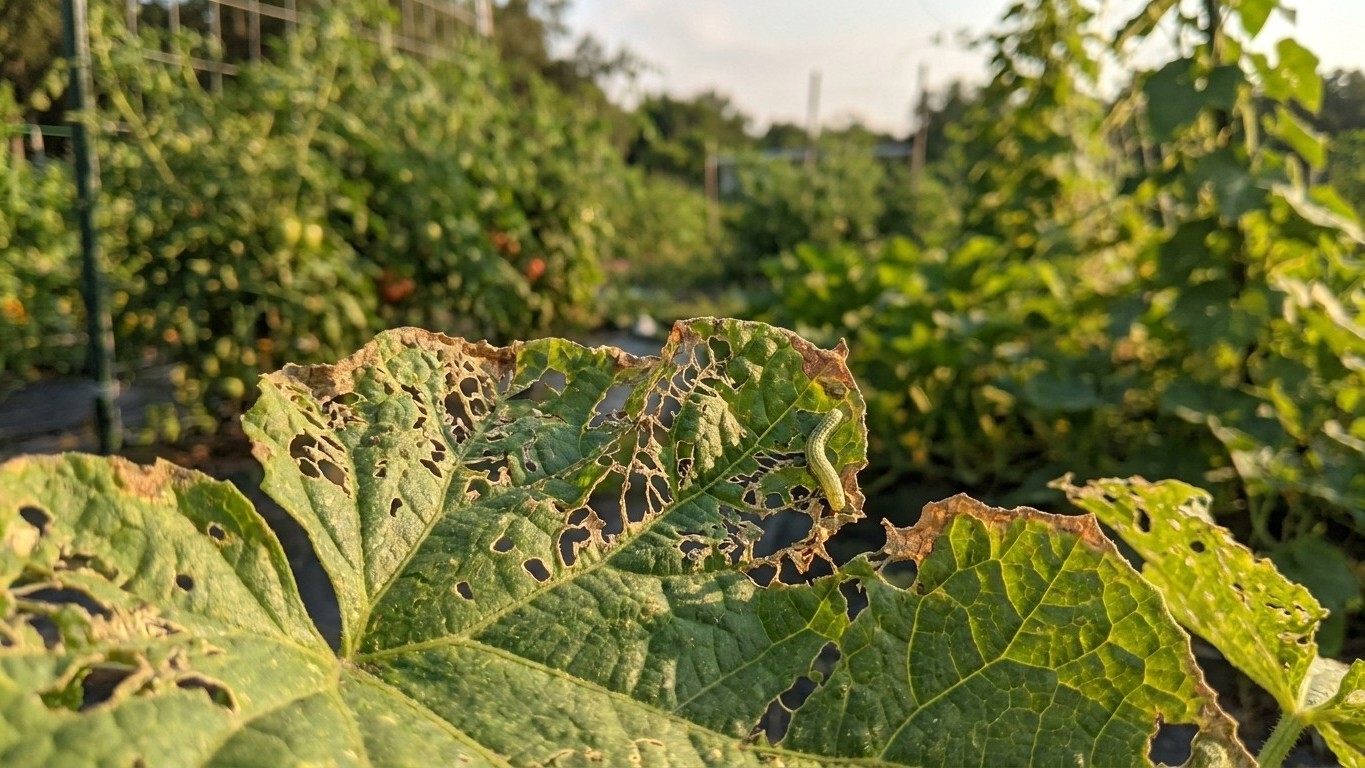

Melonworm caterpillars hit Florida cucurbit patches whenever the weather turns hot and stays that way, chewing lace-holed leaves on cucumbers, squash, and melons before anyone spots the moth that laid the eggs. UF/IFAS Extension doesn’t publish a specific calendar window for this insect, but the broader pest pattern for the state points straight to late summer plantings as the riskiest.
When Melonworm turns up in Florida

Here’s the honest answer: UF/IFAS Extension does not publish a specific seasonal window for melonworm the way it does for some other garden pests. That’s worth saying plainly rather than papering over with a made-up date range.
What the extension service does document is a broader hot-season pattern that applies to a cluster of warm-weather pests in Florida gardens. Eastern lubber grasshoppers show up from March or April through October or November, with numbers peaking in July and August. Chilli thrips get heaviest during long, hot, dry stretches. And vegetables planted in August or September, the extension notes, are the ones most exposed to pests that thrive in hot weather.
Melonworm fits that same profile even without its own named window. It’s a warm-season feeder on cucurbit vines, and Florida’s long stretch of heat, often running from late spring into fall, gives it plenty of runway. Gardeners who plant cucumbers, squash, or melons in the thick of summer are planting straight into the period when the state’s hot-weather pest pressure is documented to be at its worst.
Why no exact date exists
Insect activity tracks temperature and host-plant availability, not a fixed spot on the calendar. That’s part of why UF/IFAS frames its pest guidance around seasonal patterns and plant susceptibility rather than a single trigger date. Treat the August-September planting window as the flag it is: a period of elevated risk, not a countdown to a specific outbreak day.
Reading the calendar from your last spring frost
North Florida gardeners have one date to actually plan around: the last spring frost. For the Jacksonville area, NOAA’s 1991-2020 climate normals put that window between February 16 and March 7, based on the inland airport station. That’s a range built from three decades of freeze probabilities, not a promise, and three of those thirty years saw no freeze at all at that station.
This window applies to north Florida only. Central and south Florida are effectively frost-free, and the whole growing calendar flips there: the main vegetable season runs through winter, and summer is the hard stretch to garden through. If you’re in Orlando or Miami, this frost date tells you nothing useful.
For north Florida gardeners, the practical link works like this: melonworm doesn’t answer to a calendar square, it answers to soil warmth. An early spring pushes viable planting earlier and pulls pest pressure forward with it. A late, cool spring delays both. Cucurbit vines transplanted after that last-frost window typically show the first chewed leaves within a few weeks of establishing, once the vines are big enough to feed a growing caterpillar population.
That timing matters for row covers. A cover that goes on at transplant and stays on through the vine’s early growth blocks egg-laying moths during the vulnerable seedling stage. It has to come off once flowers appear, though, or pollinators can’t reach the blooms, and that removal is exactly when exposure begins. Treat the frost date as the anchor for transplant timing, not as a guarantee of when pest pressure starts.
What it attacks, and what the damage looks like
The tell usually shows up before the caterpillar does. Vines on cucumber, squash, melon, and pumpkin plants develop leaves riddled with irregular holes, sometimes reduced to a lace of veins with the green tissue eaten away between them. On a heavily infested plant, whole sections of foliage can look skeletonized, and the vine’s overall vigor drops as leaf area shrinks.
Leaf damage is the early warning, but it’s not the only symptom worth tracking. Melonworm caterpillars will also bore into the fruit itself on some cucurbits, tunneling in and leaving an entry hole that’s easy to miss until the fruit starts to rot from the inside. That fruit damage is what turns a cosmetic leaf problem into a lost harvest.
Which stage does the damage
The feeding is entirely a caterpillar-stage problem. The adult is a white-winged moth that doesn’t chew foliage or bore into fruit; it just lays the eggs that hatch into the leaf- and fruit-feeding larvae. That distinction decides what a gardener can still do about it. Once larvae have tunneled into a stem or fruit, they’re physically shielded from anything applied to the leaf surface, and hand-removal or exclusion has to happen before that point to matter. Catching the problem at the leaf-lace stage, before fruit entry, is the window where intervention still changes the outcome.
How Florida sits in this pest’s range

Across this site, melonworm is currently documented in two territories, Florida among them. That’s a narrow count, and a narrow count puts Florida near the edge of what’s been mapped here rather than in the middle of a well-charted range.
What that means in practice: gardeners in other states won’t find the same depth of published local guidance that Florida growers get from UF/IFAS Extension. It doesn’t mean the pest is rarer or worse in Florida than elsewhere, and it doesn’t establish any ranking of severity between territories. It simply reflects how much local extension data exists in this particular collection right now.
For a warm-climate feeder like melonworm, the more useful frame is climate suitability rather than territory count. Florida’s long hot season, especially in the central and southern parts of the state where frost barely registers, gives the insect a wide window to operate compared with cooler climates further north. That’s a function of temperature, not of how many states happen to have published guidance on it.
What actually works against it
Start with the cheapest move: planting timing.
- Plant transplants early, right around the local last-frost window in north Florida, because this gets vines through their vulnerable seedling stage before hot-season pest pressure builds toward its August-September peak.
- Use row covers to physically block the adult moth from reaching the leaf surface to lay eggs, but only while the cover stays on and sealed at the edges, and it must come off once flowers open so pollinators can do their job.
- Hand-pick caterpillars off leaves, checking the undersides where they often rest, because this works only while they are still external feeders on foliage and before they move toward the fruit.
- Rotate crops and clear old cucurbit debris after harvest, because pupae and overwintering stages can persist in plant residue and soil near where the previous crop grew, so removing that debris and moving cucurbits to a different spot the following season reduces the local carryover population feeding into the next planting.
Once a larva has bored into a stem or fruit, hand-picking and any topical treatment become useless, since the insect is physically inside the plant tissue at that point, out of reach.
Common questions
Does melonworm only attack cucumbers?
No. It feeds on the leaves and sometimes the fruit of a range of cucurbit crops, including squash, melon, and pumpkin, not just cucumbers.
Can I still save a plant once I see fruit damage?
Once a caterpillar has bored into the fruit, that individual fruit is compromised and treatments applied to the leaf surface won’t reach it. The best move at that point is removing and disposing of affected fruit and focusing prevention on the rest of the vine.
Is the frost date relevant if I garden in central or south Florida?
No. The February 16 to March 7 window cited here comes from an inland north Florida station. Central and south Florida are effectively frost-free, and the growing calendar there runs mainly through winter, with summer being the harder season to manage.