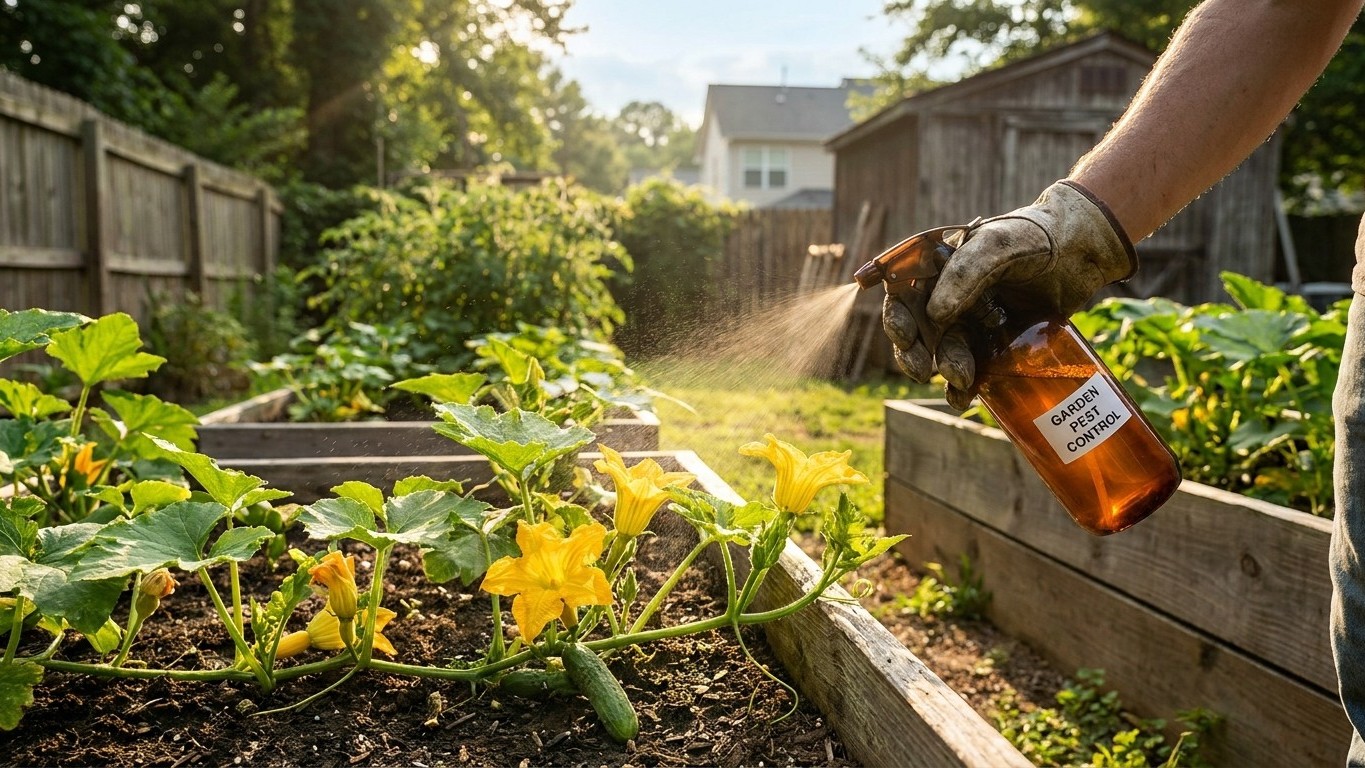

Melonworm shows up in Georgia gardens as a summer problem, not a spring one. The UGA Cooperative Extension flags crops planted after mid-June as the ones most likely to take a heavy hit, with treatment starting at first bloom and repeating weekly from there. That single window is the backbone of everything below: when to plant, when to watch, and when a cover has to come off.
When Melonworm turns up in Georgia

The clearest guidance on this pest in Georgia comes straight from UGA Cooperative Extension’s Bulletin 577 and the Georgia Pest Management Handbook: cucurbit crops planted after mid-June can be heavily attacked by pickleworm and melonworm together, and the recommended response is to treat at first bloom and keep treating weekly through the season. That’s a summer peak, not a spring or fall one, and it’s tied to a planting date threshold rather than a fixed calendar week.
That mid-June marker matters more than it looks. A squash or cucumber crop that goes in the ground in April or early May, ahead of that threshold, is largely past its most vulnerable early growth stages by the time melonworm populations build up in the heat of summer. A second or third planting made in late June or July, on the other hand, walks straight into the pest’s peak activity window with tender young foliage still exposed.
Georgia gardeners running successive plantings, a common practice to keep squash and cucumber coming through August and September, are the ones most exposed to this pattern. The extension guidance doesn’t publish a separate window specifically for melonworm alone; it groups the pest with pickleworm because the two share both host plants and timing. That grouping is itself useful information: whatever schedule works against one applies to the other.
Nothing in the current guidance narrows the peak further than “summer” and “after mid-June planting.” Anyone looking for a tighter date range for Georgia specifically won’t find one published, and treating a broader summer window as the honest answer beats inventing a precision the data doesn’t offer.
Reading the calendar from your last spring frost
Georgia’s last spring frost falls somewhere between March 11 and March 29, based on NOAA’s 1991-2020 climate normals for the region. That’s a range, not a single day, and it should stay a range: freeze risk tapers off gradually, it doesn’t switch off on one specific morning.
Melonworm doesn’t read a calendar either. It responds to soil and air warmth, so an early spring pushes the whole season’s insect activity forward, and a cold, wet March delays it. The mid-June planting threshold from UGA isn’t a fixed number of weeks after frost; it’s a separate marker tied to how long cucurbit plants stay in a vulnerable early stage before summer heat brings pest pressure to its peak.
Counting from a last-frost range of March 11 to March 29 out to mid-June gives roughly eleven to thirteen weeks of growing time before that risk threshold arrives. That span is exactly why gardeners who plant cucurbits promptly after their last frost, rather than waiting into late spring, give their crop a head start on the pest rather than a collision with it.
Row covers matter most in that same window. A cover put on right after transplanting, while plants are small, keeps adult moths from laying eggs on young leaves. It has to come off once flowering starts, though, because cucurbits need pollinators to set fruit, and that removal point (first bloom) is the same moment UGA recommends starting any treatment schedule if pressure is expected. Treat the frost date as a normal to plan around, not a guarantee that protects a specific planting day.
What it attacks, and what the damage looks like
Melonworm targets cucurbits: squash, cucumber, cantaloupe, and other melons. A gardener usually notices the plant before noticing the insect. Leaves develop a ragged, lace-holed look, sections eaten away between the veins while the main leaf structure stays standing, sometimes loosely webbed together with fine silk. Left unchecked, entire vines can look chewed and thin, and the plant’s overall vigor drops as leaf area disappears.
The larval stage does the damage
It’s the larva, not the adult moth, that causes all the visible harm. The adult moth is active at dusk and lays eggs on the undersides of leaves; it doesn’t feed on the plant itself. Once eggs hatch, the young larvae start on foliage, skeletonizing leaves and, as they grow, moving toward blossoms and eventually boring into the fruit itself, often near the stem end where the entry hole is easy to miss until the fruit is cut open or starts to rot from the inside.
That timing detail matters for anyone deciding whether an intervention is still worth it. Once larvae have tunneled into a fruit or deep into a stem, external treatments have little left to work with; the damage that leads to fruit loss is already done, and hand-picking or hand-removal at that point is more about protecting the rest of the planting than saving the fruit that’s already been bored into. Catching the problem at the leaf-feeding stage, before fruit entry, is the only point where most home-garden responses still have a real effect.
How Georgia sits in this pest’s range

This site currently documents melonworm as confirmed in two territories. That’s a narrow footprint, and it puts Georgia closer to the edge of what’s published here than to the center of a wide, well-mapped range. A pest tracked across dozens of territories usually differs mainly in timing from one place to the next, with the same pressure showing up a few weeks earlier or later depending on climate. With only two territories on record here, that broader comparison isn’t available yet, and it would be misleading to describe Georgia’s position relative to a pattern the data doesn’t yet show.
The guidance behind Georgia’s entry comes from UGA Cooperative Extension, a source built specifically around conditions in this state, not a regional average borrowed from a neighboring state’s extension service. That’s worth noting because it means the mid-June planting threshold and the treat-at-first-bloom schedule described above are Georgia-specific recommendations, not a figure pulled from elsewhere and applied here by assumption.
Nothing in the current data supports ranking Georgia’s melonworm pressure against any other state, or calling it more or less severe than what’s documented elsewhere on this site. The honest read is narrower than that: two territories tracked, Georgia among them, with its own dedicated extension guidance rather than a shared regional bulletin.
What actually works against it
The measures below are ordered from cheapest to most labor-intensive, and each one earns its place by doing something the others don’t.
- Timing of planting: getting cucurbits in the ground promptly after the last frost, rather than waiting into late spring, moves plants through their most tender growth stage before the mid-June threshold when pest pressure typically builds, and it costs nothing beyond planning the garden calendar around the frost window.
- Row covers: a physical barrier keeps adult moths from reaching leaves to lay eggs in the first place, though the mechanism only holds while the cover stays sealed at the edges and stays on before flowering begins, since it has to come off once blooms open for pollination.
- Hand-picking: checking leaf undersides regularly for visible larvae and egg clusters directly removes the pest before it reaches the fruit-boring stage, which is the point past which most interventions lose their effect.
- Crop rotation and clearing old plant debris after harvest: this reduces the number of pupae and overwintering stages present near next season’s planting site, lowering the starting population rather than eliminating an active infestation.
None of these measures reach larvae once they’ve already tunneled into a stem or a fruit. At that stage, the practical response shifts from prevention to damage control: removing and destroying affected fruit and vines to limit the next generation, rather than expecting to save what’s already been bored into.
Common questions
Does melonworm only attack squash and cucumber?
It targets cucurbits broadly, including cantaloupe and other melons alongside squash and cucumber. Any crop in that plant family planted after the mid-June threshold noted by UGA Cooperative Extension carries the same exposure.
Can I still treat a plant once I see holes in the fruit?
Holes usually mean a larva has already bored inside, past the point where most home treatments help that fruit. The practical step at that stage is removing affected fruit and vines to protect the rest of the planting, not trying to save what’s already tunneled into.
Is there a set date range for melonworm activity in Georgia?
UGA Cooperative Extension ties the risk to a planting-date threshold, crops going in after mid-June, rather than a fixed calendar window. No narrower Georgia-specific date range beyond that has been published.