
Florida gardens deal with eleven pests that UF/IFAS Extension’s Gardening Solutions program flags as the ones home gardeners run into most: chilli thrips, Eastern lubber grasshoppers, Melonworm Florida, whiteflies, aphids, Fall armyworm Florida, cycad aulacaspis scale, Root-knot nematodes in Florida, Fire ants in Florida, hornworm caterpillars, and Pickleworm in Florida. Near Jacksonville, lubber grasshopper numbers run from March or April through October or November, with the heaviest counts in July and August, according to UF/IFAS Extension. Check the undersides of leaves and along new stems weekly once night temperatures climb, since that is when most of this list starts moving.
What Florida gardens actually deal with

What’s actually chewing on your plants right now depends on the month, but eleven pests cause nearly all the damage Florida gardeners deal with, and most of them are active because the state almost never gets a freeze hard enough to knock the numbers back. Go check the undersides of your leaves and along the new stems today, especially if it’s been warm at night, because that’s where thrips, aphids, whiteflies, and the early stages of most of this list show up first, well before you’d notice damage on the top of the plant or the fruit itself.
None of this means every garden in the state sees all eleven pests at the same pressure. A coastal garden near Jacksonville and one in the Panhandle or South Florida will differ, and a county extension agent is the fastest way to confirm which of these is actually the one damaging a given plant.
Aphids

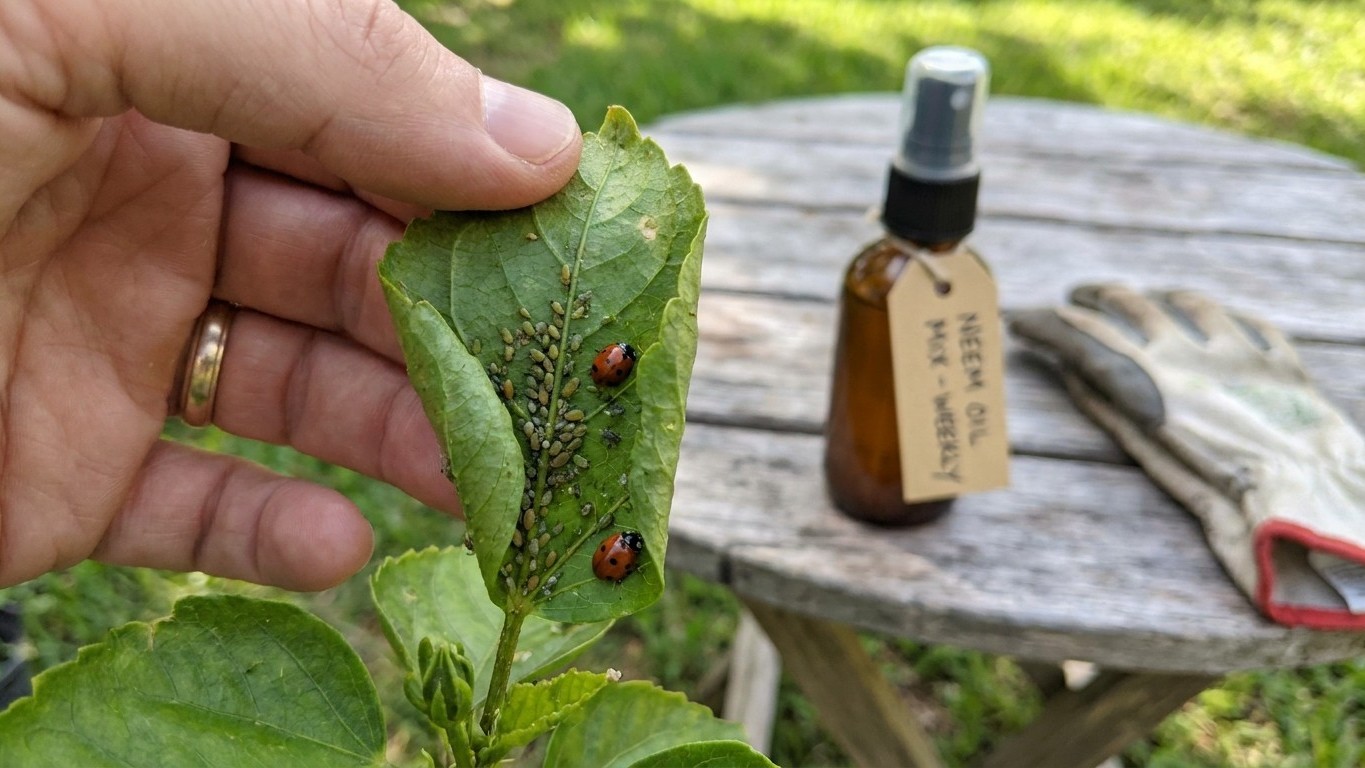
Aphids cluster on new growth and the undersides of leaves. Look for curled, distorted leaf tips and a sticky honeydew residue, which often draws ants and grows a black sooty mold. Both nymphs and adults feed by piercing stems and leaves to draw sap, so damage builds fast on tender spring growth, often alongside whitefly infestations in Florida that produce the same sticky honeydew. A strong jet of water knocks most colonies down, and ladybird beetle larvae and lacewings clean up the rest if broad-spectrum insecticides are kept out of the picture.
Whiteflies

Whiteflies rise in a small cloud when a plant is brushed. The flat, scale-like nymphs on the underside of leaves do the real damage, feeding steadily and leaving the same honeydew and sooty mold aphids do. Heavy infestations cause yellowing and leaf drop on tomatoes, peppers, and hibiscus. Yellow sticky traps catch adults and give an early warning, and insecticidal soap or horticultural oil sprayed directly onto leaf undersides handles nymphs without wiping out the parasitic wasps that keep numbers in check on their own.
Fire ants

Fire ant mounds appear after rain in open soil and lawn edges. They don’t damage plants directly, but they protect and spread sap-feeding pests like aphids and whiteflies because they feed on the honeydew those insects produce, and their stings make routine garden work miserable. Bait formulated for fire ants, scattered around the mound rather than drenched into it, works over one to two weeks as workers carry it back into the colony.
Eastern lubber grasshopper

UF/IFAS Extension tracks this grasshopper from March or April through October or November near Jacksonville, with the biggest numbers in July and August. Young nymphs are black with a bright stripe down the back, while adults grow into large, heavy-bodied grasshoppers that can reach two to three inches and barely fly. They chew large, ragged holes clean through leaves and can strip an amaryllis or crinum lily to bare stalks within days. Hand-picking works well while numbers are low in spring, since sprays do far less against an insect this large and mobile once it reaches full size.
Root-knot nematodes

Root-knot nematodes are invisible in the soil, so the sign to look for is on the roots: swollen, knotted galls, pale tan and bumpy, on roots that otherwise look healthy. Above ground, plants wilt in the heat of the day, grow slowly, and yield poorly even with adequate water and fertilizer. Florida’s sandy soils offer little natural resistance, so rotating out of susceptible crops like tomatoes and okra, working in organic matter, and choosing resistant tomato rootstock are the only reliable long-term fixes. No spray reaches them once they’re established in the root zone.
Hornworm caterpillars

Hornworms feed on tomato and pepper foliage and can strip a plant of leaves in a couple of days, leaving dark, coarse droppings on the leaves below as the giveaway. Hand-picking works well once you know to look for the pale diagonal stripes against the green body, and Bacillus thuringiensis (Bt) kills young caterpillars within a few days of feeding on treated leaves.
Chilli thrips
Both the larvae and adults feed by scraping and puncturing new leaf and flower tissue. Damage shows up as bronzed, curled, and scarred new growth on roses, blueberries, and peppers, often mistaken for herbicide injury or drought stress. UF/IFAS Extension notes they build up heaviest during long, hot, dry stretches, so new growth is worth checking closely whenever the garden goes several weeks without rain. Pruning out and bagging infested tips before they spread, rather than reaching for a spray first, keeps a light infestation from becoming a heavy one.
Pickleworm
Pickleworm larvae bore directly into squash, cucumber, and cantaloupe fruit, leaving a small entry hole plugged with wet, crumbly frass. Because the damage happens inside the fruit, by the time you spot it the crop is usually already lost, which makes row cover during flowering far more useful than any spray timed after larvae have already bored in.
Melonworm
Unlike pickleworm, melonworm larvae feed mainly on leaves first, skeletonizing them down to the veins, before moving into fruit as populations build. Because leaf feeding gives an earlier warning than pickleworm’s hidden fruit damage, checking the undersides of squash and cucumber leaves weekly through summer catches melonworm before it reaches the fruit.
Fall armyworm
Fall armyworm caterpillars feed in groups, moving across a bed and stripping leaves as they go, and can skeletonize corn, beans, and grass in a matter of days. Because young larvae are the easiest stage to kill, spot-checking new growth every few days and treating with Bt or spinosad while caterpillars are still small heads off the worst of the damage.
Cycad aulacaspis scale
Feeding drains sap from sago palms, and heavy infestations kill fronds outright and can eventually kill the whole plant. Horticultural oil, applied thoroughly enough to coat the crust and smother the insects underneath, is the main home treatment, and it usually takes more than one application spaced a few weeks apart to catch newly hatched crawlers hiding under the older, dead scale.
Telling damage apart

Chewing versus sucking damage
Large, ragged holes and leaf edges eaten in scallops mean a chewing pest, caterpillar, grasshopper, or beetle, is at work, and you can usually find droppings or the insect itself nearby if you look at dusk or early morning. Fine, pale speckling across a leaf’s surface, without any actual holes, is the mark of a sucking pest like chilli thrips scraping at cell contents from the surface rather than biting through tissue. A sticky film on leaves and any nearby patio furniture, sometimes followed by a black, sooty coating, means aphids or whiteflies have been feeding long enough to build up honeydew, and the mold that grows on it is a symptom of the pest, not a disease in its own right.
When it’s not a pest at all
Wilting is the trickiest symptom because it can mean almost anything. A plant that wilts in afternoon heat and recovers by morning is usually just responding to Florida’s sun and sandy soil, not under attack. A plant that wilts and stays wilted, especially with yellowing that starts at the bottom and moves up, points toward root-knot nematodes or a root disease rather than anything chewing on the leaves, since damaged roots can no longer keep up with water demand. Holes bored straight into fruit with no leaf damage nearby, plugged with wet frass, are the signature of pickleworm rather than any leaf-feeding caterpillar. The single most useful habit is checking the underside of a few leaves before treating anything, since most sucking insects live there and never show up if you only look at the top of the plant.
Disease is easy to rule in or out once you know what to look for: a fungal or bacterial problem produces spots, rings, or blotches with defined edges and often a yellow halo, spreading outward from a point rather than skeletonizing a whole leaf overnight. An overnight change, tissue gone rather than discolored, is almost always insect feeding, while a slow spread over a week or two with color change but intact tissue is more often disease or a nutrient problem.
When each one shows up
Pest timing in Florida tracks temperature and plant growth stage more than the calendar. Aphids and whiteflies build up fastest on tender new growth, so they tend to show first on spring transplants and again on anything pushing new leaves after a hard pruning. Fire ant mounds pop up after rain any time the ground stays warm, which in most of the state is most of the year.
Eastern lubber grasshoppers follow a more predictable arc. UF/IFAS Extension tracks them from March or April through October or November near Jacksonville, with the biggest numbers in July and August, so the smaller, easier-to-kill nymphs of early spring are worth hunting down before they grow into the nearly spray-proof adults of midsummer. Chilli thrips follow heat and dryness rather than a fixed window, building fastest, per UF/IFAS Extension, during long hot, dry stretches, which means a garden can go from clean to badly scarred in the space of two or three rainless, hot weeks.
The late-planting trap
UF/IFAS Extension flags vegetables planted in August or September as especially exposed, because that planting lands right in the stretch of the year when heat-loving pests such as fall armyworm, pickleworm, and melonworm are at their strongest. A fall tomato or squash crop started in late summer competes with these pests at their peak, not their tail end, so scouting needs to start the week seedlings go into the ground rather than waiting for obvious damage.
Root-knot nematode damage tends to show up later in the season, as a crop that started out looking fine turns yellow and stunted right as fruit set begins, because that’s when demand on damaged roots is highest. Cycad scale runs closer to a plant’s own schedule than the calendar’s, building steadily whenever a sago is putting out new fronds, which is why a plant can look fine in winter and be crusted white by summer’s end.
What actually works
Prevention beats intervention on every pest on this list, mostly because Florida’s climate gives insects so many generations per year that a spray only buys a week or two of relief. Crop rotation is the single most effective tool against root-knot nematodes, since moving tomatoes, peppers, and okra to a different bed each year, or growing a season of resistant cover like marigolds, keeps populations from building up around the same roots year after year. Floating row cover, put on at planting and removed only for pollination, keeps pickleworm and melonworm moths from ever laying eggs on squash and cucumber, which matters more for these two than any spray because the damage happens inside the fruit where nothing applied afterward can reach it.
Encouraging predators does real work if you let it. Lacewings, ladybird beetles, and parasitic wasps knock down aphid and whitefly numbers on their own in a garden that isn’t sprayed with broad-spectrum insecticides, and a strip of flowering plants nearby gives them somewhere to live between outbreaks. Birds and predatory wasps take a steady toll on hornworms and armyworms if the garden has some undisturbed edge for them to work from.
Where a targeted spray earns its place
Once prevention has failed or a pest is already established, match the product to the pest rather than reaching for whatever is on the shelf. Bacillus thuringiensis (Bt) kills young caterpillars, hornworm, fall armyworm, pickleworm, and melonworm, within a few days and leaves bees and predatory insects alone, but it does nothing once caterpillars are past their earliest instars, so timing matters more than the product itself. Insecticidal soap and horticultural oil handle soft-bodied sucking insects like aphids and whitefly nymphs on contact, but only if the spray actually reaches the underside of the leaf where they feed. Fire ant bait works by being carried back into the colony, so a bait that repels ants on contact instead of one they’ll pick up and carry defeats its own purpose.
Several widely sold remedies do essentially nothing. Ultrasonic pest repellers have no measurable effect on any insect on this list, and garlic or pepper sprays wash off in the next rain or irrigation cycle without ever reaching the pest hiding on the leaf underside. Diatomaceous earth works against soft-bodied crawling insects only while it stays bone dry, so it needs reapplying after every rain, which in Florida’s wet season can mean every few days.
What control costs
Nothing on this list is expensive in dollar terms compared to the plants themselves, but the time each method takes varies a lot, and that’s the real cost for most home gardeners.
| Method | Relative cost | Time needed | How often repeated |
|---|---|---|---|
| Hand-picking (hornworms, lubber grasshoppers, egg masses) | Lowest, no material cost | A few minutes per check | Every 2 to 3 days through the pest’s active period |
| Row cover and physical barriers | Low to moderate, one-time purchase | Set once at planting | Reusable for several seasons if stored dry |
| Biological controls (Bt, beneficial insects) | Moderate | Timed applications or one-time release | Bt reapplied after rain or roughly every week while caterpillars are small; beneficials establish and need no repeat |
| Contact sprays (soap, oil, or chemical) | Moderate to higher over a season | Requires thorough coverage, especially leaf undersides | Every 7 to 10 days, more often after rain |
Hand-picking is the cheapest control by far and the only one with no material cost at all, though it only scales to a garden a person can walk through in a few minutes and works best on large, visible pests like hornworms and lubber grasshoppers rather than something as small as chilli thrips. Row cover costs more upfront than a bottle of soap spray but pays for itself over a season or two, since a season of pickleworm damage on unprotected squash usually costs more in lost fruit than the cover did.
Biological controls sit in the middle. Bt and insecticidal soap need buying and reapplying, but a garden that supports its own lacewings and parasitic wasps gets ongoing aphid and whitefly control for the one-time cost of not spraying broad-spectrum insecticides that would kill them off. Sprays cost the most over a full season once repeat applications are counted, both in product and in the time it takes to cover every leaf underside thoroughly enough to matter, and a poorly timed spray on caterpillars past their earliest stage is money spent for no real control at all.
Local help
UF/IFAS Extension’s county offices identify pest specimens, track outbreak reports, and give guidance specific to conditions on the ground rather than the state average. Bring or photograph an actual sample, the insect itself, the damaged leaf, or the galled root, since a written description alone is often not enough to tell one caterpillar or scale from another. Find the office covering your county through the UF/IFAS Extension directory, since pest pressure and timing both vary within the state.
Two Pests Worth Watching Closely
Florida’s growing season runs long, and that works in favor of a couple of caterpillar pests that gardeners tend to underestimate until the damage is done. If your beans, corn, or turf grass are putting on new growth in hot weather, it’s worth reading up on the fall armyworm, since it shows up whenever conditions are warm and plants are actively growing — which in Florida means most of the year rather than a single season. The same hot-and-humid pattern brings out trouble in cucurbit beds, where the melonworm caterpillar chews lace-holed leaves on cucumbers, squash, and melons long before anyone notices the moth responsible for the eggs. Both pages walk through what UF/IFAS Extension has documented about timing and control, so if you’re seeing chewed foliage on vegetables or turf and aren’t sure which culprit is behind it, start there. Knowing which pest you’re dealing with — and when it’s likely to appear — makes the difference between catching an infestation early and losing a bed of squash or a patch of lawn to something that could have been stopped weeks earlier.
Common questions
Do I need to spray on a regular schedule just in case?
No. Scouting first and spraying only when you find damage or the pest itself saves money and keeps predators like lacewings and parasitic wasps, which do a lot of the work for free, from being wiped out by a routine broad-spectrum spray.
Is this list of eleven pests everything I might find in my garden?
No, it’s the set that UF/IFAS Extension’s Gardening Solutions program highlights as the ones home gardeners run into most, not a complete inventory of every insect in the state. Something chewing or sucking on a plant that doesn’t match any description here is common enough, and a county extension office can identify it from a sample or photo.
Does a cold winter kill off pests for the year?
Not reliably. Florida’s winters vary a lot by region, and even a light frost near Jacksonville does not do what a hard, sustained freeze does farther north, so populations of fire ants, aphids, and whiteflies especially can carry over through a mild winter with barely a dent.
Should I follow the same pest calendar as someone near Miami or in the Panhandle?
No, the timing described here is measured near Jacksonville, and UF/IFAS Extension figures for lubber grasshoppers and chilli thrips will shift earlier in South Florida and later or lighter through the Panhandle’s cooler winters. Treat the season given here as a starting window to watch, not a fixed date, and adjust based on what you actually find in your own garden.