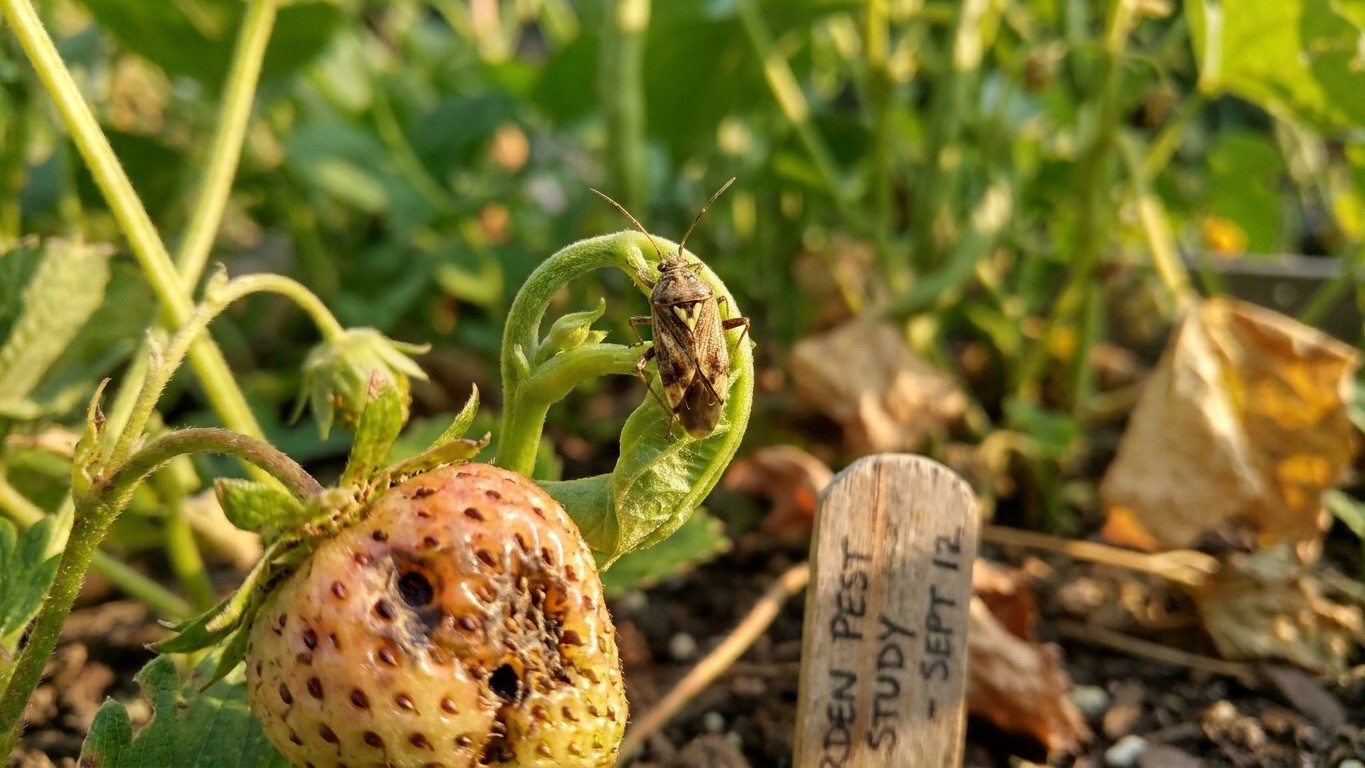

Tarnished plant bug (Lygus lineolaris) becomes active in New Hampshire gardens as soil and air temperatures climb through late spring, feeding on tender shoots, buds, and fruit until cold weather sets in. It attacks a wide range of vegetables, berries, and ornamentals, and the damage often looks like deformed or scarred fruit rather than an obvious insect.
The weeks to watch

UNH Cooperative Extension does not publish a specific emergence window for tarnished plant bug in its beetle and vegetable pest fact sheets. What the fact sheets do document is a broader seasonal pattern among garden pests active in the same months, and that pattern is useful as a reference even without a tarnished-plant-bug-specific date.
Japanese beetle adults emerge late June to early July and stay most active from mid-July through August. Rose chafer shows up mid-to-late June. Squash vine borer moths appear first around June 20, peak between July 10 and 15, and produce one generation per year. Flea beetle damage runs worst in spring and early summer. Taken together, these figures describe a garden where insect pressure builds through late spring, spikes through midsummer, and tapers as summer ends.
Tarnished plant bug fits into that same rhythm. It overwinters as an adult in leaf litter and plant debris, then becomes active once temperatures rise consistently in spring, feeding and reproducing through the growing season with multiple generations possible before fall. Since no local window is published for this species specifically, the safest approach is to watch for the symptoms described below starting whenever the general pest calendar above says other early-season insects are already active, rather than circling one date on a wall calendar.
Reading the calendar from your last frost
The one date most New Hampshire gardeners plan around is the last spring frost, and for the reference weather station used in NOAA’s 1991-2020 climate normals, that date falls between April 16 and April 27. That is a range, not a guarantee, and it comes from an airport weather station. Suburban and rural gardens typically see their own last frost later, often by one to two weeks, and more at elevation, so check your county’s actual frost history before setting a transplant date.
Tarnished plant bug does not answer to a printed calendar. It answers to soil warmth and to how quickly host plants leaf out and set buds, so an early, mild spring pulls its activity forward while a cold, wet one pushes it back. This is exactly why UNH does not print a fixed date for it: the insect’s own schedule shifts with the weather each year.
For a gardener, the practical marker is transplanting, not the frost date itself. Damage from tarnished plant bug commonly shows up within a few weeks of transplants going into the ground, once new growth and flower buds are tender enough to attract feeding. That means row covers or other physical barriers need to go on close to transplant time, before the plants flower, and they need to come off before pollination starts on crops that require it, since a cover left on too long blocks bees along with the pest. Counting backward from the April 16 to April 27 frost range only gives another range, never a single planting day, so treat both dates as normals to work around, not deadlines.
What it attacks, and what the damage looks like
Most gardeners notice tarnished plant bug damage before they ever see the insect itself. Fruit and vegetable crops most affected include strawberries, beans, potatoes, and a long list of vegetable and ornamental hosts along with fruit trees and small fruits. On strawberries, the classic symptom is “cat-facing,” where the fruit develops a lumpy, deformed shape with brown, sunken patches where seeds cluster tightly together. On beans and other vegetables, look for pitted, discolored spots on pods and leaves, distorted new growth, and buds or blossoms that shrivel and drop before they ever open.
New shoots on many plants show wilting or blackened tips, sometimes mistaken for disease, because the insect’s feeding kills the growing point itself. Leaves can appear tattered or stippled with small discolored flecks where feeding punctures have damaged the tissue around them.
Both the nymphs, small and pale green with dark spots, and the adults, roughly a quarter-inch long with a mottled brown and yellow pattern, cause this damage using piercing-sucking mouthparts. They inject saliva that breaks down plant tissue as they feed, and that saliva is what actually causes the localized dieback and deformity, not just the puncture wound itself. Because both nymphs and adults feed externally on exposed plant surfaces rather than tunneling inside stems, damage is visible on the outside of the plant from the earliest stage of the insect’s development, which is different from a borer that hides its damage until the stem is already hollowed out.
How New Hampshire sits in this pest’s range

This pest is currently documented in 2 territories on this site’s coverage. That is a narrow footprint compared to a truly widespread species, and it puts New Hampshire near the edge of the documented range on this platform rather than in the middle of a broad, well-mapped territory. A wide range would mean the real difference between states is simply timing, some warmer, some later, with the pest present everywhere. A narrow range like this one means less local, state-specific data has been published and compiled so far, not that the insect is rare in the region.
Tarnished plant bug itself is a widely distributed agricultural pest across much of North America, feeding on hundreds of host plants from field crops to home gardens. The limited count here reflects how much dedicated state-level guidance exists on this particular pest network, not the insect’s actual biological range. For New Hampshire gardeners, that means falling back on the general seasonal pattern described earlier, drawn from UNH Cooperative Extension’s broader vegetable and ornamental pest fact sheets, is currently the most reliable local reference available, rather than a tarnished-plant-bug-specific state bulletin.
What actually works against it
Timing costs nothing and works best before the insect ever arrives.
- Delay transplanting highly attractive crops like strawberries until new growth has hardened slightly, which reduces the tender, attractive tissue the insect prefers, since adults and nymphs target the softest, most actively growing plant parts first.
- Use row covers right after transplanting and before flowering to physically block adults from reaching plants and laying eggs, though this only holds while the cover stays sealed at the edges, and covers must come off once flowering starts on any crop that needs pollinators, reopening the window for the insect, so this works as an early-season tool, not a season-long fix.
- Hand-pick adults and nymphs off plants, ideally in early morning when the insects move slowly in cooler temperatures, to physically remove feeding individuals before they reproduce, though this only makes a dent on a small planting checked regularly, not on a larger garden or field-scale crop.
- Rotate crops and clear plant debris to target the insect’s overwintering strategy, since adults shelter in leaf litter, garden debris, and weedy field margins over winter, so removing that debris in fall reduces the local population that emerges the following spring, and rotating attractive host crops to a different bed each year disrupts the buildup of local populations near a preferred food source.
None of these measures help once feeding has already deformed the fruit or killed a growing tip. The visible damage described earlier does not heal or reverse, it simply marks where feeding already happened, so the real payoff from these methods comes from preventing the next round of feeding and reproduction, not from undoing damage already done.
Common questions
Does tarnished plant bug spread disease between plants?
It is primarily known for direct feeding damage rather than for transmitting plant viruses, unlike some other sap-feeding insects. The deformity and dieback it causes come from its saliva breaking down tissue at the feeding site, not from a pathogen it carries.
Can I tell tarnished plant bug damage apart from frost damage?
Frost damage tends to appear suddenly after a cold night and affects broad areas of soft tissue uniformly, while tarnished plant bug damage shows up as scattered, localized deformity, pitting, or dieback concentrated around buds, shoot tips, and developing fruit, often appearing gradually over days rather than overnight.
Does one bad tarnished plant bug year mean next year will be worse?
Since UNH Cooperative Extension has not published a state-specific tracking record for this species, there is no local data to confirm a year-over-year trend. Clearing garden debris each fall remains the most direct way to limit how many adults overwinter nearby regardless of how the prior season went.