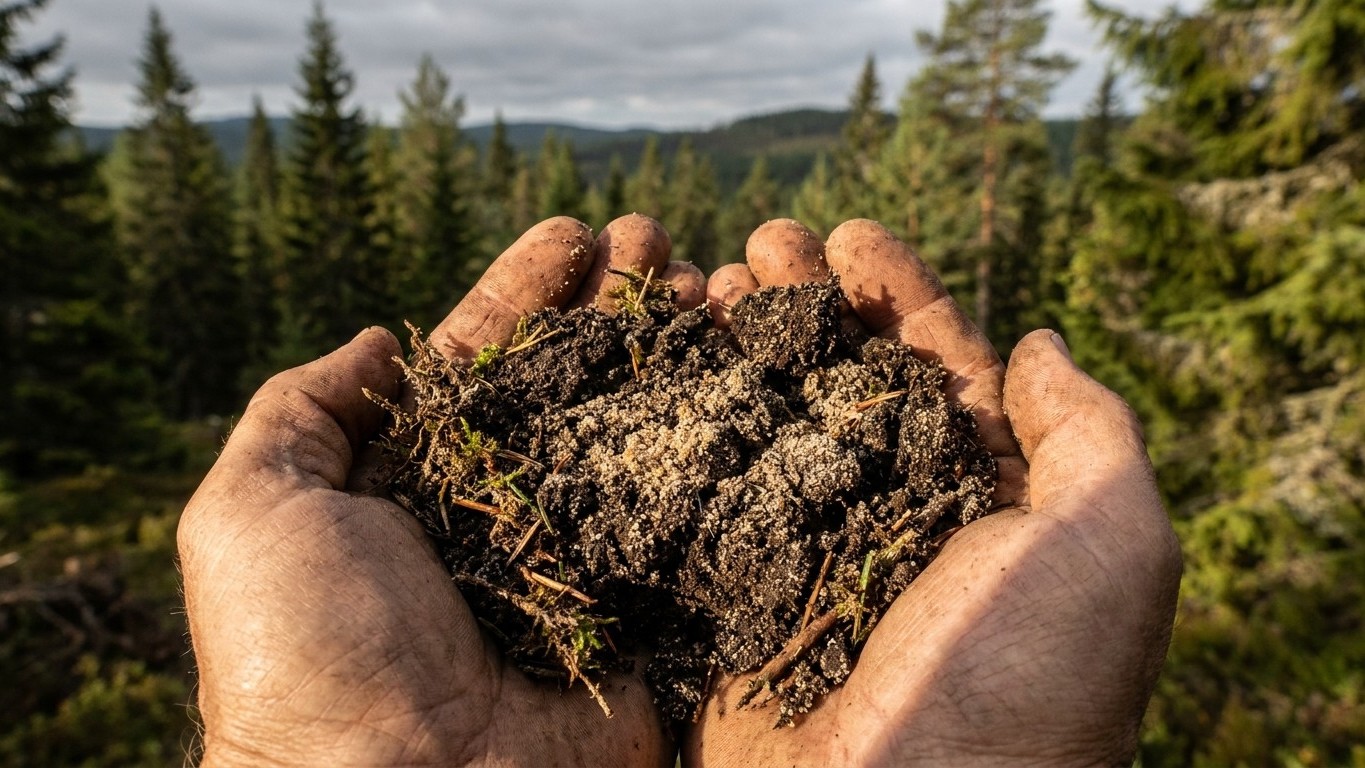

Newfoundland and Labrador’s ground is, more often than not, acid, sandy, and slow to drain. That combination shapes almost everything gardeners here fight: nutrients locked away, water that lingers instead of moving through, and plants that sulk without an obvious cause. Here’s what the mapped data says is actually under your boots, and what to do about it.
What is under your garden

Across the mapped agricultural surface of Newfoundland and Labrador, the most common soil order is Podzol, accounting for 59 percent of the surveyed ground, with Organic soils the next most frequent type. A Podzol is what forms under centuries of conifer cover in a cool, wet climate: rain moves steadily downward through the topsoil, stripping out calcium, magnesium, and other bases and carrying them deeper, leaving behind a surface layer that’s acidic and mineral-poor. It’s the classic soil of spruce and fir country, and it’s why so much of the province’s native vegetation leans toward plants that tolerate sour ground.
The numbers from the Canadian Soil Information Service back this up plainly. Median surface pH across the mapped components sits at about 4.3, which is strongly acid. Texture runs 56 percent sand, 9 percent clay, and 35 percent silt, a loam-to-silt mix with sand as the dominant fraction. Organic matter comes in around 3.3 percent, estimated from measured organic carbon. Drainage is classed as imperfectly drained. Those are the figures as measured, not rounded, not softened into a range.
What this figure is, and isn’t
That 4.3 is a median across 459 mapped soil components, not a reading from your backyard. It describes the dominant profile of the province’s agricultural land, not every garden in it. River bottoms and lowland flats can run very different, muskeg and Organic soils behave nothing like a mineral Podzol, and any lot where a builder scraped topsoil or brought in fill dirt has a profile with no relationship to the regional pattern at all. Treat the provincial number as a strong hint about what your ground tends to do, not a substitute for knowing your own.
You can get a rough read on your own dirt in about five minutes with two low-tech checks. For the ribbon test, wet a small handful of soil until it’s moist but not sopping, then squeeze it between thumb and forefinger, pushing it upward to form a ribbon. Sandy, low-clay ground like the provincial median falls apart after an inch or less; heavier clay holds a longer, smoother ribbon. For the jar test, fill a clear jar about a third full of soil, top it with water, shake it hard, and let it sit overnight. Sand settles first and forms the bottom layer, silt settles next, and clay stays suspended longest, forming a fine top layer once it finally drops. Compare what settles in your jar to the 56/9/35 split above and you’ll know quickly whether your ground tracks the regional pattern or runs its own way.
Testing before you amend
Adding lime or fertilizer without a test is a coin flip. A bag of lime can’t tell you if your soil is already near neutral, and a soil test can, along with details your eyes never will: available phosphorus and potassium, organic matter percentage, and the exact pH number rather than a guess based on what grows well nearby.
Taking a sample worth trusting means resisting the urge to grab one scoop from one spot. Walk the bed or plot and pull eight to ten cores from different points, all at the depth where roots actually feed, roughly the top 6 to 8 inches for a vegetable bed. Mix those cores together in a clean bucket, remove any rocks, roots, or mulch, and pull your test sample from that combined mix. A single scoop near the compost pile or the downspout will skew the result and send you chasing a fix your whole bed doesn’t need.
When results arrive, the pH number is the first thing to read, since it governs how available every other nutrient is regardless of how much fertilizer you add. The provincial median of 4.3 lets you expect a strongly acid reading before you even open the envelope, especially on ground that hasn’t been limed before. But expecting isn’t knowing. Garden soils that have been limed, composted, or built up with imported topsoil over the years can sit well above that median, and only a current test tells you where your particular bed actually stands.
Amending it
With a median surface pH of about 4.3, the province’s dominant soil sits well below the 5.5 threshold where most vegetables and ornamentals start to struggle. That points in one direction: lime is the tool, and sulphur, which pushes pH lower, is the wrong move on ground this acid. Acid soil ties up phosphorus in forms roots can’t reach, so a plant can be sitting in phosphorus-rich ground and still show the stunted, purple-tinged look of a phosphorus shortage. Brassicas suffer a different way here: acid soil is exactly the condition clubroot disease favors, and raising pH toward neutral is one of the most reliable non-chemical defenses a cabbage or broccoli grower has.
Lime is not a quick fix. It needs to react with soil moisture and microbial activity to shift pH, a process that plays out over a full season or more, not over a couple of weeks. Apply it in fall where possible, so it has the winter to work before spring planting, and retest after a year rather than assuming one application settled the matter for good.
Working with the texture you have
The 56 percent sand, 9 percent clay split means this is light, loose ground for a garden, with clay content low enough that it won’t hold nutrients or water the way a heavier soil would. Organic matter is the fix here, and it’s close to a universal one: compost, aged manure, or leaf mold added yearly builds the water and nutrient-holding capacity that the clay fraction isn’t providing on its own. Don’t try to fix a sandy soil by adding more sand, which does nothing for structure, and don’t expect a single season of compost to transform it. Building organic matter in soil this light is a three-season project, not a one-time amendment, though the payoff compounds each year as it accumulates.
Because sandy, low-clay ground drains fast at the surface, water and nutrients move through and past the root zone quickly. Shorter, more frequent watering suits this soil better than the deep, infrequent soaking recommended for heavier clay ground, where standing water on the surface tells you the opposite problem exists. Match your watering habit to the texture in front of you, not to generic advice written for clay-heavy gardens elsewhere.
Drainage and compaction
The province’s mapped ground carries an imperfectly drained rating, which sits between “well drained” and “poorly drained” on the standard scale. In practice, that means water moves through the soil, but not quickly. After a heavy rain, expect puddles that take longer than an hour or two to disappear and topsoil that stays cool and damp well after the surrounding gravel path has dried. It’s a pattern that surprises some gardeners, since a sandy-textured soil sounds like it should drain freely; in Newfoundland and Labrador, shallow bedrock and dense glacial till sitting just under the topsoil often slow the water’s escape regardless of how sandy the surface itself is.
A simple percolation test tells you where your own bed stands. Dig a hole about 12 inches deep and 12 inches across, fill it with water, and let it drain completely once to saturate the surrounding soil. Fill it a second time and time how far the water level drops per hour. A drop of 1 to 3 inches per hour is workable for most garden plants; less than an inch per hour signals genuinely slow drainage, the kind that drowns roots in a wet spring.
Foot traffic and tiller wheels compact this soil over time, squeezing out the pore space that water and roots need. Double digging, once the standard fix, has fallen out of favor because it disturbs soil structure and biology more than it helps, and the compaction often returns within a season or two anyway. On ground that tests as imperfectly drained and also runs compacted, a raised bed is the more honest answer than years of amendment. Building up 8 to 12 inches of good soil above grade sidesteps both the drainage and compaction problem at once, rather than fighting them indefinitely in place.
Local help
Soil testing in the province runs through the Department of Fisheries, Forestry and Agriculture, which handles agricultural and horticultural soil analysis for residents. Reach out to the department directly for current sampling instructions and submission details, and ask about pricing when you contact them, since costs can change. A provincial agronomist or extension officer will typically walk through the results with you once they’re back, translating the raw numbers into a plan suited to your particular plot.
Common questions
Is all soil in Newfoundland and Labrador this acidic?
No. The 4.3 median describes the dominant mapped Podzol across agricultural regions. Gardens that have been limed for years, low-lying wet ground, and disturbed or filled lots can all read very differently. Only a current test tells you your own number.
Can I skip liming if my plants look fine?
Some plants, like blueberries and rhododendrons, actually prefer acid soil and need no correction. But most vegetables and lawn grasses perform below their potential on strongly acid ground even without obvious symptoms, so a test is worth doing before you assume everything’s fine.
How much lime should I add?
That depends on your soil’s current pH, its texture, and how much you need to shift it, all of which a lab test provides. Applying lime by guesswork risks overshooting into alkaline territory, which creates a different set of nutrient problems.
Why does my sandy soil still drain slowly?
Shallow bedrock or dense glacial till beneath the topsoil is common in this province and can block water from moving past the root zone, even when the surface soil itself is sandy and loose. A percolation test on your own site is the only way to confirm what’s happening below the surface you can see.