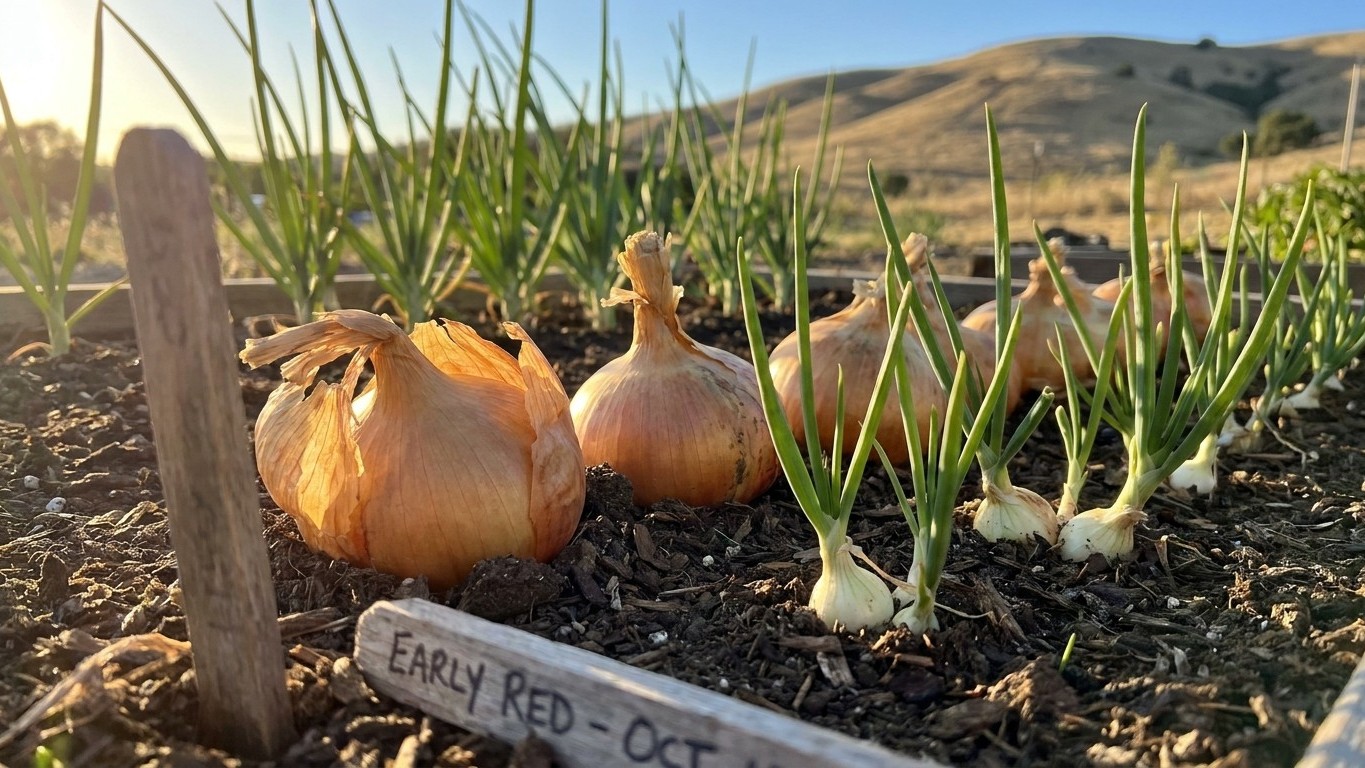

At 33.94 degrees north, the Los Angeles area gets 14 hours and 16 minutes of daylight on the longest day of the year. That single number decides which onions will actually bulb here and which ones will just sit in the ground making leaves. Southern and coastal California falls into short-day and intermediate-day territory, which rules out most of the long-day varieties sold at big-box garden centers. Here’s what that means for your seed order, your planting calendar, and what ends up in your kitchen next spring.
How long your longest day is

The Los Angeles area, home to the weather station this data comes from, sits at 33.94 degrees north latitude. On the summer solstice, the day there stretches to 14 hours and 16 minutes of daylight, measured from the standard sunset hour-angle formula and not counting the extra few minutes atmospheric refraction adds at dawn and dusk. That’s the number an onion plant actually reads. Bulbing isn’t triggered by heat or by the calendar; it’s triggered by day length crossing a threshold specific to each variety. Short-day types start bulbing once daylight hits around 12 hours, a threshold documented by Clemson Cooperative Extension. Long-day types wait for 14 to 16 hours of daylight, and if that never arrives, they never get the signal to stop making leaves.
At 14 hours 16 minutes, this latitude clears the bar for short-day onions easily and reaches into intermediate-day territory too. It falls short, or right at the edge, of what most long-day onions need. That single fact is really the whole story of onion growing in this state. Everything below is detail on top of it.
One caution worth repeating: California spans roughly ten degrees of latitude, from the Mexican border up past the Oregon line. A gardener in San Diego and a gardener in Crescent City are not gardening under the same sky. The 33.94-degree figure belongs to the Los Angeles area specifically. If you’re gardening near the northern edge of the state, in the Sierra foothills, or up in the far north, your longest day runs noticeably longer than 14 hours 16 minutes, and some varieties written off here may actually work for you. Check your own latitude before ruling anything out.
Which varieties bulb in California
Twelve documented varieties have a published latitude range that covers 33.94N outright. On the short-day side: Gabriella, Madalyn, Red Rock, Red Sensation, Texas Grano 1015Y, Vidora, and White Castle. On the intermediate-day side: Candy, Elsye, Expression, Scout, and Sierra Blanca. These are bred to bulb at day lengths in the 12-to-14-hour range, which is exactly what southern and coastal California delivers, and they’re the safest picks for a first attempt. For a deeper look at how these varieties compare, see The Best Onion Varieties for California. For exact sowing and transplanting dates tailored to these varieties, consult a Planting calendar onions California.
Six more sit close enough to a published boundary that they fall into what’s really a blurred zone rather than a clean yes or no: Bridger, Cabernet, Calibra, Monastrell, Red Long of Tropea, and Walla Walla Sweet. Their catalogue ranges start around 35 degrees, less than a degree and a half above the reference latitude. Treat these as an edge case. They may bulb, especially in a warm inland pocket with a slightly earlier effective day length, but they’re not a sure thing the way the first twelve are.
Varieties that will not bulb here
This is the list that actually matters if you’ve ever bought a bag of sets at a hardware store and ended up with nothing but green tops. Thirteen documented varieties are bred for latitudes well above this one, and their day-length requirement simply never gets met in southern or coastal California:
- Ailsa Craig (38-60N)
- Barolo (38-55N)
- Blush (38-55N)
- Frontier (40-50N)
- New York Early (38-50N)
- Patterson (38-55N)
- Powell (43-47N)
- Red Carpet (40-45N)
- Red Long of Florence (38-50N)
- Redwing (43-65N)
- Rossa di Milano (38-50N)
- Safrane (42-50N)
- Talon (42-50N)
Plant any of these here and the pattern is predictable: strong leaf growth all spring, no swelling at the base, and eventually the tops flop over and the bulb (what there is of one) starts to soften and rot in the ground. It isn’t a small onion. It’s no onion. If that description matches something that happened in your own garden, the variety was almost certainly the problem, not your soil or your watering.
When to plant onions in California
Planting time follows day length too, which is why California’s calendar doesn’t match what you’ll read on a seed packet grown for Ohio or Minnesota. NOAA’s 30-year climate normals for the Los Angeles station show no computable freeze date at all, zero days at or below 32 degrees Fahrenheit across three decades, and a frost-free season listed as 365 days. In plain terms: this part of the state doesn’t freeze in an average year.
That changes the whole planting logic. Instead of racing to get onions in before a hard freeze, southern and coastal California gardeners plant in fall, typically October through December, so the young plants spend a mild winter building leaves before the lengthening spring days trigger bulbing. That’s the standard approach for short-day and intermediate-day types in a frost-free or near-frost-free climate, and it lines up with the varieties in the first list above.
Two things to flag. First, “frost-free in an average year” is not a guarantee. Averages smooth over outliers, and a cold snap that dips below freezing for a night or two can still happen, especially away from the immediate coast. Treat the normals as a planning baseline, not a promise. Second, this frost-free pattern is a coastal and southern California story. It does not describe the whole state. The Central Valley, the Sierra foothills, and most of Northern California see real winter freezes, and gardeners there are working with an entirely different calendar, closer to the late-winter or early-spring planting window used in colder climates. Never assume a Los Angeles planting date applies statewide.
Sweet onions or onions that keep
Southern and coastal California is built for sweet onions, not for onions that last until spring, and the reason is chemistry rather than bad luck. Pungency in an onion comes from volatile sulfur compounds, and those same compounds are what protect the bulb during storage. University of Missouri Extension puts it plainly: sweet onions do not store as well as more pungent types, because they simply have fewer of those protective compounds. There’s no way to get both traits in the same bulb.
Day length ties directly into this. Short-day varieties, the ones best suited to 33.94N, tend to run milder and sweeter, which is exactly the group this latitude favors. Long-day varieties, grown farther north where summer days stretch past 14 hours, tend to build up more of those sulfur compounds and keep for months in a cool, dry spot. That’s not a coincidence of breeding; it’s the same latitude gradient at work twice.
What that means for your kitchen: onions grown in southern or coastal California from the recommended varieties will be excellent sliced raw on a burger or diced into salsa shortly after harvest, but they’re not going to be the onions still sound in your pantry come March. Plan to eat them within a few months of pulling them, or process and freeze what you can’t use fresh. If long storage matters more to you than sweetness, that’s a case for looking at what gardeners in the northern reaches of the state, or in colder states entirely, can grow instead.