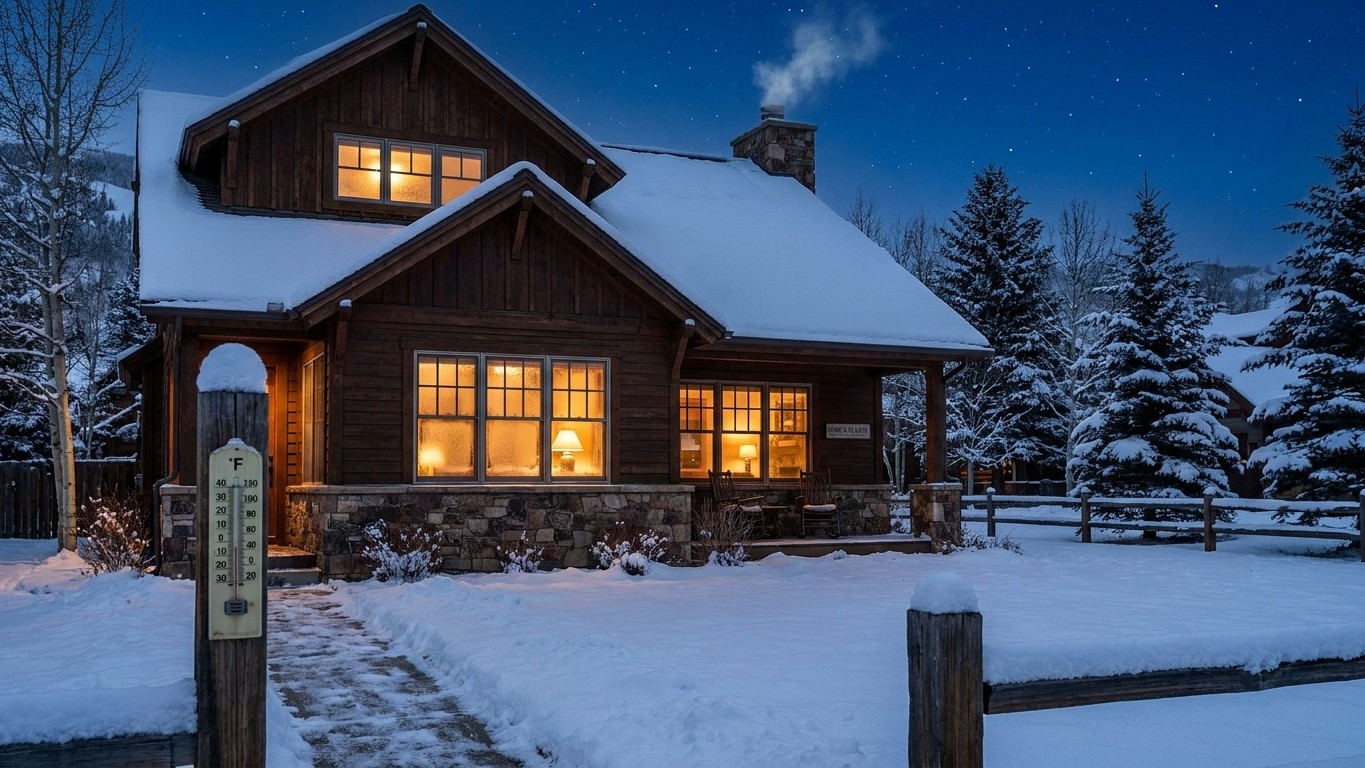

Denver’s coldest-month average low sits at 18.4°F, and that single number shapes everything about heating a Colorado home: how long the furnace runs, how much wood a stove burns through, and how forgiving (or not) the season is on equipment that’s cutting it close.
How cold it gets, and for how long

Start with the number: 18.4°F is the mean daily minimum for the coldest month at the Denver reference station, per NOAA’s 1991-2020 Climate Normals. That’s not a record low, and it’s not the kind of polar-vortex headline that makes the news. It’s the ordinary overnight temperature a heating system has to beat, night after night, for weeks on end.
That distinction matters more than it sounds. A house that sees 18°F lows for a handful of nights each January is a different animal than one that sits near that mark for four straight months. Colorado’s Front Range leans toward the second case: a long, steady heating season rather than short violent cold snaps. When Does the Heating Season Start in Colorado? Furnaces and wood stoves here aren’t sized for one brutal week, they’re sized for sustained output across a season that often runs from October into April, and knowing When Can You Turn the Heat Off in Colorado? is just as important as knowing when to turn it on.
What that means in practice is duty cycle. A furnace rated for occasional deep cold but not built for constant mid-teens overnight lows will run longer hours, cycle more often, and wear parts faster than the same unit would in a milder climate. Wood stoves face the same math: a firebox that can throw enough heat for one cold snap needs to do it again the next night, and the one after that.
Elevation complicates the picture further. Denver’s own elevation (around 5,280 feet) already puts it above most U.S. cities, and plenty of Colorado homes sit thousands of feet higher still, in mountain valleys and foothill towns where the coldest-month minimum runs colder than the Denver reference figure. The 18.4°F number is a starting point, not a ceiling. Anyone heating a home outside the Denver metro should treat it as the mild end of the state’s range, not the norm.
What a cord of wood is worth here
A cord is a volume, not a weight, and that’s the detail that trips up most first-time firewood buyers. It’s defined as a stack measuring 4 feet by 4 feet by 8 feet, or 128 cubic feet total. Nothing in that definition says what kind of wood fills it, which is exactly why two cords can deliver wildly different amounts of heat.
Michigan State University Extension puts a well-seasoned cord of hardwood at roughly 20 million BTU. That’s an average across species, and it moves depending on density and how dry the wood actually is when it burns. Denser hardwoods pack more mass into the same 128 cubic feet, so they release more heat per stack than a cord of something lighter and more porous. The volume never changes. The energy inside it does.
| Measurement | Value |
|---|---|
| Cord dimensions | 4 ft x 4 ft x 8 ft |
| Total volume | 128 cubic feet |
| Heat output (seasoned hardwood, average) | about 20 million BTU |
| Fuel oil equivalent | roughly 145 gallons of #2 fuel oil |
| LP gas equivalent | roughly 215 gallons of LP gas |
That fuel-oil comparison is worth sitting with. One cord, properly seasoned, does the work of 145 gallons of heating oil or 215 gallons of propane. For a Colorado household weighing a wood stove against a propane tank, that’s the real trade being made, measured in stacked wood against tanked fuel, not in some vague sense of “how many logs.”
None of that 20-million-BTU figure holds if the wood is wet. Seasoning time is the variable that decides whether a cord delivers close to its potential or burns away most of its heat just drying itself out. That’s the next problem worth understanding before buying anything.
How long wood takes to dry in Colorado
Firewood needs to reach roughly 20 percent moisture or less before it burns efficiently. Green wood, fresh off the tree, can carry more than 60 percent moisture, and every bit of that water has to boil off before the wood starts giving up usable heat. That’s not a minor tax on efficiency. It’s the difference between a fire that throws real warmth and one that hisses, smokes, and barely takes the chill off a room.
Split green wood, stacked so air can move through the pile, typically reaches that 20 percent mark after one full summer of seasoning. The stacking matters as much as the timing. Rounds left whole, or wood piled tight against a wall with no airflow, dry far slower than split pieces stacked loosely with sun and wind reaching them.
Colorado’s dry climate and long, intense summer sun actually work in a homeowner’s favor here. Low humidity pulls moisture out of split wood faster than it would in a muggier region, which is one of the few genuine advantages of Heating a Home in a place this arid. But species still matters more than geography. Red oak is the named exception in MSU’s research: its cell structure holds onto water longer, so it needs more time than a single summer to season properly, regardless of how dry the air around it is.
Burning too soon carries a cost beyond a weaker fire. Unseasoned wood produces more creosote as it burns, and that creosote builds up in the flue faster than it would with properly dried fuel. That means more frequent chimney sweeping and a higher risk of the buildup that leads to chimney fires. It’s not an emergency. It’s a maintenance schedule that gets tighter the wetter the wood.
Where to check before you buy
Everything above describes conditions at the Denver reference station and general Colorado seasoning behavior, not the specific elevation, exposure, or species availability where a given house actually sits. Colorado runs from high plains to alpine valleys, and a homeowner in Grand Junction is working with a different climate than one in Leadville or Colorado Springs.
For local guidance, Colorado State University Extension is the resource built for exactly this kind of question. Their extension service can point to which wood species are actually sold and seasoned locally, and what county-level guidance applies to cutting or storing firewood on private land.
Burn restrictions are the other piece worth checking directly, not assuming. Air quality alerts and wood-burning limits are set at the local or county level in Colorado, and they change from year to year based on conditions like drought, wildfire smoke, and winter inversion patterns along the Front Range. A rule that applied last winter may not apply this one. Calling ahead, or checking a county’s current air quality guidance before stacking a season’s worth of wood, is a five-minute step that avoids a fine or a wasted purchase.
What each heat source costs to run in Colorado
At Colorado’s average residential prices, this is what one million Btu of heat delivered into the house costs with each system. It compares fuels on the same unit: it is not a yearly bill, and it leaves out the price of the equipment.
| System | Cost per million Btu delivered |
|---|---|
| Electric resistance (baseboard, 100% efficient) | $49.00 |
| Heat pump at 8.1 HSPF2 (seasonal COP about 2.4) | $20.64 |
| Natural gas furnace at 97% AFUE | $11.10 |
Cheapest to run in Colorado: natural gas furnace, $9.54 less per million Btu than the heat pump.
Prices: U.S. Energy Information Administration (EIA), average residential prices. Efficiencies: ENERGY STAR criteria. A heat pump’s figure is a seasonal average; in the coldest weather its efficiency drops.