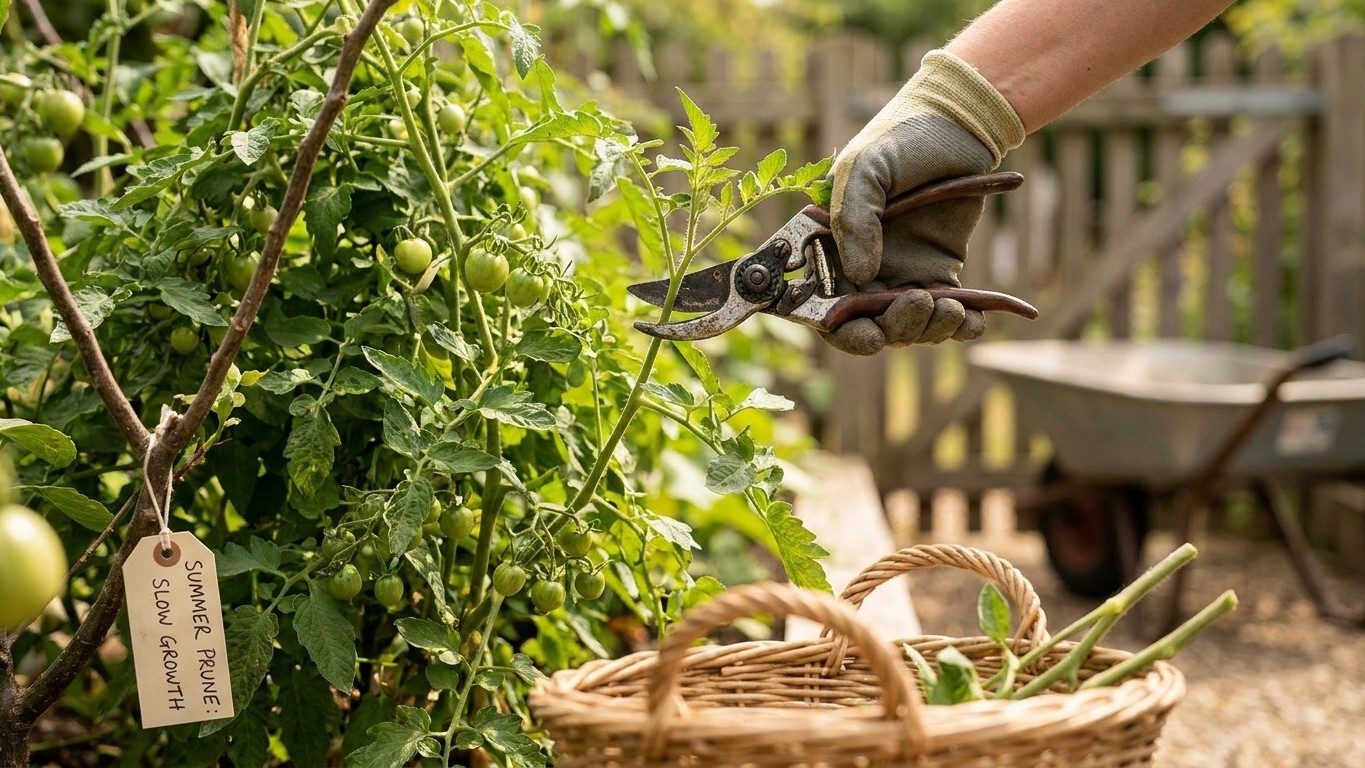

Summer pruning holds a tree back where winter pruning pushes it forward. Cut wood off in the dormant season and the tree answers with a rush of vigorous new shoots once sap rises, because dormant-season cuts remove no leaves and cost the tree no stored sugar. Cut the same wood off in summer, while leaves are still manufacturing sugar, and the tree has less surplus to spend on regrowth, so the response is restraint instead of a push. Check your rootstock’s mature height first: USU Extension’s figures run from the compact M.9 at 8 to 12 feet up to seedling stock at 35 to 40 feet, and that number should decide how hard you cut.
Why it matters
A tree spends the whole growing season banking carbohydrate in its wood and roots, mostly through the leaves it grows between petal fall and late summer. Cut a limb off in winter and none of that banking is disturbed. The tree still has a full reserve sitting in the roots when spring arrives, and it spends that reserve pushing out new wood to replace what you removed. That is why winter pruning reads as a wake-up call: the harder you cut, the harder the tree comes back, often as a thicket of upright watersprouts around the cut.
Why the response differs
Summer pruning works on the opposite side of the ledger. Take leaves off in the growing season, while the tree is still actively photosynthesizing, and you cut into the supply line itself rather than into stored capital. The tree has fewer leaves left to manufacture sugar, so there is less surplus to spend on regrowth. The same cut that provokes three new shoots after a winter pruning barely provokes one after a summer pruning. This is the mechanism growers lean on when a tree has outgrown its space: summer cuts calm a tree down, winter cuts wind it up.
The stage matters more than the calendar here. Summer pruning belongs after petal fall, once the current season’s shoots have made real growth and started to firm up at the base, not during the early spring flush when the tree is still running on stored reserves. Done at the right stage, it also lets more sun into the canopy, which is exactly the light that colors and firms the fruit inside. That is one reason it pairs naturally with thinning fruit down to one per cluster, since both jobs open the canopy and put the tree’s remaining energy into fewer, better fruit.
When to do it
Summer pruning starts after petal fall, once the current season’s new shoots have grown enough to show their own character: still soft and green at the tip, but firming and turning from green to brown at the base. That base color change is the cue to watch, not a date on the wall, because it moves with the season. A cool, wet spring pushes the whole schedule later, a warm one pulls it earlier, and an orchard a few states over from yours can be off by weeks even in an ordinary year.
Reading the shoot, not the wall calendar
Wait for that firming at the base before you cut. Prune while the whole shoot is still soft and green and you get the winter response instead of the summer one. The cut reads as an injury to a tree that is still running on spring vigor, and it answers with regrowth rather than restraint. The window stays open through most of the summer, closing again as the season turns toward fall, because cuts made too close to dormancy do not have time to callus over before cold weather arrives.
Bloom timing sets the calendar for the rest of the tree’s year, and it is worth knowing even though it is not the cue for pruning itself. Clemson Cooperative Extension groups apple varieties by how early they flower relative to each other. Group A, including Anna and Dorsett Golden, blooms earliest. Group B, which covers Fuji, Gala, Ginger Gold, Granny Smith, Jerseymac, Mollie’s Delicious, Mutsu, Red Delicious and Yates, blooms next. Group C, including Arkansas Black, Golden Delicious, Jonagold, Ozark Gold, Priscilla, Rome Beauty and Stayman, blooms latest. A late-blooming group C tree sets its fruit later, so its shoots also reach the firm-at-the-base stage later than an early group A tree growing next to it. Watch each tree on its own schedule rather than pruning the whole orchard on the same day.
How to do it

Start by telling watersprouts from fruiting wood. A watersprout stands straight up, grows as a single whippy shoot, and usually grows faster and thicker than the wood around it. Fruiting spurs are short and stubby, and they carry the swollen buds that will flower next spring. Remove or shorten the watersprouts, and leave the spurs alone.
Step by step
- Look for shoots that have firmed at the base (green turning to brown) since petal fall.
- Cut vigorous upright watersprouts back to their point of origin, or to a short stub if you want new spurs to form there instead.
- Shorten long lateral shoots that are reaching outside the tree’s intended footprint, cutting to a bud or side shoot rather than leaving a bare stub.
- Open up the center of the canopy where branches cross or shade each other, favoring removal of upright growth over spreading growth.
- Stop once light reaches most of the fruit and leaves inside the canopy. Cutting past that point removes leaf area the tree still needs to finish the crop.
Work on this year’s growth first. Cutting into two- or three-year-old wood in summer removes spurs that are already carrying fruit or are set to flower next spring, and it opens larger wounds that are slower to callus before fall. Save the harder structural cuts, the ones that reshape a limb or remove a major branch, for the dormant season, when the tree can answer with the vigorous regrowth it is built to produce at that time of year.
The table below sets the two seasons side by side, because a grower who does only one of them is missing half of what pruning can do.
| Timing | Effect on vigor | Best used for |
|---|---|---|
| Dormant season (winter) | Stimulates vigorous regrowth | Structural shaping, removing large limbs, setting scaffold branches |
| Petal fall through summer | Restrains regrowth, calms vigor | Controlling size, opening canopy for light and color, removing watersprouts |
A tree that gets both kinds of pruning, structural cuts in the dormant season and corrective, light-opening cuts in summer, tends to hold a manageable shape without the tall, sparse look that comes from relying on winter pruning alone. That balance matters most on vigorous rootstocks. MM.111 and seedling rootstock, which USU Extension lists at 30 to 35 feet and 35 to 40 feet at maturity, throw far more watersprout growth after a hard winter cut than a dwarfing rootstock like M.9 at 8 to 12 feet, so summer pruning earns its keep fastest on the bigger trees.
What goes wrong
The most common mistake is pruning too early, while new shoots are still fully green and soft from base to tip. A cut made then behaves like a winter cut. The tree still has a full reserve of stored sugar to spend, and it answers with a cluster of new watersprouts right at the wound, undoing whatever calming effect you were after. If you see two or three vigorous new shoots springing from a cut within a few weeks, that is the sign the timing was off, not the technique.
Overcutting and sunburn
The opposite error, pruning too late, carries a different cost. Cuts made as the season turns toward fall do not have enough warm weather left to callus over before the wood goes dormant, and an open wound heading into winter is an easy entry point for wood-rotting organisms and cold injury. A fresh cut that has not sealed by the time growth stops for the year is a wound the tree carries all winter. Fresh cuts are also one of the entry points a season-long spray program is meant to protect, which is part of why timing pruning against the tree’s own stages lines up with reading the spray schedule off the tree rather than the calendar.
Removing too much leaf area at once is its own failure. Leaves are the tree’s only sugar factory during summer, and stripping too many of them in one pass starves the fruit still sizing on the tree, leaving it smaller and less sweet at harvest than it would have been with a lighter hand. A canopy opened too fast can also expose bark that has spent its whole life in shade to direct sun for the first time, and that bark can scald in a single hot afternoon in a way that shaded bark never has to tolerate.
Cutting into wood older than the current season’s growth causes a third kind of damage. It removes spurs that are already committed to next year’s bloom, so the loss shows up not this season but the next, as a lighter crop with no obvious cause unless you remember exactly where the loppers went.
What changes where you are
The stage-based cue, shoots firming from green to brown at the base, holds everywhere apples grow, but the calendar date attached to it does not. A longer, warmer growing season pushes shoots through that firming point earlier in the year and stretches the summer-pruning window wider, while a short, cool season compresses the same window into a few weeks. Rather than borrow a date from another region, watch the shoots on your own trees each year, since the same variety can firm up weeks apart depending on where it is planted.
Rootstock changes how much correction a tree needs
Rootstock choice changes how much summer pruning matters in the first place. A tree on a dwarfing rootstock such as M.26 or G.11, which USU Extension lists at 12 to 15 feet at maturity, is already close to its ceiling and needs less correction to stay in bounds. A tree on M.106 (25 to 30 feet), MM.111 (30 to 35 feet) or seedling rootstock (35 to 40 feet) keeps growing for years longer, and summer pruning is the main tool for keeping that growth from running away before winter structural pruning gets a chance to catch up. Know your rootstock before you decide how aggressively to summer prune, since the same cut that barely dents a seedling tree can noticeably slow a tree on M.9.
Local frost dates, humidity, and disease pressure all shift the fine details of when a wound is safe to leave open and when it needs watching, and those specifics belong to your own county rather than to a national guide. Start with the broader groundwork in growing apples for your region, then check with your state’s extension service for the local chill-hour figures and disease pressure that decide exactly how tight a pruning window you’re working with this year.
Common questions
Can I summer prune a young tree in its first year?
Hold off on anything beyond removing damaged or crossing shoots in the first year. A young tree needs all the leaf area it can grow to build root and trunk mass, and summer pruning works against that goal exactly when the tree needs to be growing fastest.
Will summer pruning stop my tree from fruiting next year?
Done at the right stage, on the current season’s watersprouts, it should not. Cutting into older wood that is already carrying next year’s fruit buds is the mistake that costs a crop, not summer pruning itself.
Do I need to seal or paint the cuts?
Most extension guidance does not call for wound sealant on routine pruning cuts made at the right stage, since a clean cut calluses over on its own. Check with your local extension office if you are working on a larger limb or in a region with particular disease pressure they track.
What if I missed the window, can I still prune in fall?
Cutting once the shoots have hardened fully and the tree is heading into dormancy behaves more like a winter cut than a summer one, so you lose most of the calming effect. It is better to wait for next year’s window than to cut late this year.