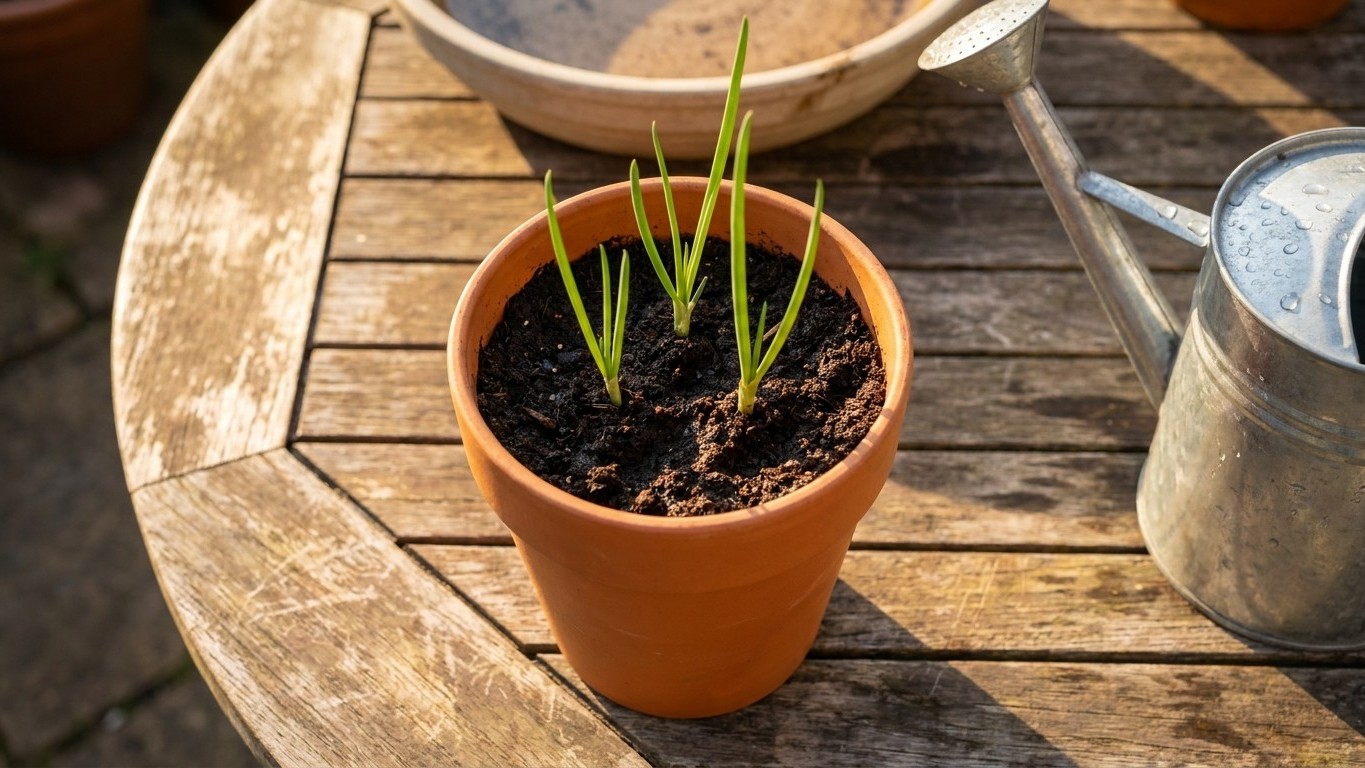

Onions grow well in containers as long as the pot is deep enough and the compost never dries out between waterings. Depth matters more than width, because bulbing onions push roots straight down before they push sideways. Get those two things right and a container onion performs close to one grown in open ground. Get them wrong, and the plant locks into a small size early and never recovers.
Growing Onions in Containers

A container onion is limited by depth and by consistency of water, not by the width of the pot’s mouth. That single fact reshapes how most people choose their pots. A wide, shallow bowl looks generous but starves the root system of the vertical room it needs, while a narrower pot with real depth gives the bulb somewhere to develop. Onions don’t spread laterally the way squash or tomatoes do. Their root system is fine, sparse, and mostly vertical, which means a container that’s tall enough matters far more than one that’s wide enough.
That sparse root system is also why containers dry out faster than garden beds, and why this is the single biggest risk in growing onions this way. A raised bed holds a reservoir of moisture that buffers a missed watering day. A container doesn’t. Warm afternoons pull moisture out of a small volume of compost quickly, and because onion roots are shallow and thin, they can’t chase water the way a deep-rooted plant would. A dry spell during the leaf-growth stage costs the plant rings it will never grow back, because of how the bulb actually forms.
Why leaf growth decides the final bulb size
Rings are built by leaves before bulbing starts, not during it. Each leaf an onion produces while days are still short corresponds to a ring that will later thicken into part of the bulb. Once day length triggers bulbing, the plant stops making new leaves and starts swelling what it already has. That means the size ceiling for the bulb is set in the weeks before bulbing even begins. A container onion that gets checked early, whether by drought stress, cold shock, or crowding, stops adding leaves ahead of schedule and locks in a smaller final size. There’s no second growth phase where it catches up. What’s built by bulbing time is what you harvest.
This is different from most vegetables, where a rough patch early in the season can be outgrown later. With onions, the early phase isn’t a warm-up. It’s the phase that determines the ceiling. That’s part of why container growing rewards steady, boring consistency over occasional heavy feeding or watering. A plant that never wobbles, even a little, tends to out-produce one that gets a big rescue watering after a dry week.
How to do it
- Choose a container with real depth. Look for at least 8 to 10 inches of soil depth for bulbing onions, since that’s the vertical room the root system actually uses. Width can be modest; depth can’t be skipped.
- Confirm the variety suits your day length before planting. A pot doesn’t change the latitude the plant is growing in. Short-day varieties still need short-day conditions to bulb properly, and long-day varieties still need the longer summer daylight of northern latitudes. Check with your regional Cooperative Extension office if you’re unsure which category fits your area.
- Fill with a loose, moisture-retentive mix. A dense, compacted mix works against the shallow root system; a loose one lets roots spread without a fight, and holds water longer between refills.
- Space sets or transplants generously if you’re growing for storage bulbs. Crowding gives small onions, which is fine if you want scallion-sized spring onions but works against you if the goal is onions that store through winter.
- Water on a fixed schedule rather than waiting for visible wilting. Because containers dry faster than beds, checking soil moisture with a finger every couple of days catches a dry spell before the leaves show stress, which is before any damage to ring formation has happened.
- Feed lightly and regularly through the leaf-growth stage. This is the phase that sets bulb size, so steady nutrition here matters more than a heavy feed later once bulbing has started.
- Stop fertilizing once bulbing visibly begins. The tops will start to swell at the base; from this point the plant is converting existing leaf growth into bulb, not adding new structure.
- Harvest once the tops yellow and fall over on their own. Pulling early sacrifices size that’s already locked in; letting them finish naturally gets the full result of however the leaf-growth stage went.
What goes wrong
- The container dries out during a hot stretch. Leaves look dull, slightly floppy, and growth visibly slows for a few days even after watering resumes. Once this happens, there’s no fixing the rings already lost. Resume consistent watering immediately to protect whatever growth is still ahead, and treat it as a sign to check moisture more often, not less, for the rest of the season.
- The bulbs come out small at harvest. This usually traces back to something that happened weeks earlier, either crowding, a dry spell, or a wrong-latitude variety, since the leaf-growth stage had already set the ceiling before bulbing began. There’s nothing to do for that harvest, but it’s a strong signal to widen spacing or switch to a variety matched to your day length next time.
- Growth stalls early and the plant seems to just sit there. This is often crowding: too many sets or transplants packed into one pot competing for the same shallow root zone. If it’s caught mid-season, thinning the weakest plants can give the remaining ones more room to keep building leaves before bulbing starts.
- The onions bulb too early and too small. This points to a variety mismatched to your latitude, since day length triggers bulbing regardless of plant size or container conditions. Once bulbing starts, there’s no reversing it for that crop; the fix is choosing a short-day or long-day variety that actually matches your region next season.
- Tops flop over well before harvest time. If this happens early rather than at the natural end of the season, it’s often a stress response rather than a sign of maturity, commonly from a container that dried out or from crowded roots competing for space. Check soil moisture and spacing before assuming the crop is simply done.