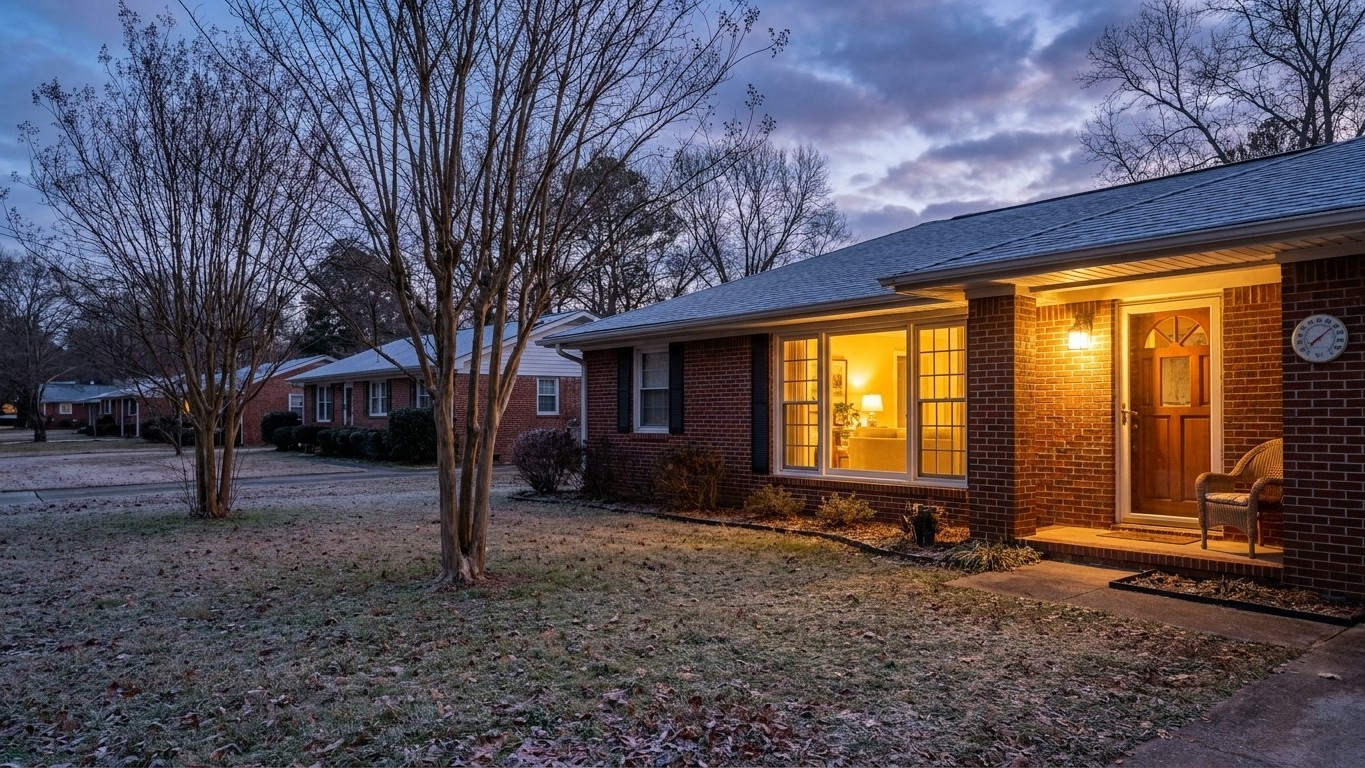

Georgia winters rarely bite hard, but they linger just long enough to matter for a heating budget. The coldest month averages a low of 35.6°F in Atlanta, cool enough to run a furnace daily without ever pushing it to its limit. Here’s what that actually means for wood, seasoning time, and where to double-check local rules before you buy.
How cold it gets, and for how long

The number that matters isn’t the record low everyone remembers from that one freak ice storm. It’s the average daily minimum in the coldest month, and for Atlanta that’s 35.6°F, per NOAA’s 1991-2020 Climate Normals. That’s a winter that hovers right around freezing on a typical night, not one that plunges into single digits for weeks at a stretch.
That distinction changes what a house needs. A climate with a coldest-month minimum in the teens or single digits demands a heating system built for sustained, punishing cold: thick insulation, a furnace sized for extremes, a wood-burning setup that can hold a fire through a 20-below night. Georgia’s winter asks for something different. It’s a season of steady, moderate demand, more marathon than sprint, with heating equipment cycling on and off through mild nights rather than running flat-out for days.
In practice, this means the heating season here is long in duration but light in intensity. A furnace or heat pump works most nights from late November through February, sometimes into early March, but it rarely faces the kind of brutal cold that stresses undersized equipment. Wood-burning households see the same pattern: a stove or insert gets lit most evenings, but nobody’s feeding it around the clock to keep pipes from freezing. That gradual taper also raises the question of When Can You Turn the Heat Off in Georgia?, since the shoulder months can still catch an unprepared household off guard.
The catch is that “mild” doesn’t mean “cheap.” A heating system running every night for four months can rack up more total hours than one running hard for six weeks in a colder state. The number to watch isn’t how low the thermometer goes. It’s how many nights it dips below the point where your house needs help staying warm, and in Atlanta, that’s most of them from November to March.
What a cord of wood is worth here
A cord is a volume, not a weight, and that single fact is where most firewood buyers get taken. The standard measure is a stack 4 feet high, 4 feet deep, and 8 feet long, which comes out to 128 cubic feet total (some of that is airspace between the pieces, which is normal). What varies wildly is how much wood mass sits inside that stack, because dense hardwoods like oak or hickory pack far more burnable material into the same 128 cubic feet than a softer species like pine.
| Measurement | Figure |
|---|---|
| Cord dimensions | 4 ft x 4 ft x 8 ft |
| Total volume | 128 cubic feet |
| Heat output (well-seasoned hardwood) | about 20 million BTU |
According to Michigan State University Extension, a cord of well-seasoned hardwood delivers roughly 20 million BTU. To put that in a frame a homeowner can actually use, MSU notes that’s comparable to the heat from about 145 gallons of #2 fuel oil, or 215 gallons of LP gas. Given Atlanta’s mild-but-long heating season, one cord can carry a household through a meaningful chunk of winter if it’s the primary or supplemental heat source, though a home that heats exclusively with wood through the full season will likely need more than one.
The number that decides how much heat you actually get from that cord isn’t printed on any receipt: it’s moisture. MSU is blunt about this. Wood needs to burn at 20 percent moisture or less to deliver anything close to that 20-million-BTU figure. Green wood can sit above 60 percent moisture, and every bit of that water has to boil off inside your stove before the wood gives you any usable heat. You’re not buying firewood at that point. You’re buying kindling with a water problem, and paying full cord price for it.
How long wood takes to dry in Georgia
Seasoning time isn’t a fixed number stamped on every log pile in the country. It’s a function of local humidity and summer heat, which means the answer for Georgia isn’t automatically the answer for Vermont or Minnesota. According to MSU Extension, split and stacked green wood typically reaches that 20-percent moisture target after one full summer of drying, provided air can actually move through the stack. Rounds that are never split, or wood stacked so tight nothing breathes, won’t hit that mark on schedule no matter how many months pass.
Red oak is the named exception worth remembering if you’re buying or cutting locally. MSU flags it as a slow drier because of its cell structure, meaning it needs more time under the same conditions than most other hardwoods. If a supplier tells you red oak is “ready” after a couple months in a stack, that claim deserves some skepticism.
Burning wood before it’s actually seasoned doesn’t just waste heat, though that’s the first casualty. Every BTU spent boiling off internal moisture is a BTU that never reaches your living room, so a stove loaded with wet wood runs cooler and needs more frequent refueling to hold the same temperature. The second problem builds up quietly: unburned moisture and incomplete combustion send more creosote up the flue, and that creosote is what turns a routine chimney inspection into an earlier, more urgent sweep. Neither outcome is dramatic in the moment. Both cost more over a season than the wood itself.
Georgia’s humid summers can work in a wood-burner’s favor here, since warm, drying air over several months does the job MSU describes, as long as the stack is split, off the ground, and open enough to let air pass through. Wood tossed in a damp corner of the yard under a tarp is a different story entirely, and no amount of calendar time fixes poor airflow.
Where to check before you buy
Everything above describes Atlanta specifically, and Georgia is a state with real variation in elevation and exposure between the mountains near the North Carolina line and the flatter coastal plain toward Savannah. A coldest-month minimum measured in Atlanta won’t match every county exactly, and species availability shifts with it too. Some parts of the state have more oak and hickory in easy supply; others lean toward pine, which seasons faster but burns hotter and faster through a firebox.
Burn restrictions are the other piece worth checking locally, and they’re worth checking every year, not just once. Air quality alerts, seasonal burn bans, and local ordinances around outdoor burning are set at the county or municipal level in Georgia, and they change based on conditions each season rather than sitting fixed in a handbook.
The University of Georgia Extension is the resource built for exactly this kind of local detail: species that grow and season well in your specific county, current burn guidance, and practical advice suited to Georgia’s climate rather than a national average. It’s a better starting point than guessing from a statewide figure, especially if you’re heating with wood as anything more than an occasional backup.