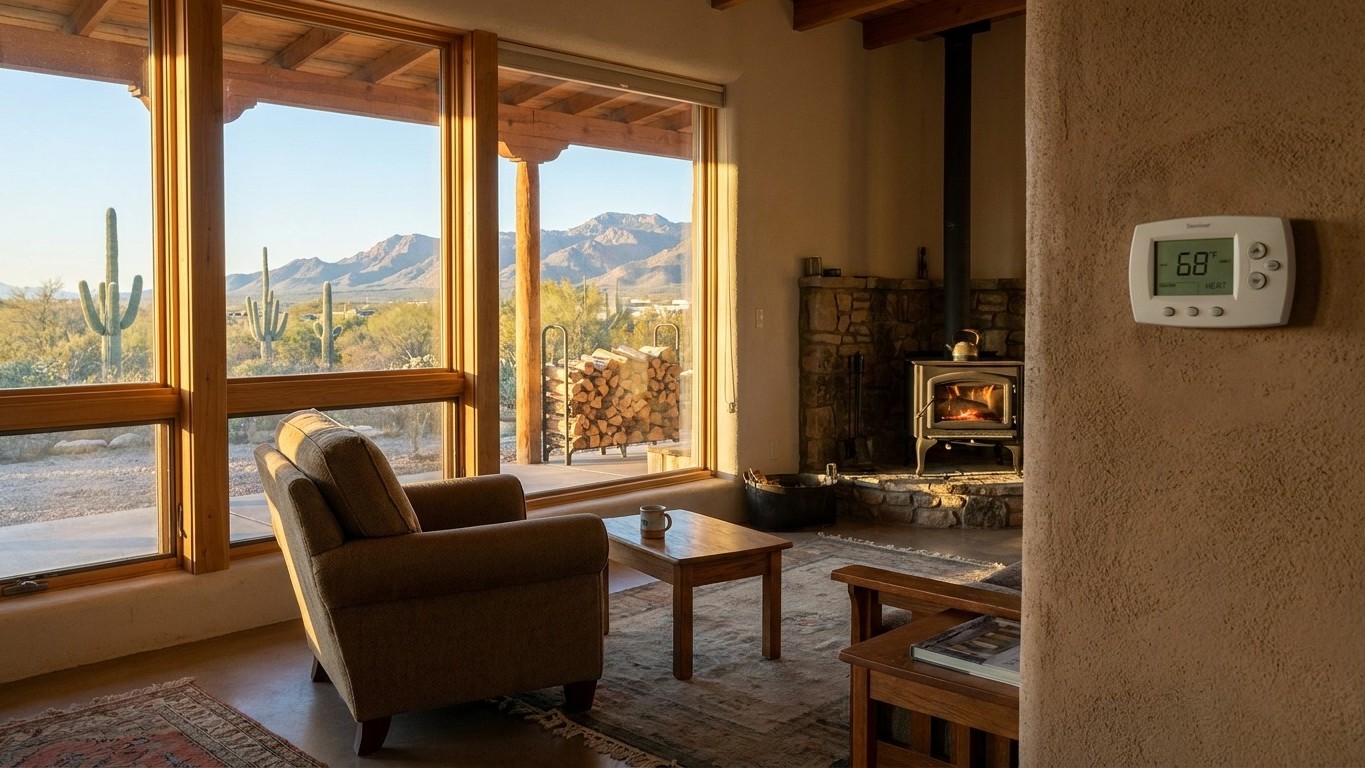

Winter in Arizona doesn’t hit like it does in Minnesota or Maine, but that doesn’t mean the furnace stays off. The math on what it actually takes to keep a house warm here comes down to three things: how cold it really gets, how much heat a load of firewood delivers, and how long that wood needs to dry before it’s worth burning.
How cold it gets, and for how long

The mean daily minimum for the coldest month in Phoenix sits at 45.3°F, according to NOAA’s 1991-2020 Climate Normals. That’s not a record low and it’s not some vague seasonal average. It’s the number that tells you what a typical cold night actually looks like, and it’s mild by national standards.
But mild doesn’t mean short. A low hovering in the mid-40s means the heating season here isn’t a brutal two-week freeze followed by relief. It’s a long, low-grade stretch where the thermostat clicks on most nights from December through February, sometimes into early March at higher elevations. For a closer look at When Does the Heating Season Start in Arizona?, the timing depends heavily on elevation and location. That’s a different problem than what a homeowner in the upper Midwest deals with, where the furnace runs nonstop for months at temperatures far below freezing. In Arizona, the equipment doesn’t need to fight arctic air. It needs to handle steady, moderate demand night after night without wasting energy on a system sized for weather that never shows up.
This matters for anyone deciding between a heat pump, a gas furnace, or a wood stove as backup. A system built for deep-freeze climates is often oversized and inefficient here, cycling on and off in ways that waste fuel. The desert Southwest calls for equipment tuned to modest, consistent temperature swings, not extremes. That’s also why supplemental heat sources, like a wood stove in a rural property or a mountain cabin, can carry more of the load here than people expect. The season is long enough that a well-managed woodpile or a well-tuned heat pump earns its keep, even if the coldest nights never approach what other parts of the country consider normal.
Elevation changes this picture fast. Flagstaff and the high country see real winter, snow included, while the Phoenix basin barely dips below the mid-40s. That gap also affects When Can You Turn the Heat Off in Arizona?, since the answer varies widely depending on where you live. The NOAA figure above is anchored to Phoenix as the reference station, so anyone living at higher elevation should expect a colder, longer season than these numbers suggest.
What a cord of wood is worth here
A cord of well-seasoned hardwood delivers about 20 million BTU, according to Michigan State University Extension. That figure is an average, not a guarantee, because species and moisture content swing it considerably. But it gives a useful anchor: MSU puts one cord roughly on par with 145 gallons of #2 fuel oil or 215 gallons of LP gas in heat output.
Here’s the part that trips up a lot of first-time buyers: a cord is a volume, not a weight. It’s a stack measuring 4 feet by 4 feet by 8 feet, which works out to 128 cubic feet. That’s the legal and practical definition, and it’s the single most common place where a buyer gets shorted. Dense hardwoods like oak or hickory pack more mass into that same stack than a softer wood like pine, which means more energy per cord even though the volume is identical. Two cords can look the same on a truck and burn completely differently once they’re in the stove.
For a Phoenix-area household, given the mild-but-long heating pattern described above, a cord of dense hardwood used as supplemental heat, say for a wood stove backing up a gas furnace on the coldest nights, can stretch across a good chunk of the season if it’s not the sole heat source. It won’t carry a whole house through winter here the way it might in a colder climate, but paired with a furnace or heat pump running on the milder nights, it takes real pressure off the heating bill.
None of that works with wet wood. If the wood hasn’t seasoned properly, a meaningful share of its potential heat gets spent boiling off internal moisture before any warmth reaches the room. That’s not a minor efficiency loss. It’s the difference between a cord that performs close to its 20 million BTU potential and one that burns sluggish, smoky, and disappointing.
How long wood takes to dry in Arizona
Seasoning time isn’t a fixed number stamped on every log. It depends on humidity, heat, airflow, and how the wood was stacked, which means a general figure has to be read as a starting point, not a promise. MSU Extension puts the target at 20 percent moisture or less for good burning, while green wood fresh off the tree can run over 60 percent. That gap has to close before the wood is worth putting in a stove.
Split green wood, stacked properly so air moves through the pile, usually reaches that 20 percent threshold after one full summer of drying. Arizona’s low humidity and intense summer heat actually work in a homeowner’s favor here. Wood that might take longer to dry in a humid Southeast climate has a real shot at drying faster in the desert, provided it’s split and stacked, not left in whole rounds where the bark seals in moisture.
Red oak is the exception worth knowing. MSU notes it dries more slowly than other hardwoods because of its cell structure, so anyone burning red oak should plan on extra time rather than assuming the standard season is enough.
Burning too soon has real consequences. Wet wood produces less usable heat, since so much energy goes into evaporating water instead of warming the room. It also burns dirtier, sending more creosote up the flue and into the chimney lining. That buildup raises the risk of a chimney fire and means the chimney needs sweeping more often than it would with properly dried wood. None of this is dramatic if it’s caught early, but it’s the kind of maintenance cost that sneaks up on someone who assumed a few months on the porch was enough seasoning.
Where to check before you buy
Arizona spans a huge range of elevation and climate, from the low desert around Phoenix to the pine forests near Flagstaff, and the figures above are anchored to Phoenix as the reference city. A homeowner at 7,000 feet is dealing with a different winter than one in the valley, and local conditions should always take priority over statewide averages.
Before buying a cord of wood or planning a burn schedule, check with the University of Arizona Cooperative Extension for guidance specific to your county, including which species are locally available and how they season in that particular microclimate. Extension offices also track seasonal burn restrictions, which are common in parts of Arizona during high-pollution winter days. These rules are set at the local level, tied to air quality conditions, and they change from year to year. What was allowed last winter isn’t automatically allowed this one, so it’s worth a quick check before stacking up a season’s worth of wood.
What each heat source costs to run in Arizona
At Arizona’s average residential prices, this is what one million Btu of heat delivered into the house costs with each system. It compares fuels on the same unit: it is not a yearly bill, and it leaves out the price of the equipment.
| System | Cost per million Btu delivered |
|---|---|
| Electric resistance (baseboard, 100% efficient) | $45.25 |
| Heat pump at 8.1 HSPF2 (seasonal COP about 2.4) | $19.06 |
| Natural gas furnace at 95% AFUE | $18.86 |
Cheapest to run in Arizona: natural gas furnace, $0.20 less per million Btu than the heat pump.
Prices: U.S. Energy Information Administration (EIA), average residential prices. Efficiencies: ENERGY STAR criteria. A heat pump’s figure is a seasonal average; in the coldest weather its efficiency drops.