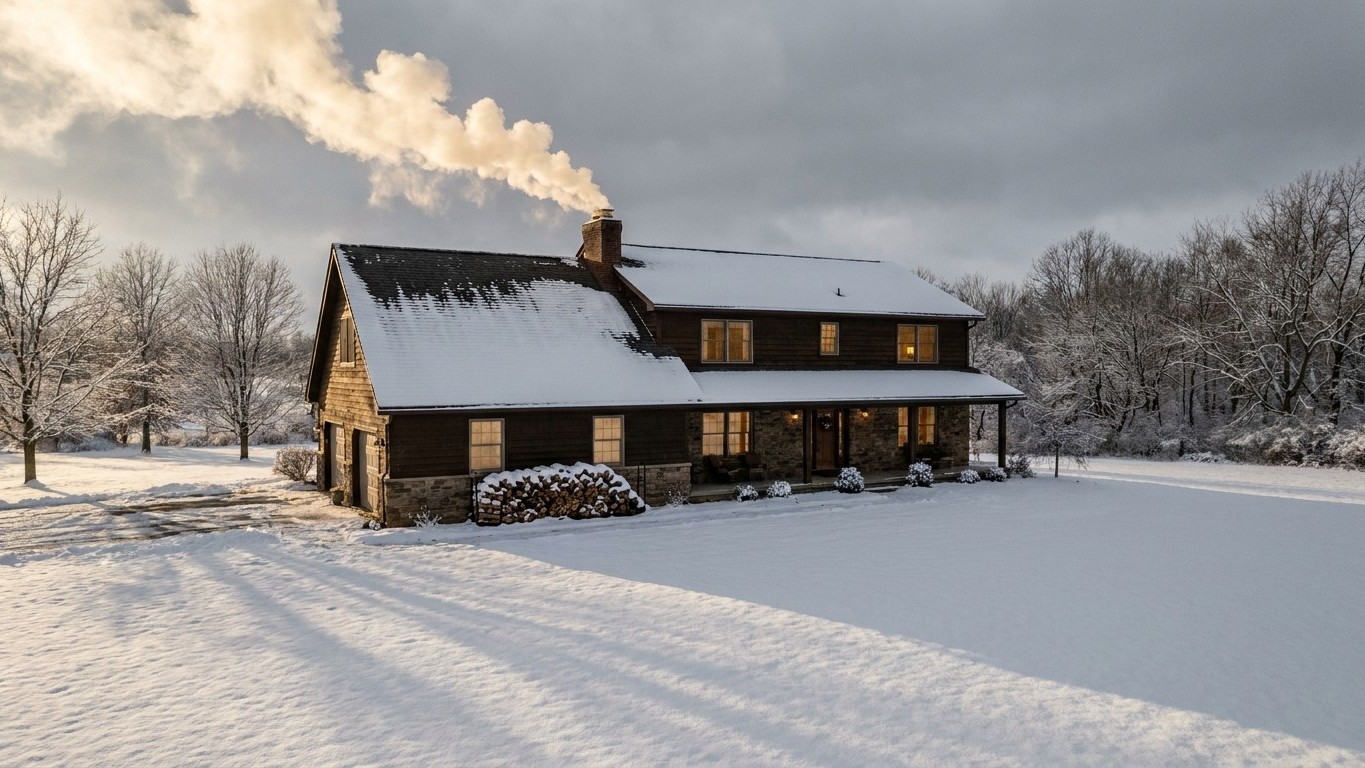

Columbus averages a coldest-month minimum of 22°F, which means most Ohio homes spend a solid stretch of winter running the furnace or feeding a stove nonstop. Here’s what that actually costs in wood, time, and planning.
How cold it gets, and for how long

Twenty-two degrees. That’s the average low during Ohio’s coldest month, based on NOAA’s 1991-2020 climate normals for Columbus. Not the record low that shows up on the news once a decade, and not some rounded-off seasonal average. This is the number that describes an ordinary night in January, over and over, for weeks at a stretch.
That distinction matters more than it sounds like it should. A climate that sits near freezing for four straight months puts different demands on a heating system than one that drops far below zero for six weeks and then breaks. Ohio falls into the first category. The cold isn’t dramatic here so much as it’s persistent, and persistence is what runs up a heating bill or burns through a woodpile.
A furnace in this climate isn’t cycling on for a few hours during scattered cold snaps. It’s working through late November, all of December and January, most of February, and often bleeding into March. Anyone who’s tracked degree-days for a Midwest heating season knows the total climbs fast when the daily minimum hovers in the low twenties for weeks rather than spiking down and recovering.
For wood burners, this steady cold changes the math on supply. A stove that only needs to fight off the occasional hard freeze can get by on less fuel and less careful planning. A stove working against a four-month stretch near 22°F needs a stack that’s sized for endurance, not for a handful of bitter nights. That’s the frame for everything that follows: Ohio’s winter is a marathon at a moderate pace, not a sprint into extreme cold.
It also means insulation and air sealing pay off differently here than in a place with short, sharp cold snaps. Steady losses over sixteen or seventeen weeks add up in a way that a brief cold spike doesn’t, which is worth remembering before assuming a bigger furnace or a bigger woodpile is the only fix.
What a cord of wood is worth here
A cord isn’t a weight. It’s a volume: a stack measuring 4 feet by 4 feet by 8 feet, which works out to 128 cubic feet. That distinction is where most firewood buyers get shorted, because a “face cord,” a “truck load,” or a loosely stacked pile can all get sold under the word “cord” without actually measuring up.
According to Michigan State University Extension, a cord of well-seasoned hardwood holds about 20 million BTU. That’s an average, since species and moisture content shift it considerably, but it gives a household something concrete to plan around. MSU frames it in terms people can picture: a cord’s heat is roughly equivalent to 145 gallons of #2 fuel oil, or 215 gallons of LP gas.
| Measurement | Value |
|---|---|
| Cord dimensions | 4 ft x 4 ft x 8 ft |
| Total volume | 128 cubic feet |
| Heat content (seasoned hardwood) | about 20 million BTU |
| Fuel oil equivalent | roughly 145 gallons of #2 fuel oil |
| LP gas equivalent | roughly 215 gallons |
Set against Columbus’s coldest-month minimum of 22°F, a single cord is rarely the whole answer for a house relying on wood as a primary heat source through a four-month season. It’s a piece of the picture, and how far it stretches depends heavily on how the house is heated, how well it’s sealed, and how dry that wood actually is when it goes into the stove.
Moisture is the variable that decides whether a cord delivers close to that 20 million BTU figure or falls well short. Wet wood doesn’t just burn less efficiently. It spends a chunk of its own energy boiling off water before any of that heat reaches the room, which is the whole reason seasoning matters as much as species when someone’s stacking a woodpile for an Ohio winter.
How long wood takes to dry in Ohio
Seasoning time isn’t a fixed number stamped on every log. It depends on humidity, summer heat, and, most of all, how the wood is stacked. MSU Extension puts the target at 20 percent moisture or less before burning, and notes that green wood can start out above 60 percent. That’s a lot of water to remove before a piece of firewood is actually doing its job.
Split green wood typically reaches that 20 percent mark after one full summer, provided it’s split and stacked so air can move through the pile. Rounds left whole, or logs stacked tight against a wall with no airflow, take much longer and sometimes never get there. Ohio’s humid summers help evaporation along, but they don’t substitute for a stack built with gaps and exposure to sun and wind.
Red oak is the one species MSU calls out by name as an exception. Its cell structure holds onto water longer than most hardwoods, so it needs more than a single summer to season properly. Anyone burning oak on a one-summer timeline is likely burning it too soon.
The cost of skipping ahead isn’t subtle once you know what to look for. Wood burned above that 20 percent threshold produces less usable heat, since energy that should be warming the house is instead boiling off trapped moisture. It also builds creosote in the flue faster, which means a chimney that needs sweeping sooner than it would with properly dried fuel. Neither problem is dangerous in the sense of an emergency, but both are avoidable with a stack that’s had a full season to dry, split, and exposed to air rather than piled in a damp corner of the yard.
Where to check before you buy
Every figure above traces back to Columbus, the NOAA reference station for the 1991-2020 normals. Ohio stretches across a range of elevation and lake exposure that Columbus doesn’t fully represent, from the snowbelt counties near Lake Erie to the flatter terrain further south. A property closer to the lake can see meaningfully different winter conditions than the reference city, even within the same state.
Species availability shifts across that range too, along with what’s locally cheap versus scarce. Before buying wood by the cord, or planning a season’s heating budget around a stove, it’s worth checking with Ohio State University Extension for guidance specific to a given county, including which hardwoods are commonly sold nearby and how sellers in that area typically measure a load.
Burn restrictions are also worth confirming locally. Some Ohio municipalities and air districts set seasonal or air-quality-triggered limits on open burning and outdoor wood burners, and those rules are set at the local level and revised from year to year. What was allowed last winter isn’t guaranteed to hold this one, so a quick check before stacking up next season’s supply beats finding out mid-January that the rules changed.