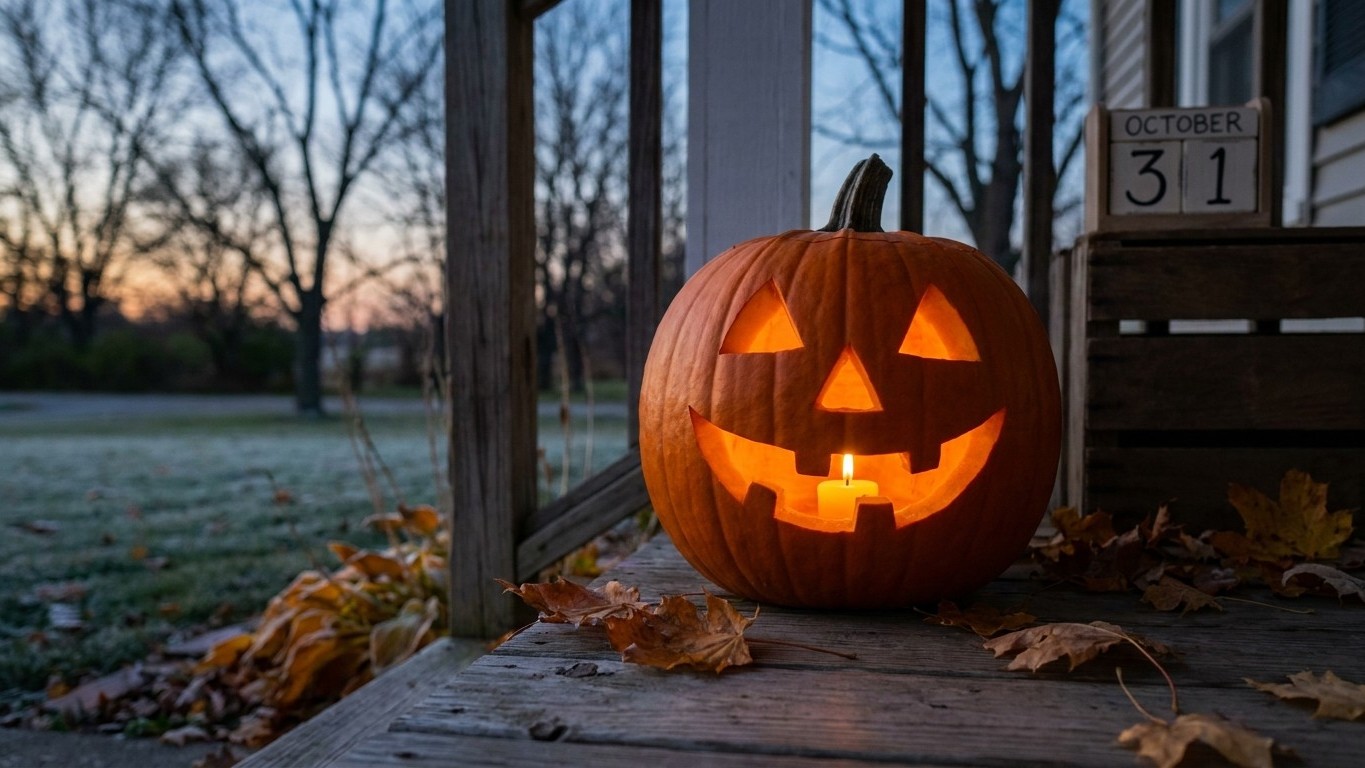

Around Chicago, the mean first fall frost lands somewhere between October 24 and November 3. That’s a wide window sitting right on top of Halloween, which means frost could show up a week early or a few days after the holiday. For a whole, uncarved pumpkin, the safe move is to carve within about three to five days before October 31, keeping the pumpkin whole and cool until then.
The short answer

The mean first fall frost for the Chicago reference station falls somewhere in the October 24 to November 3 range. That’s an average built from three decades of weather records, not a forecast for any single year, so treat it as a guide rather than a guarantee. Some years the first frost arrives a full week before Halloween. Other years it holds off until early November. Either way, the date sits close enough to October 31 that anyone planning a jack-o’-lantern in Illinois needs to think about timing, not just about picking a good pumpkin.
Here’s what that window means in practice. If frost tends to arrive around October 24 in your area, you’re looking at roughly a week of exposure between a likely frost and the holiday itself. If your local pattern runs closer to November 3, you’ve got more room, and the pumpkin sitting on the steps is less likely to face a hard freeze before trick-or-treaters show up. Neither scenario is fixed, and a pumpkin left outside through an early frost can suffer, even if it looks fine at first glance.
Given that spread, the practical window for carving is the three to five days before Halloween. Carve too early and a whole pumpkin sitting cut open for two weeks starts to shrink, wrinkle, and mold, regardless of storage temperature. Carve too late and you risk rushing the job or missing the display window entirely if a cold snap or a wind event knocks out your plans.
The three-to-five-day window isn’t a rule handed down by a lab. It’s a balance between two facts: cut pumpkin flesh dries out and molds fast once exposed to air, and Illinois weather in late October is unpredictable enough that waiting too long risks a freeze finding your pumpkin before you’ve had a chance to light it. Splitting the difference gives you a jack-o’-lantern that still looks sharp on the actual night, without betting on a specific date holding steady.
None of this changes how you choose the pumpkin in the first place. A good pumpkin, picked well and stored whole until you’re ready, gives you more flexibility on exactly when inside that window you carve. A pumpkin with a damaged stem or soft spots gives you less room to work with, no matter what the calendar says.
Frost or heat: which one gets it here
The cold end
In Illinois, cold is the risk, not heat. A whole pumpkin keeps best between 45 and 50 F, according to University of Illinois Extension. That’s a narrow band, and it sits well above what outdoor air in this region does once the first frost arrives. The coldest month in the Chicago area averages a daily minimum of 18.8 F, a figure that describes deep winter, not late October, but it signals how fast this climate turns once cold weather sets in. A pumpkin left on an open porch or steps after the first frost date isn’t just flirting with temperatures below the 45-50 F storage band. It’s flirting with an actual freeze, which can turn pumpkin flesh soft and translucent, sometimes within a single cold night.
This is a different problem than a hardiness zone number. Zone maps describe whether a perennial plant survives winter in the ground over years. They say nothing about whether a single frosty night in late October will damage a pumpkin sitting outside your door. The mean first fall frost date is the number that actually matters here, and in Illinois, that date and Halloween sit close enough together that a cold snap arriving on schedule, or a little early, is a real possibility every year.
The warm end
Heat isn’t the concern in this region the way it might be somewhere with mild, dry autumns. Illinois doesn’t typically see late-October afternoons warm enough to push a stored pumpkin above the top of that 45-50 F band for long stretches. The risk here runs the other direction: afternoons can still feel mild, even into the 50s or 60s some years, while nights swing well below the storage range once a frost event moves through. That swing, warm days and cold nights, is what makes timing tricky. It’s not a slow, steady warmth degrading the pumpkin from the top of the range. It’s a sudden drop from the bottom.
Where to keep it until you carve
Once you’ve picked a pumpkin, the goal is holding it as close to that 45-50 F range as an Illinois home allows, in the dark, until you’re ready to cut into it.
- An unheated garage or breezeway usually runs closer to outdoor temperature than an attached, heated room, and stays out of direct sun, which matters as much as the temperature itself.
- A cool basement corner, away from the furnace and any heat duct, often sits nearer the target range than anywhere upstairs, especially once the heating system starts running for the season.
- An enclosed, unheated porch works until the first hard freeze arrives; after that, the porch is doing more harm than good, and the pumpkin should move somewhere with more buffer from outdoor swings.
- Keep it away from apples, potatoes, and tomatoes, wherever it’s stored. Ripening fruit gives off a gas that speeds up aging in a whole pumpkin, and it’s an easy detail to miss if the pumpkin is sitting near a fall fruit bowl or a bin of harvest produce.
- Check the stem before you commit to a storage spot. A pumpkin with one to two inches of stem still attached seals the fruit and resists spoiling. If the stem has already broken off, that exposed section is the first place trouble starts, no matter how good the storage location is.
None of these spots is a guarantee. They’re the closest approximations of a controlled 45-50 F environment that a typical Illinois home offers without dedicated cold storage. The goal is minimizing swings, not hitting an exact number.
Checking this against your own county
The frost dates and storage guidance here come from a single reference weather station near Chicago, and county-level conditions across Illinois vary more than a statewide figure can capture. Rural gardens and low-lying areas often see frost arrive earlier than an airport or city station reports, sometimes by a week or two, and higher elevations shift that timing further still. Before locking in a carving date, it’s worth checking conditions specific to where you live.
University of Illinois Extension maintains county offices across the state, each with local knowledge about frost timing, growing conditions, and seasonal produce advice tailored to that area. Their statewide site, extension.illinois.edu, is the starting point for finding your local office and getting a frost estimate that reflects your actual yard rather than an averaged reference point from miles away.
Common questions
How long does a carved pumpkin last?
No university extension publishes a specific number of days for a carved pumpkin, and none publishes a preservation protocol involving bleach, sealants, or similar treatments. What’s actually documented is guidance for a whole pumpkin: choose one with an intact stem, store it between 45-50 F away from ripening fruit, and carve close to the day you plan to display it.
Can I carve two weeks before Halloween and expect it to hold up?
Cut pumpkin flesh is exposed to air the moment you carve, and it starts drying and softening from that point forward regardless of storage temperature. Carving close to the display date, within the three-to-five-day window discussed above, gives a sharper result than carving far in advance.
Does a light frost ruin a pumpkin sitting outside?
A brief, light frost on the surface isn’t the same as a hard freeze reaching the flesh. But repeated exposure, or a harder freeze event, can cause soft, translucent damage. Since the mean first fall frost sits close to Halloween in Illinois, moving a whole pumpkin to a more protected spot once frost risk rises is worth the effort.
Is it safe to carry a pumpkin by its stem?
No. The stem isn’t a handle. It’s the seal that keeps that section of the pumpkin from spoiling early. Carrying or lifting a pumpkin by the stem risks snapping it off, which exposes the fruit underneath and shortens how long it holds up before carving.