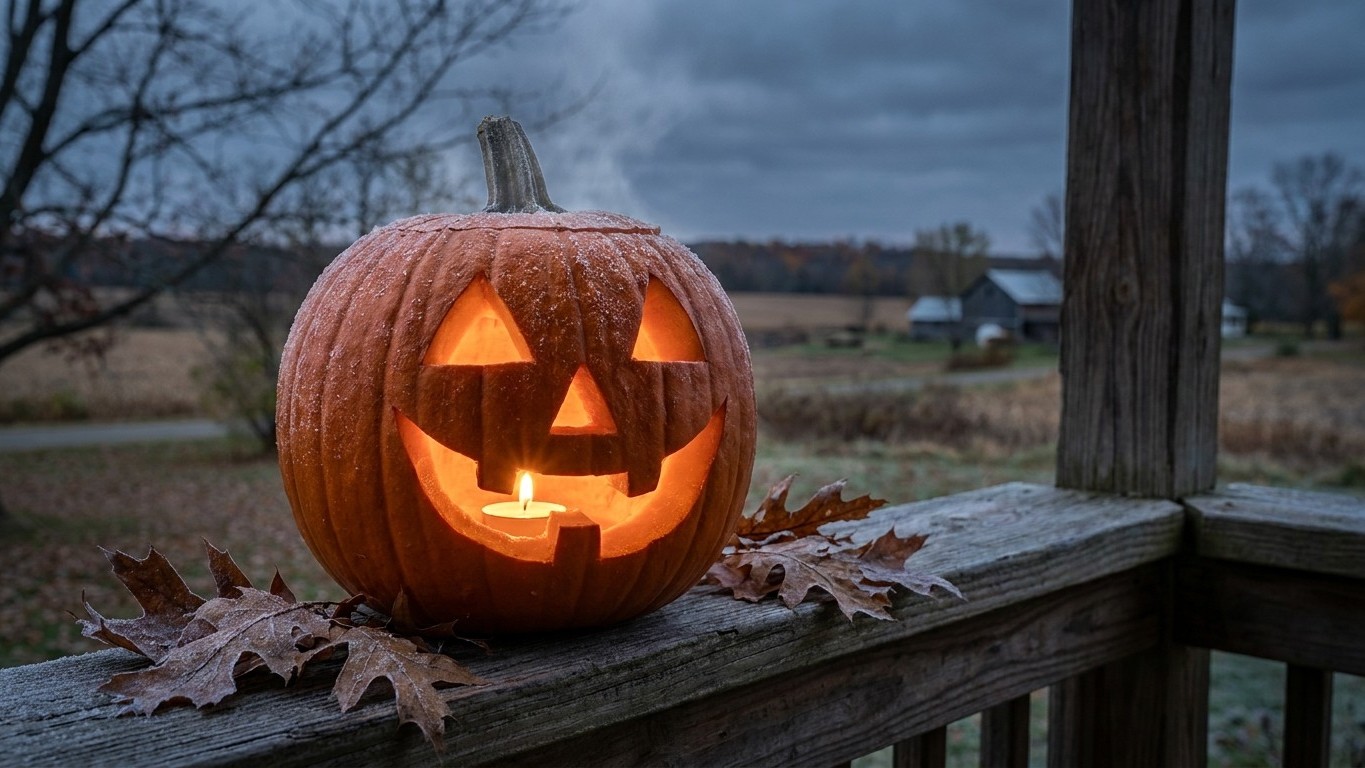

Around Halloween in Michigan, the first fall frost has often already come and gone in much of the state. That timing matters more than most carvers realize: it determines whether your pumpkin should go under the knife a week early or right up against the 31st. Here’s how to read your local frost window and pick the right day.
The short answer

Zone 6a in Michigan sees its mean first fall frost arrive around October 6 to October 21, according to the MSU Extension Michigan Garden Calendar. That’s a range, not a single date, and it lands well before Halloween on October 31 in most years. For anyone planning to keep a pumpkin looking good on the porch until trick-or-treaters show up, that gap is the whole story.
A pumpkin that gets carved too early sits exposed for two, sometimes three weeks before Halloween even arrives. During that stretch, the odds of a frost event, sometimes more than one, are already fairly high across most of the state. Frost doesn’t ruin a whole pumpkin the way it wrecks a carved one. An intact pumpkin has its rind as a barrier. Once you’ve cut into it, the exposed flesh is far more vulnerable to cold damage, and a light freeze can turn firm orange flesh into a soft, collapsing mess overnight.
So the practical window: aim to carve in the final three to five days before Halloween, not earlier. That’s not because a carved pumpkin has some fixed shelf life, no research body publishes that number, but because it shrinks the amount of time your jack-o’-lantern spends exposed during a period when frost is already a live possibility in a zone 6a location. The closer you carve to the 31st, the less exposure window you’re gambling with.
Keep in mind that “around October 6 to October 21” is an average drawn from decades of weather data, not a guarantee for any single year. Some years push frost later into the month, some years bring it earlier. Treat the range as a planning tool, not a countdown clock. If your area tends toward the earlier end of that window, lean toward carving closer to Halloween itself rather than the week before. If you’re farther toward the later end, or in a warmer microclimate near one of the Great Lakes, you may have a touch more flexibility, though “more flexibility” still means days, not weeks.
The bottom line for most of Michigan: buy early if you want the pick of the patch, but hold the knife until the pumpkin’s last few days before Halloween.
Frost or heat: which one gets it here
A whole pumpkin keeps best in a cool, dark spot between 45 and 50 degrees Fahrenheit, per University of Illinois Extension guidance. That’s a narrow band, and the question for any state is which direction local weather tends to push past it: too cold, or too warm. In Michigan, the answer is clearly cold.
The cold end
NOAA climate normal data for the 1991-2020 period puts the mean daily minimum Temperature for the coldest month, using Detroit as a reference station, at 19.2 degrees Fahrenheit. That’s a description of deep winter, not late October, but it tells you something useful: Michigan’s cold season arrives hard and fast once it gets going, and the state sits firmly on the freezing side of that 45-50 degree storage range for months at a stretch. A pumpkin left outside unprotected once temperatures drop toward freezing, which happens well before that January cold snap, is at risk. This is exactly why the mean first fall frost date matters so much here. It’s not a hardiness zone number, it’s the specific point in the calendar when overnight temperatures are expected, on average, to cross that freezing line for the first time.
The warm end
Excess heat is barely a factor in Michigan by late October. Unlike states where a warm autumn keeps temperatures above that 45-50 degree band and speeds up softening and mold, Michigan’s late-October air is typically already trending toward or below the cool end of the storage range, sometimes considerably below it. The risk here isn’t a pumpkin baking on a warm porch. It’s a pumpkin freezing on a cold one.
That distinction matters for how you plan storage. In a state where heat was the enemy, you’d focus on shade and ventilation. In Michigan, the priority flips: protect from cold snaps, frost, and freezing wind, especially once you’re within that early-to-mid October frost window.
Where to keep it until you carve
- Choose the right pumpkin first. Look for one with 1 to 2 inches of stem still attached. Once that stem breaks off, the spot where it was becomes an open wound and the pumpkin spoils there first. Skip anything with soft spots or blemishes; shape doesn’t matter, weight and firmness do.
- Store it whole in a cool, dark space. An unheated basement corner, an insulated mudroom, or an attached garage that doesn’t get direct sun tends to land closest to that 45-50 degree band in a Michigan home. A whole pumpkin kept this way holds for three to six months, per University of Illinois Extension, far longer than most people expect.
- Never carry it by the stem. That stem is the seal protecting the inside of the pumpkin, not a handle. Lift from underneath with both hands.
- Keep it away from ripening fruit. Apples, potatoes, and tomatoes all give off ethylene gas as they ripen, and that gas speeds up aging in the pumpkin sitting nearby. A porch table next to a bowl of apples is one of the worst spots you can pick.
- Bring it inside before hard frost nights. If it’s sitting outside for display, move it into that cool interior space, garage or basement corner, on nights when frost is forecast. A whole pumpkin can handle brief chill better than a carved one, but repeated freeze-thaw cycles still shorten how long it looks good.
- Wait to carve until the final stretch before Halloween. Once you cut into it, there’s no published research protocol for extending a carved pumpkin’s life, no bleach dip, no petroleum jelly trick, backed by extension science. The only reliable move is choosing a sound pumpkin, keeping it whole as long as possible, and carving close to the day you plan to display it.
Checking this against your own county
Frost timing shifts even within a single state. Coastal counties near Lake Michigan or Lake Superior often see a delayed first frost compared to inland areas, thanks to the moderating effect of the water. A pumpkin grower or carver in a county tucked along the western shoreline may have a few extra days of buffer compared to someone farther inland or in the Upper Peninsula.
For a frost date specific to your county, and for seasonal planting and harvest guidance built for Michigan conditions, MSU Extension is the resource to check. Their outreach office, reachable through canr.msu.edu/outreach, can connect you with county-level data and local horticulture staff who track these patterns year to year. It’s a better source than a national average, since Michigan’s geography, all that lake-effect influence, makes county-by-county variation more pronounced here than in flatter, more uniform states.
Common questions
Does a light frost ruin an uncarved pumpkin?
A brief, light frost usually doesn’t harm a whole pumpkin the way it damages a carved one. The rind acts as protection. Repeated hard freezes are more of a concern than a single mild frost event.
Can I carve my pumpkin two weeks before Halloween in Michigan?
You can, but given how early frost tends to arrive in zone 6a Michigan, a pumpkin carved that far out is exposed to a longer stretch of freeze risk. Carving closer to the final few days before Halloween reduces that exposure window.
Is there a trick to make a carved pumpkin last longer?
No university extension service publishes a preservation method for carved pumpkins, no bleach soak, no petroleum jelly coating, no verified home remedy. The only research-backed advice covers choosing a sound pumpkin and storing it whole until you’re ready to carve.
Why does the stem matter so much when picking a pumpkin?
The stem seals the spot where the pumpkin was attached to the vine. Once it breaks off, that area is exposed and becomes the first place the pumpkin starts to spoil. Look for 1 to 2 inches of stem still intact, and never lift the pumpkin by it.