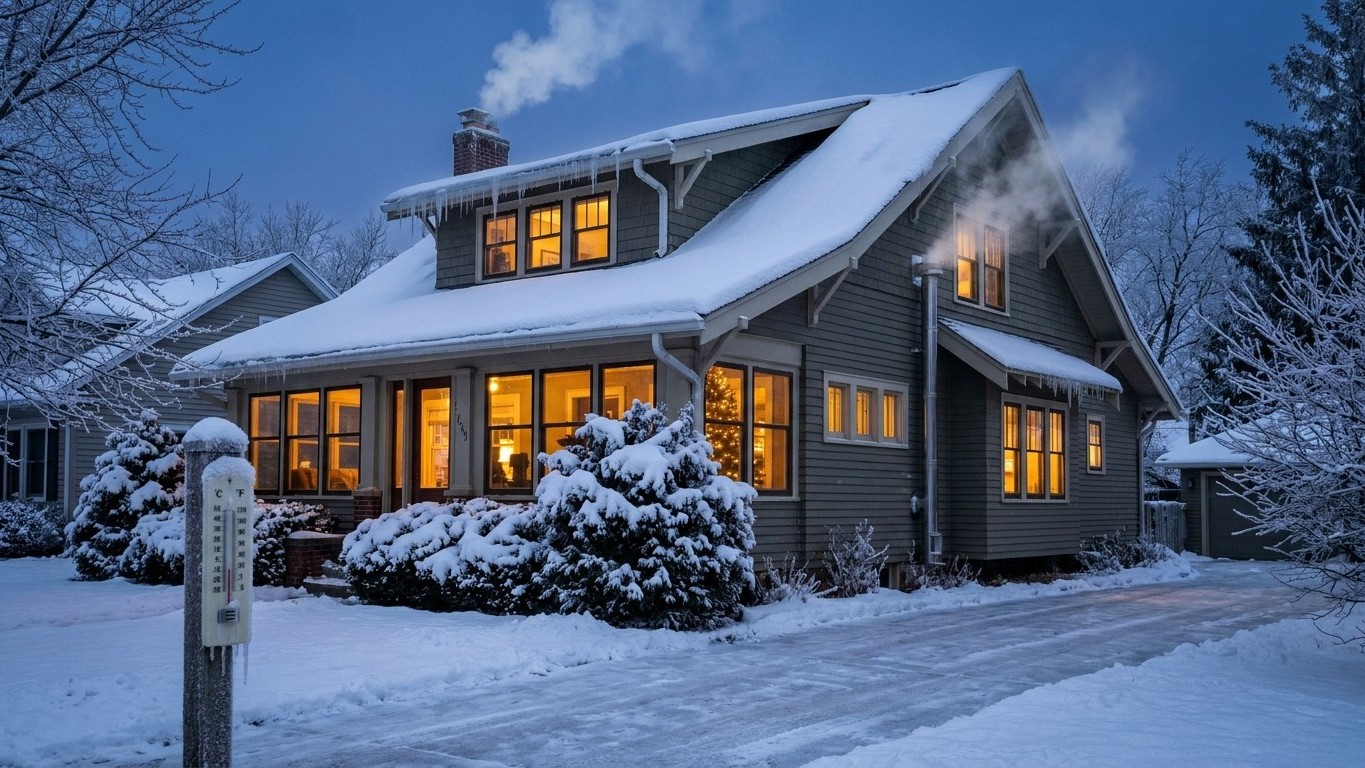

Indiana winters hover near freezing for months at a stretch, and the coldest month averages a low of 20.9°F. That single number shapes everything else here: how long a furnace runs, how much wood a stove burns through, and how much margin a household needs before the cold snap that always seems to arrive in January.
How cold it gets, and for how long

The 20.9°F figure comes from NOAA’s 1991-2020 Climate Normals for Indianapolis, and it measures the average daily minimum temperature in the coldest month, not the record low and not a monthly average. That distinction matters. A record low is a single bad night; this number describes what a typical night looks like, over and over, for weeks.
A house in Indiana doesn’t face one brutal week and then a break. It faces a heating season that typically stretches from October into April, with the core stretch of real cold running December through February. When Does the Heating Season Start in Indiana? and, just as important on the other end, When Can You Turn the Heat Off in Indiana? That’s four solid months where a furnace, a heat pump, or a wood stove is working every day, not just on the occasional cold snap.
Compare that to a Deep South climate where the coldest-month low sits well above freezing, and the equipment math changes completely. A heat pump that struggles below 20°F is a reasonable choice in a milder territory. In Indiana, that same equipment either needs backup heat or needs to be sized differently from the start. The same logic applies to wood heat: a stove sized for occasional shoulder-season fires in a mild climate will get run hard, and run often, in a Hoosier winter.
What this means practically is that Indiana homeowners are budgeting for sustained output, not peak output. The question isn’t “can my system handle the coldest night of the year.” It’s “can my system handle four months of nights like that one.” That’s a different design problem, and it’s the one that shapes every other decision below, from insulation upgrades to how many cords of wood get stacked before November.
What a cord of wood is worth here
A cord is a volume, not a weight, and that’s the detail that trips up a lot of first-time buyers. A cord measures 4 feet by 4 feet by 8 feet, which works out to 128 cubic feet of stacked wood. Two loads that look similar in a truck bed can hold very different amounts of actual wood depending on how tightly they’re stacked and how much air space sits between the pieces.
| Measurement | Value |
|---|---|
| Standard cord dimensions | 4 ft x 4 ft x 8 ft |
| Total volume | 128 cubic feet |
| Heat content (seasoned hardwood) | about 20 million BTU |
Michigan State University Extension puts that 20 million BTU figure into terms a homeowner can actually use: one cord of well-seasoned hardwood delivers roughly the heat of 145 gallons of #2 fuel oil, or about 215 gallons of LP gas. That’s a useful yardstick for figuring out how many cords a given winter is going to eat, especially in a climate where the burning season runs four months long.
That 20 million BTU number is an average, not a guarantee. Species density and moisture content move it substantially in either direction. A cord of dense hardwood that’s been properly dried will outperform a cord of the same species that’s still wet, and it will outperform a cord of lighter wood species by a wide margin. Green wood spends a large share of its heat just boiling off the water still trapped inside it, heat that never reaches the room. That’s the mechanism behind the next section, and it’s the single biggest factor in whether a cord actually delivers close to that 20 million BTU figure or falls well short of it.
How long wood takes to dry in Indiana
Wood needs to reach roughly 20 percent moisture content or less before it burns efficiently. Green wood, fresh off the tree, can sit above 60 percent moisture, and that gap is enormous. MSU Extension notes that split, stacked green wood usually reaches that 20 percent target after one full summer of drying, provided air can actually move through the stack. Rounds that never get split, or wood piled in a tight heap with no airflow, take much longer, sometimes a full year or more longer.
Indiana’s humid summers help and hurt in equal measure. Summer heat does the work of driving moisture out, but the region’s humidity slows the process compared to a drier climate. That’s part of why the “split and stacked” instruction isn’t optional advice, it’s the difference between wood that’s ready by fall and wood that’s still fighting its own moisture content when the first cold night arrives.
Red oak deserves a specific mention here. MSU flags it as an exception because its cell structure resists drying, so it needs more time than most other hardwoods common to the region. A red oak round split in spring and burned by the following November may still be well above that 20 percent target, even though it looks and feels dry on the outside.
Burning wood before it’s ready doesn’t just mean a weaker fire. The moisture still trapped in the wood absorbs heat as it boils off, so less warmth actually reaches the room and more of the fire’s energy goes up the flue as steam. That unburned moisture also condenses inside the chimney, where it combines with smoke particles to form creosote. A creosote buildup means a chimney that needs sweeping sooner than it otherwise would, and it raises the risk of a chimney fire. None of this requires alarm, it just requires stacking wood a year ahead rather than a month ahead.
Where to check before you buy
Everything above describes conditions at the reference station in Indianapolis, and Indiana covers a lot of ground beyond that single point. Elevation, exposure, and local microclimates shift the numbers around the state, and species availability varies by region too. Southern Indiana’s forests don’t match what’s common up near the Michigan line.
For guidance tuned to a specific county, the Purdue Extension office is the right first stop. It can speak to which hardwood species are actually available locally, how regional drying times compare to the statewide average, and what firewood suppliers are active in a given area.
It’s also worth checking on burn restrictions before stacking a season’s worth of wood. Air quality advisories and local burn ordinances are set at the county or municipal level in Indiana, and they change from year to year depending on conditions. What was allowed last winter isn’t automatically allowed this one, so a quick call or visit to the local extension office before buying in bulk saves a headache later.
What each heat source costs to run in Indiana
At Indiana’s average residential prices, this is what one million Btu of heat delivered into the house costs with each system. It compares fuels on the same unit: it is not a yearly bill, and it leaves out the price of the equipment.
| System | Cost per million Btu delivered |
|---|---|
| Electric resistance (baseboard, 100% efficient) | $49.94 |
| Heat pump at 8.1 HSPF2 (seasonal COP about 2.4) | $21.04 |
| Natural gas furnace at 97% AFUE | $11.42 |
Cheapest to run in Indiana: natural gas furnace, $9.62 less per million Btu than the heat pump.
Prices: U.S. Energy Information Administration (EIA), average residential prices. Efficiencies: ENERGY STAR criteria. A heat pump’s figure is a seasonal average; in the coldest weather its efficiency drops.