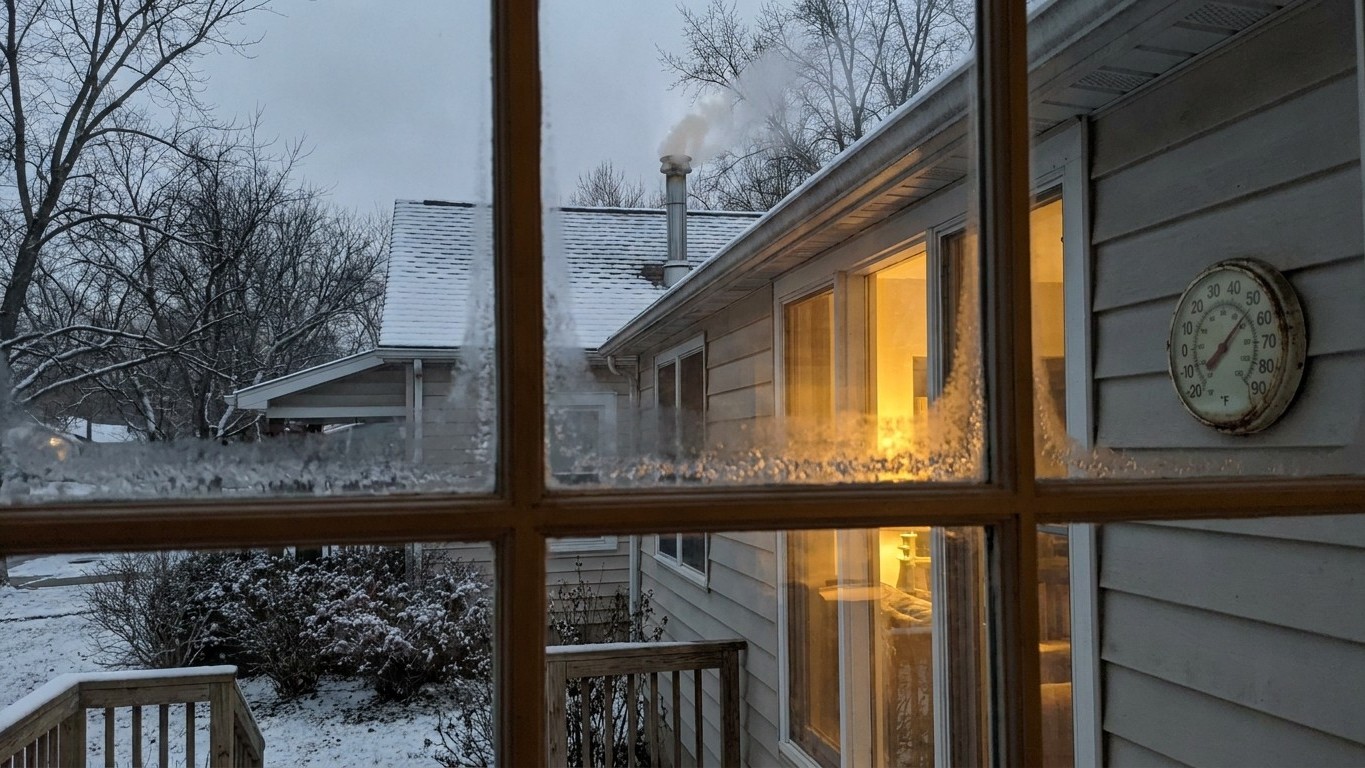

Kentucky winters hover close to freezing more often than they plunge deep below it, but that steady chill is exactly what drives up a heating bill. Knowing how cold it actually gets, and how a cord of wood measures up against that cold, changes how you plan for the season instead of reacting to it.
How cold it gets, and for how long

In Louisville, the reference station for the state, the coldest month averages a daily minimum of 27.8°F, according to NOAA’s 1991-2020 Climate Normals. That’s not a record low from some rare arctic blast. It’s the typical overnight floor, night after night, for the coldest stretch of the year. And that distinction matters more than people think.
A mean minimum sitting just below freezing describes a specific kind of winter: one that doesn’t spend weeks locked deep into single digits, but also doesn’t let a house coast. Pipes near exterior walls sit right at the edge of freezing risk on a regular basis, not just during a single cold snap. Heating systems don’t get to rest for long stretches, either. They cycle on through most of the night, all winter, because the outdoor temperature rarely climbs high enough to let them idle.
What this means for equipment
A climate that lingers near 28°F puts different demands on a furnace or a wood stove than one that swings to zero and back. Heat pumps, for instance, lose efficiency as the outdoor temperature drops, and a winter that spends four or five months hovering in the 20s and 30s keeps that efficiency loss in play for the whole season rather than for a few sharp weeks. Wood-burning households feel it too: a stove sized for occasional deep cold performs differently than one asked to run steadily through a long, moderately cold stretch.
None of this makes Kentucky’s winter extreme. It makes it persistent. When Does the Heating Season Start in Kentucky? The answer explains why it runs long enough that small inefficiencies, a drafty window, wood that wasn’t dry enough, add up across months rather than days. And knowing when that stretch finally loosens its grip matters just as much; see When Can You Turn the Heat Off in Kentucky? for how the shoulder season plays out.
What a cord of wood is worth here
A cord of well-seasoned hardwood delivers about 20 million BTU, according to Michigan State University Extension. That’s the average for dense, properly dried hardwood, and it’s worth pinning down what a cord actually is before comparing anything else, because the word itself is where most firewood buyers get shorted.
| Measurement | Value |
|---|---|
| Standard cord dimensions | 4 ft x 4 ft x 8 ft |
| Total volume | 128 cubic feet |
| Heat output (seasoned hardwood) | about 20 million BTU |
A cord is a stacked volume, not a weight, and that’s the whole trick behind buying it well. A load of loosely tossed, oddly cut wood might fill the same truck bed as a tightly stacked cord and still fall short of 128 cubic feet once it’s actually racked up. Density matters just as much. A cord of a dense hardwood packs more actual wood mass into that same 128 cubic feet than a cord of a lighter species, and more mass means more sustained heat from the identical stack size.
MSU puts that 20 million BTU figure into terms a household can actually compare: one cord of seasoned hardwood is roughly equal to the heat from 145 gallons of #2 fuel oil, or 215 gallons of LP gas. For a Kentucky winter that runs long rather than brutally cold, that’s the kind of steady, gradual draw that a couple of well-managed cords can meaningfully offset, though how many cords a specific house needs depends on the stove, the insulation, and how much of the heating load is meant to come from wood versus a furnace.
None of that value shows up, though, if the wood hasn’t dried properly first.
How long wood takes to dry in Kentucky
Seasoning is a moisture problem before it’s anything else. MSU Extension puts the target at 20 percent moisture or less for good burning, while green wood fresh off the tree can carry over 60 percent moisture. Every bit of that water has to boil off before the wood releases usable heat, which means a fire built from unseasoned wood is spending a chunk of its own energy just drying itself out as it burns.
Split and stacked properly, so air can move through the pile, most green hardwood reaches that 20 percent mark after one full summer of drying. Left in rounds instead of split, or stacked tight against a wall with no airflow, it takes longer, sometimes much longer, and there’s no fixed calendar date that guarantees readiness regardless of how it was handled. Red oak is the specific exception worth knowing: MSU notes it dries slower than most hardwoods because of its cell structure, so a red oak batch cut and split at the same time as other species may still need more time on the rack.
Burning too soon carries a real cost beyond a weaker fire. Wet wood produces more smoke and unburned particulates, and those condense in a cooler flue as creosote, the buildup responsible for most chimney fires and the reason a chimney needs sweeping more often when it’s fed unseasoned wood all winter. It’s not a dramatic risk if it’s caught early, it just means a shorter interval between cleanings and a noticeably weaker fire in the meantime.
Where to check before you buy
Every figure above describes Louisville, the state’s NOAA reference station, and Kentucky stretches across a good deal more terrain than that single city. Elevation, valley exposure, and local humidity all shift how cold a given county gets and how fast wood dries there, so a homestead in the eastern hills or a river-bottom property won’t necessarily match the Louisville numbers exactly.
For species availability in your specific area, and for any seasonal burn restrictions that might apply, the University of Kentucky Cooperative Extension Service is the right first stop. Burn rules, when they exist, are set at the local level and can change from year to year depending on air quality conditions or drought status, so it’s worth a quick check each season rather than assuming last year’s rules still apply. Local extension agents also know which hardwoods are actually common and affordable in a given county, which matters more for planning a wood-heat season than any statewide average ever will.
What each heat source costs to run in Kentucky
At Kentucky’s average residential prices, this is what one million Btu of heat delivered into the house costs with each system. It compares fuels on the same unit: it is not a yearly bill, and it leaves out the price of the equipment.
| System | Cost per million Btu delivered |
|---|---|
| Electric resistance (baseboard, 100% efficient) | $41.82 |
| Heat pump at 8.1 HSPF2 (seasonal COP about 2.4) | $17.62 |
| Natural gas furnace at 95% AFUE | $14.44 |
Cheapest to run in Kentucky: natural gas furnace, $3.18 less per million Btu than the heat pump.
Prices: U.S. Energy Information Administration (EIA), average residential prices. Efficiencies: ENERGY STAR criteria. A heat pump’s figure is a seasonal average; in the coldest weather its efficiency drops.