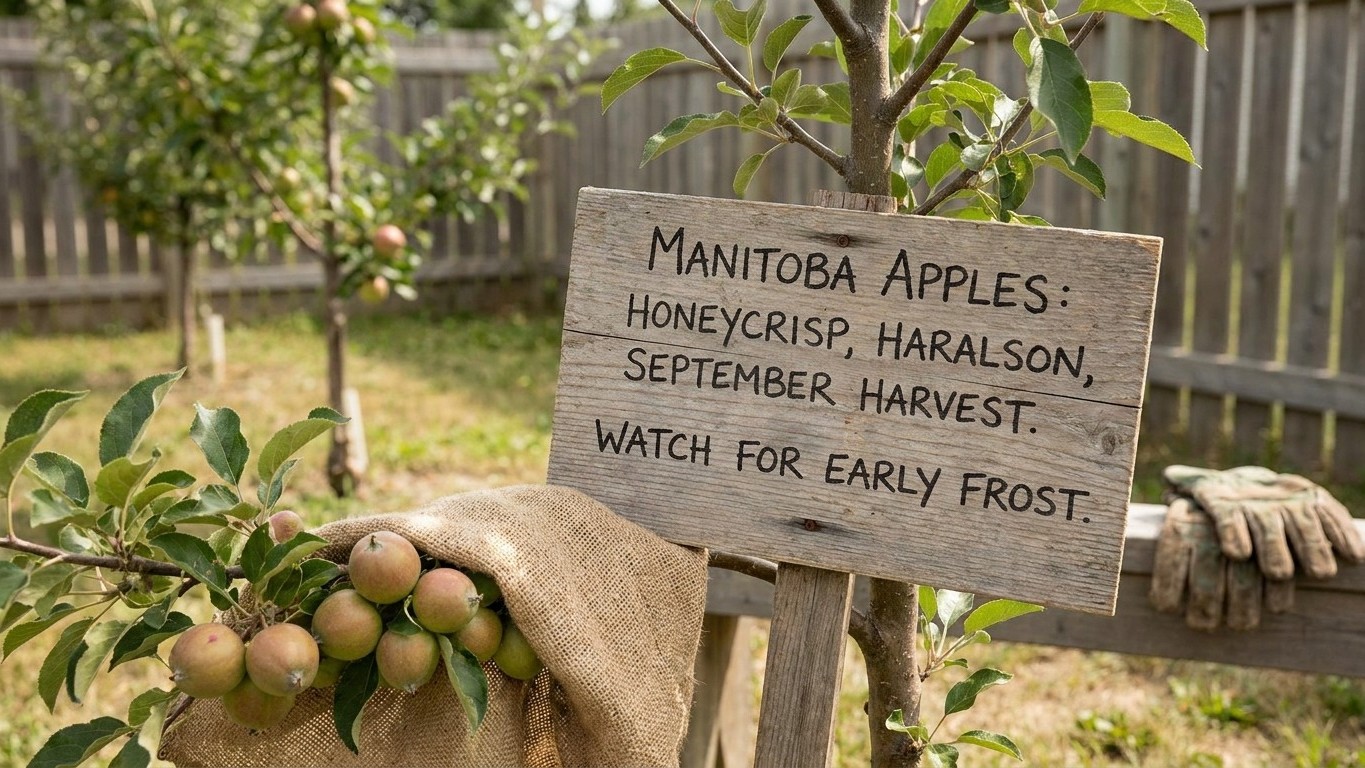

Minus six and a half degrees is the number Winnipeg averages on its coldest nights, and that single fact throws out most of what an apple catalog tells you. Those catalogs are built for zone 5 or 6 orchards, places that never see a cold snap like this one. Here the trees that live are the ones bred for zone 2 or 3 — Norland, Goodland, Parkland, Rescue — with Honeycrisp standing as the rare grocery-store name tough enough to join them.
Which varieties suit this climate

The hardiness filter
Winnipeg’s cold snaps are the first thing to plan around. Environment and Climate Change Canada’s 1981-2010 normals put the average minimum of the coldest month at -21.4 °C there, and most of southern Manitoba sits close to that reading, while northern districts and low-lying frost pockets run colder still. A variety rated for the mild range most American orchard catalogs are built around will not survive a Manitoba winter, where the Canadian plant hardiness zones run far colder. You need a cultivar bred for zone 2 or 3 cold, full stop — see The Best Apple Varieties for Manitoba for a full rundown of proven choices.
Honeycrisp is the one widely sold eating apple hardy enough to work here on its own roots, rated to zone 3 by most nurseries that carry it. Several older cultivars bred at the Morden Research and Development Centre in Manitoba were developed for exactly this cold: Norland, Goodland, Parkland and September Ruby are all published to zone 2, a full zone hardier than Honeycrisp needs, and the small crabapple Rescue matches them. Once you’ve settled on varieties, The Manitoba Apple Calendar, Stage by Stage lays out what to expect from bud break through harvest for each of them.
| Variety | Published hardiness | Type | Harvest season |
|---|---|---|---|
| Honeycrisp | Zone 3 | Eating apple | Early autumn |
| Norland | Zone 2 | Eating apple | Midsummer |
| Goodland | Zone 2 | Eating apple, McIntosh type | Late summer |
| Parkland | Zone 2 | Eating apple | Late summer |
| September Ruby | Zone 2/3 | Eating apple, McIntosh type | Early autumn |
| Rescue | Zone 2 | Crabapple, pollenizer | Late summer |
Winter chill is not the problem here
Winter chill is the other filter, and it cuts the opposite way in this climate. Low-chill varieties bred for the Deep South’s mild winters need only a modest number of hours below 45°F to break dormancy cleanly. Manitoba’s winters deliver many times that before the ground even thaws, so chill accumulation is never what limits an apple tree here. Skip any variety marketed as low-chill or bred for warm winters, not because the fruit won’t ripen but because that tree is built for a hardiness zone it will never see in Winnipeg.
Manitoba Agriculture does not publish a ranked variety list keyed to these climate figures, so treat the zone ratings above as the nursery’s own published data and confirm current availability with a prairie nursery or the extension service before you order trees.
Planting a pair that works here
Two trees, overlapping bloom
A single apple tree, even a fully hardy one, sets little fruit on its own. Apples need pollen carried from a different variety blooming at the same time, moved between the two trees by bees. Plant a pair rather than one specimen, and pick two whose bloom windows genuinely overlap rather than just two names off a hardiness list.
Bloom timing lines up more reliably among the Morden-bred cultivars than across a random pair pulled from a general mail-order catalog. Norland, Goodland, Parkland and September Ruby were bred and trialed together on the prairies and generally flower within the same window. The crabapple Rescue was bred specifically as a pollenizer for prairie orchards and blooms alongside the eating varieties, so it earns a spot in the yard even though its own fruit is small and mostly ornamental rather than something you’d eat fresh.
Where Honeycrisp and triploids complicate things
Honeycrisp blooms a little later than the older Morden cultivars in most nursery notes, so pair it with another mid-to-late bloomer rather than assuming any two hardy trees will overlap automatically. Skip triploid varieties as your only second tree; a triploid carries poor or sterile pollen and needs a third, fertile tree nearby just to set fruit itself, on top of failing to pollinate its partner. None of the cultivars named above are known triploids, which is one more reason they make a simpler pairing than a general nursery selection assembled without regard for this climate.
Growers working out the same pairing problem in New Brunswick run into it with imported varieties that bloom too early or too late for that region’s own frost window, the same mismatch that trips up Manitoba growers who buy on flavor alone and ignore bloom timing.
The frost that costs a crop here

The last frost is a midpoint, not a deadline
Winnipeg’s frost calendar is the figure that decides whether a Manitoba apple crop survives to harvest. Environment and Climate Change Canada’s 1981-2010 climate normals put the average last spring frost at Winnipeg at May 23, and that is a mean date, not a guarantee. In roughly half of all years the last frost falls later than that, sometimes by two weeks or more. Treat May 23 as the midpoint of a risk window rather than a green light, and expect districts north or west of Winnipeg to run behind it.
What a late frost actually kills
The frost that costs a crop arrives after the buds have already opened, not before. Apple wood itself tolerates hard cold; the tree survives temperatures far below anything a spring frost delivers. But once the buds reach the pink stage and the flowers open, a frost of only a few degrees below freezing kills the blossom tissue outright. The tree leafs out fine that summer. It just carries no fruit, because the flowers that would have become apples are already dead before the leaves even open.
There is not much a home grower can do to warm an orchard on a frosty May night. Covering small trees with old sheets or frost cloth overnight, watering the soil beforehand so it releases heat slowly through the night, and choosing a planting site partway down a slope rather than the lowest frost pocket all help at the margins. The real protection is a late-blooming variety, one that keeps its buds closed until the frost risk has mostly passed. Bloom timing among the prairie-bred cultivars runs a week or two apart from one to the next, so leaning your pollinizer pair toward the later-blooming end buys real insurance in a district where frost can still fall well into late May.
Growers in Colorado face a comparably late frost risk for a completely different reason, elevation rather than northern latitude, but the underlying rule is identical: it is the bloom stage that decides what a frost costs, not the calendar month it falls in.
The apple year in Manitoba
Stage by stage, anchored on Winnipeg’s frost dates
An apple tree’s calendar runs on stage, not on a fixed date, and each stage anchors loosely to Winnipeg’s own frost dates from Environment and Climate Change Canada’s 1981-2010 normals. Districts north or west of the reference station move through these stages later, sometimes by a couple of weeks, so use the stage in front of you rather than a date on a wall calendar.
- Dormancy: from leaf fall through winter, while the tree sits well below anything a live, awake bud could tolerate. Check trunk guards against sunscald and rodent damage; there is nothing else to do.
- Green tip: buds swell and show the first color as the ground thaws, generally as the season pushes toward the last-frost window. This is the last safe point to finish any dormant pruning.
- Pink: buds show color but have not opened. From here on, a frost damages the flower inside even though the bud still looks intact from the outside.
- Bloom: flowers open, typically close to the average last spring frost date of May 23 at Winnipeg, which is exactly why this stage carries the heaviest frost risk of the whole season.
- Petal fall: petals drop and pollinated flowers begin swelling into fruit. A light frost now costs far less than the same frost at full bloom, since the ovary has already started forming.
- Fruit set: the tree sheds some fruit naturally through early summer. Thin what remains by hand if a branch is carrying more apples than it can size properly.
- Harvest: timing depends on the variety, from midsummer for Norland to early autumn for Honeycrisp, and needs to wrap up well ahead of Winnipeg’s average first fall frost of September 22, since districts further north see that date arrive earlier still.
Local help
Manitoba Agriculture publishes provincial variety information and pest and disease spray guidance that goes well beyond what any general climate normal can tell you about a specific yard. Check the Manitoba Agriculture website before you order trees, since a local recommendation from that office carries more weight than a nursery catalog’s zone rating alone, and its spray timing accounts for pest pressure that varies by region. Confirm current variety availability and any regional cautions with them directly, since no figure in this article substitutes for a site-specific check.
Common questions
Can you grow apples farther north than Winnipeg in Manitoba?
Check with a prairie nursery or Manitoba Agriculture before planting in a northern or high-elevation district.
Is Honeycrisp self-pollinating so I only need one tree?
No. Honeycrisp needs a second variety blooming nearby with fertile pollen, and a lone tree typically blooms well but sets little or no fruit. Plant a compatible second tree, not a single specimen, even if the catalog description doesn’t mention it.
Does planting against a south-facing wall help avoid frost damage?
It can backfire. A warm wall pushes bud break earlier in spring, which often moves the bloom into an earlier, still-risky part of the frost window rather than past it. A more open site that warms up gradually tends to delay bloom slightly and can be safer for this specific risk.
What rootstock should I use for this cold a climate?
Rootstock hardiness matters as much as the scion variety, and dwarfing rootstocks are frequently less cold-hardy than seedling or Antonovka rootstock.
My tree bloomed fine but set no fruit at all, what’s wrong?
The most common cause is a missing or poorly timed pollinizer, not disease or nutrition. Check whether a second, compatible variety was blooming at the same time close enough for bees to move between the two trees in the same visit, and confirm neither tree is a triploid relying on a partner that also needs its own pollinizer.