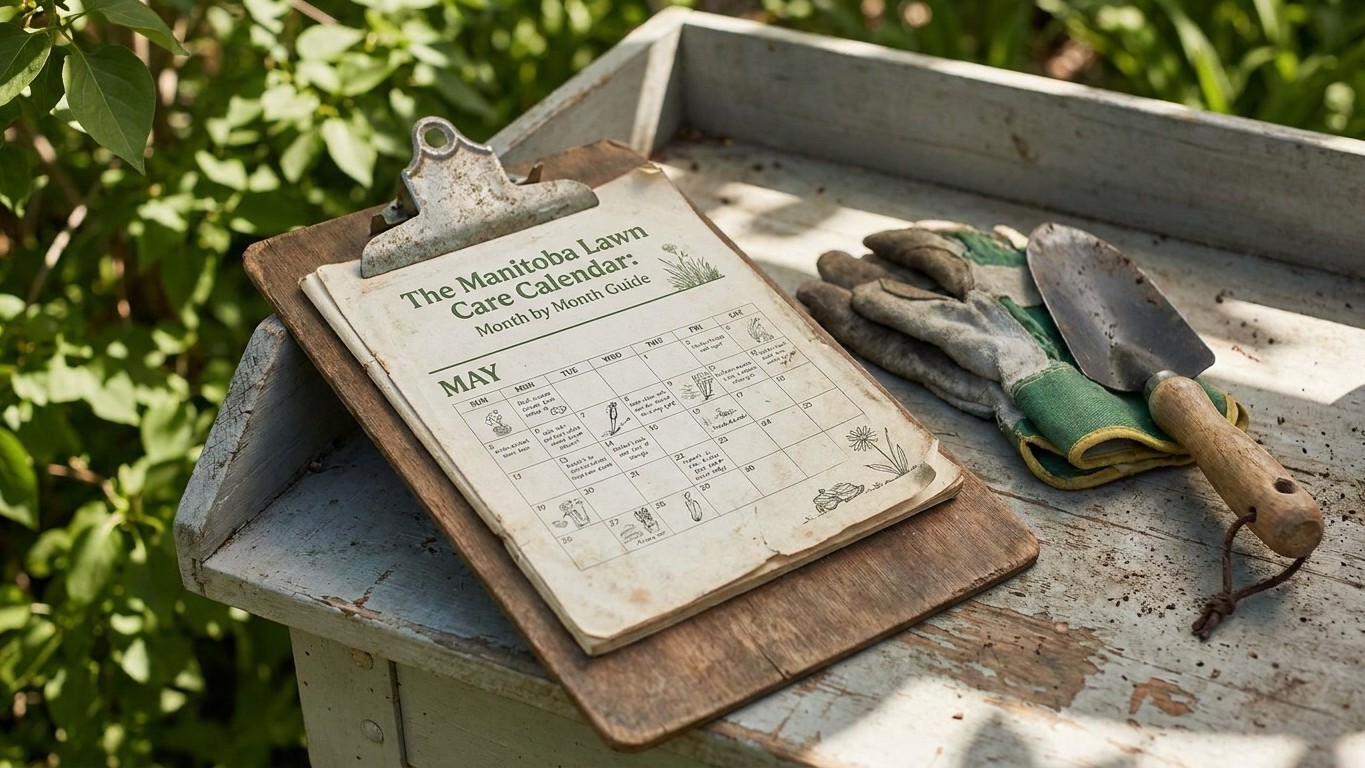

Manitoba lawns are cool-season lawns, full stop. The species that hold up here are Kentucky Bluegrass, Fine Fescues, Tall Fescue, Perennial Ryegrass and Rough Bluegrass, the group Clemson Cooperative Extension’s HGIC 1214 and Penn State Extension both classify as cool-season turf. Environment and Climate Change Canada’s 1981-2010 climate normals put the average first fall frost at Winnipeg Richardson Int’l A at September 22, though it lands later than that in roughly half of all years. The action that follows: finish any fall seeding or overseeding with real margin before that date, not on it.
The short answer for Manitoba
What actually grows well in your yard here comes down to one thing: Manitoba is cool-season turf country, no exceptions, so the calendar you follow has to bend around cold, not heat. Kentucky Bluegrass, Fine Fescues, Tall Fescue, Perennial Ryegrass and Rough Bluegrass are the only species worth your effort. So before you touch a mower or a seed bag, walk the yard and figure out which of those five is already out there — that one fact decides how you feed it, cut it, and when you seed it this fall.
What the calendar you actually follow depends on is simpler than it looks: which of those five species is already growing in your lawn, how much shade and traffic it takes, and whether you’re gardening near Winnipeg’s clay-heavy Red River Valley or somewhere the season runs shorter. A Kentucky Bluegrass lawn wants a different mowing and nitrogen rhythm than a Tall Fescue stand, and sorting that out before you seed anything is worth the extra week; the full comparison lives in The Best Grass Seed for Manitoba Lawns.
Soil matters too. Heavy clay common through the Red River Valley holds spring moisture longer and drains slower after summer storms, which shifts the safe mowing and aeration window compared with sandier ground toward the Manitoba escarpment. None of the warm-season species sold on some big-box seed racks, Bermudagrass, Zoysia, St. Augustine, do not belong on a Manitoba lawn. They go dormant at temperatures cool-season grass shrugs off, and through a Manitoba winter they simply die rather than brown and wait for spring.
Working through the year

Manitoba lawns run on a cool-season rhythm: growth peaks in the cooler weeks of spring and fall, and slows or stalls in the peak heat of summer. Clemson Cooperative Extension’s HGIC 1219 Tall Fescue Maintenance Calendar lays out the general shape any cool-season lawn follows, even though its numbers were built for a different climate and need to be read against Manitoba’s own frost timing.
| Season | Mowing | Nitrogen | Key task |
|---|---|---|---|
| Spring | Higher end of cutting range | Light, once growth starts | Pre-emergent if crabgrass has been a problem |
| Summer | Raise height further, mow less often | Minimal to none | Deep, infrequent watering |
| Fall | Gradually lower as growth slows | Heaviest feeding of the year | Aeration and overseeding, finished with margin before frost |
| Winter | None | None | Keep traffic off frozen or frost-heaved turf |
Spring
Once the ground has thawed and the grass is actively greening, mow at the higher end of its recommended cutting height rather than scalping it, the same principle HGIC 1219 applies to spring tall fescue care, since a taller blade shades the soil and slows weed germination. This is also the window for a pre-emergent herbicide if crabgrass has been a recurring problem, applied before soil has warmed enough for seed to germinate rather than after you’ve already seen it come up. Hold off on heavy nitrogen until growth is well underway. A light spring feeding supports the flush without pushing soft, disease-prone top growth.
Summer
Cool-season grass does not want to be pushed hard through Manitoba’s hottest weeks. Raise the mowing height further rather than cutting close, water deeply and infrequently rather than little and often so roots follow the moisture down, and skip nitrogen almost entirely until the heat breaks. A lawn that goes brown and crisp in a dry August stretch is not dead, it’s dormant, and it greens back up once cooler, wetter weather returns.
Fall
Fall carries the heaviest work of the year for cool-season turf, and Clemson’s calendar puts most of a tall fescue lawn’s nitrogen budget here rather than in spring. Cool soil and cool air favor root and seedling establishment over top growth, which makes fall the best window for core aeration and overseeding. In Manitoba that work needs to finish with real margin before the season turns: Environment and Climate Change Canada’s average first fall frost at Winnipeg Richardson Int’l A is September 22, and since that’s a mean rather than a hard cutoff, seed put down in the first half of September has time to root before the odds of a killing frost climb.
Winter
Once growth stops for the year, mowing and feeding stop with it. The main task left is keeping heavy foot traffic and equipment off frozen or frost-heaved turf, since crushed cool-season crowns under ice and snow are slow to recover the following spring.
What changes across Manitoba
Every date and rate in this calendar is read from Winnipeg Richardson Int’l A, and Manitoba is a large province with a lot of ground that doesn’t behave like the capital.
The Interlake region, the strip of land between Lake Winnipeg and Lake Manitoba, sits under the moderating and sometimes destabilizing influence of two large lakes. Spring green-up there can lag Winnipeg by weeks rather than days, and a cold snap off the lake can knock back tender new seedlings well after the capital’s soil has warmed. Higher ground to the west, around the Riding Mountain area, runs on a similarly delayed schedule for the same reason elevation always works: cooler nights persist later into spring and arrive earlier in fall.
Northern Manitoba, from around The Pas up toward Thompson and beyond, is a different climate outright. Environment and Climate Change Canada’s own caution on the Winnipeg normals notes that northern and upland districts run weeks behind the reference station, so a grower there should treat every date in this calendar as a starting point to push later, not a fixed target.
The Red River Valley’s heavy clay, the same soil that makes the region excellent farmland, drains slowly after spring melt and again after fall rain, which pushes safe aeration timing a little later than it would be on the sandier soils found toward the Manitoba escarpment in the southwest. Wet clay compacts under an aerator’s tines instead of coring cleanly, so waiting for the surface to firm up matters more here than the calendar date does. None of this changes which grasses belong on a Manitoba lawn, only when the calendar built around them should shift.
The mistakes this climate punishes
Seeding too late is the most common one. Cool-season grass seed needs several weeks of soil warmth to germinate and root before growth slows for winter, and pushing an overseeding job into the back half of September gambles against Environment and Climate Change Canada’s own numbers, which put the average first fall frost at Winnipeg Richardson Int’l A on September 22, with roughly half of all years running later and half running earlier or on time. Seed that hasn’t rooted by then sits exposed through the first freeze and often needs redoing in spring.
Cutting too short through summer is the second. A cool-season lawn mowed close in July or August loses the shade its own blades cast over the soil, and the crown and root system take the heat stress directly instead of through a buffer of leaf tissue. The damage doesn’t always show immediately. It shows up two or three weeks later as thin, yellowing patches that look like disease but are really just a scalped lawn baking in the sun.
Feeding heavily in spring and skipping fall is the third, and it runs backwards for this climate. A big spring nitrogen dose pushes fast, soft top growth right as summer heat and any drought stress arrive, leaving a lawn with more leaf than root heading into the hardest stretch of the year. Clemson’s HGIC 1219 calendar puts the heavier feeding in fall for exactly this reason: cool-season grass uses fall nitrogen to build root and store energy rather than to grow taller, and that root reserve is what carries it through summer.
Planting a warm-season species because a bag was cheap or on sale is the fourth, and the least forgivable, because it fails every time in this province. Bermudagrass and Zoysia are built for climates that don’t freeze the way Manitoba does. They don’t go semi-dormant and wait out winter here, they die, and the failure shows up as a lawn’s worth of bare dirt the following spring.
Checking this against your county
Every figure above comes from a single weather station and a set of extension calendars built for other climates, adapted here for Manitoba’s cool-season lawns. For local soil test recommendations, current pesticide and fertilizer rules, and any pest or disease pressure specific to your municipality, check with Manitoba Agriculture, the province’s own extension service, at gov.mb.ca/agriculture. If you’re just getting a new lawn established, the basics of site prep, soil, and seeding down a Manitoba lawn are covered in Manitoba Lawn Care before you ever reach this calendar.
Common questions
When should I overseed my Manitoba lawn?
Aim for the first half of September, not the date of the average frost itself. Environment and Climate Change Canada’s 1981-2010 normals put the average first fall frost at Winnipeg Richardson Int’l A on September 22, but that’s a mean, and seed needs several weeks of warm soil to root before a freeze, so waiting until mid-September or later leaves little margin.
Can I grow a warm-season grass like Zoysia in Manitoba?
No. Zoysia, Bermudagrass and other warm-season species are built for climates that don’t freeze hard through winter, and in Manitoba’s cool-season classification they die rather than go dormant. Stick to the cool-season list: Kentucky Bluegrass, Fine Fescues, Tall Fescue, Perennial Ryegrass or Rough Bluegrass.
Why does my lawn look dead by late summer?
It’s most likely dormant, not dead. Cool-season grass browns and stops growing under summer heat and dry stretches as a survival response, and it typically greens back up once cooler, wetter fall weather arrives. Give it a few weeks after conditions improve before assuming it needs reseeding.
Is one mow-and-feed schedule the same for the whole province?
No, and treating it that way is a common mistake. The dates in this calendar are anchored to Winnipeg Richardson Int’l A, and areas near Lake Winnipeg’s Interlake region, higher ground to the west, and especially northern Manitoba all run behind that schedule by anywhere from days to weeks, so use this calendar as a starting point and adjust based on what you actually see in your own yard.