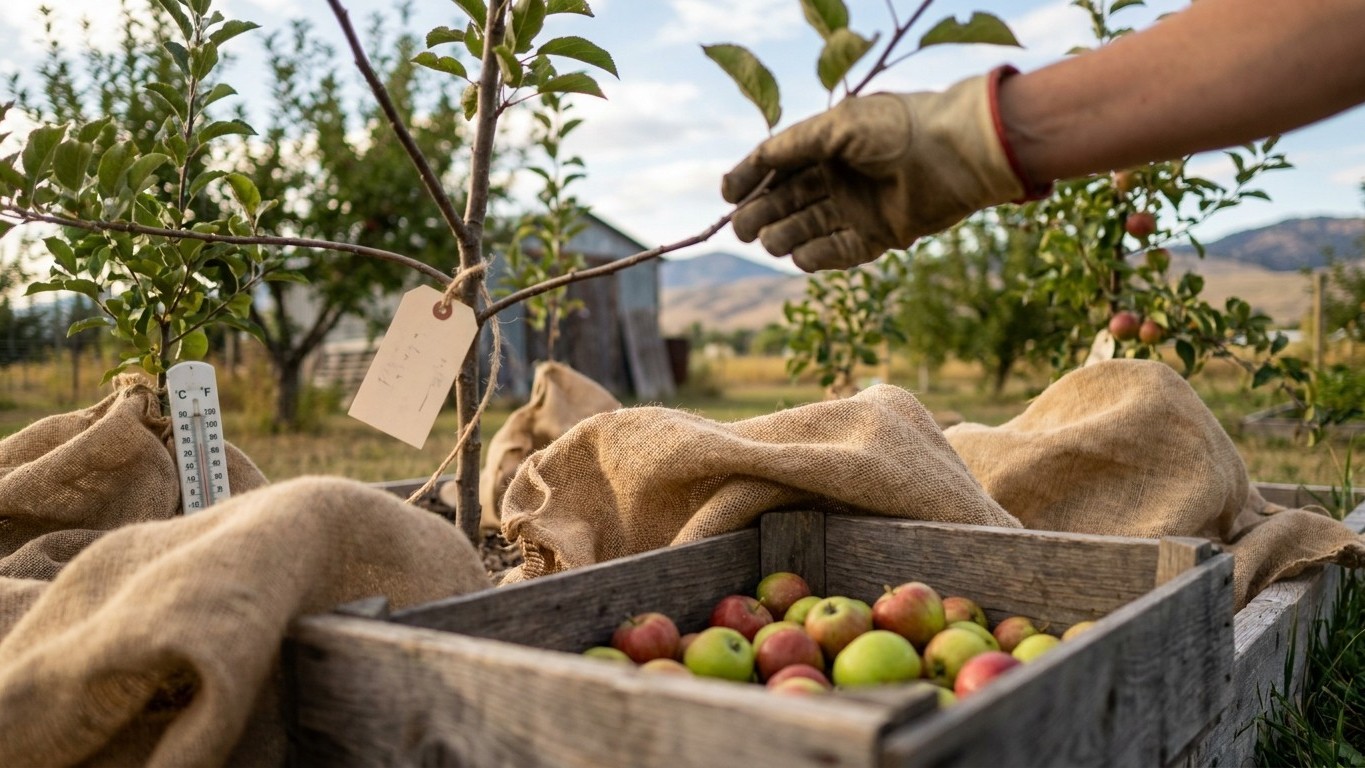

Zone 3a to 6a is the spread that decides everything in Montana apple-growing, and it’s why the same state can hold a thriving orchard and a hillside where fruit trees simply give up. A river valley traps warmth a mountain bench never sees. Billings, with its long weather record, averages 17.8°F on the coldest month’s low — survivable for a hardy tree, brutal for anything bred in the mid-Atlantic or the Pacific Northwest. That single number, more than soil or sun, sorts which varieties are worth planting and which are wishful thinking.
Can you grow apples in Montana
Apples have been grown in Montana for well over a century, mostly in the river valleys where the growing season runs long enough and winter lows stay survivable for a hardy tree. The USDA Plant Hardiness Zone Map, using the 2023 edition built on 1991-2020 normals, places the state across zones 3a to 6a, a wide spread. A Bitterroot Valley orchard and a bench above the Yellowstone River are not gardening in the same climate, even though both sit inside Montana’s borders.
Billings is used here as the reference city because it has a long NOAA weather record, and it sits toward the milder end of that range. NOAA’s National Centers for Environmental Information put the average minimum Temperature of the coldest month at Billings at 17.8°F across the 1991-2020 normals period. That is a monthly average low, not the record cold snap of a hard winter, and it is enough to rule out apple varieties bred for the mid-Atlantic or the Pacific Northwest without ruling out apples altogether.
Higher, colder valleys west of the Continental Divide and mountain benches at elevation run closer to zone 3a, where only the toughest cultivars set fruit reliably. Lower river valleys around Billings, the Yellowstone bench country, and similar warmer pockets sit closer to zone 5a-6a and give a grower more variety choice and a longer, more forgiving season. Where you sit in that range decides which cultivars are worth planting, not whether apples belong on your property at all.
A gardener in a zone 3a mountain valley and one on a zone 5a bench both grow apples in Montana. They just grow different ones, on different timelines, with different frost margins — a point covered in more depth in The Best Apple Varieties for Montana. Montana orchardists have long favored planting on a gentle slope with good air drainage rather than in the bottom of a valley, since cold air pools in low ground on clear nights and can turn an ordinary spring frost into a harder one right where the trees stand. A site just a little higher than the surrounding land, out of the frost pocket, buys real margin without changing the calendar at all, and that calendar is laid out in detail in The Montana Apple Calendar, Stage by Stage.
Which varieties suit this climate

Start from hardiness, then filter by chill. A variety’s catalogue hardiness zone tells you whether the wood survives a Montana winter. It says nothing about whether the tree flowers well the following spring, and the two questions have different answers.
Hardiness first
Several cultivars bred specifically for northern winters carry a published hardiness rating down to zone 3, which covers even the coldest valleys in the state. ‘Honeycrisp’, ‘Haralson’, ‘Zestar!’, ‘State Fair’ and ‘Norland’ are all rated hardy to USDA zone 3 on their nursery tags, and all of them are widely sold through mail-order nurseries that list zone ratings at purchase. ‘Sweet Sixteen’ and ‘Wealthy’ run hardy to zone 3-4 as well and are worth asking for by name if a local nursery stocks them. None of these figures change with the county. They come from the breeder’s or nursery’s published catalogue rating, the same figure printed on the tag whether the tree ships to Montana or Vermont.
| Variety | Published hardiness zone | Bloom timing | Typical use |
|---|---|---|---|
| Honeycrisp | 3-8 | Mid-season | Fresh eating |
| Haralson | 3-7 | Mid-season | Baking, fresh eating |
| Zestar! | 3-7 | Early | Fresh eating, early harvest |
| State Fair | 3-7 | Early | Fresh eating |
| Norland | 2-7 | Early | Fresh eating, cooking |
| Sweet Sixteen | 3-7 | Mid-season | Fresh eating |
Chill is the filter most guides skip
Apple varieties need a certain number of hours below roughly 45°F to break dormancy evenly and flower well, a requirement called winter chill. Montana sits at the high-chill end of the national range, with winters long and cold enough that chill accumulation is rarely the limiting factor the way it is in the Deep South. A low-chill variety bred for a mild climate such as coastal Georgia or California’s Central Valley will still flower in a Montana spring, but it wastes the genetics. Those varieties are bred to break dormancy on a short, mild winter, not to survive one that runs into April. Compare a warm, low-chill growing region like Growing Apples in Nevada: Varieties, Timing and Frost Risk, where the chill and frost calculus runs the opposite direction and low-elevation valleys flower far earlier, needing very different variety choices entirely.
In Montana, the safer rule is to pick a cultivar bred by a northern program, Minnesota, South Dakota or Manitoba among them, for exactly this kind of winter, since those programs select for cold hardiness and adequate chill in the same stroke. No Montana State University Extension variety list with named local recommendations appears in the sources available here, so treat the cultivars above as catalogue-hardy choices to confirm against the nursery tag and, where possible, against local extension guidance before you order.
Planting a pair that works here
Almost every apple variety needs a different variety blooming at the same time nearby to set fruit at all; a single tree alone in a yard usually blooms and drops most of its flowers unfertilized. Pick two varieties from the hardy list above that bloom in the same window, rather than assuming any two apple trees will do the job.
Among the zone-3 cultivars named above, ‘Zestar!’, ‘State Fair’ and ‘Norland’ bloom early, while ‘Honeycrisp’, ‘Haralson’ and ‘Sweet Sixteen’ bloom mid-season. Pairing an early bloomer with another early bloomer, or a mid-season bloomer with another mid-season one, gives the overlap a pollinator actually needs. Pairing ‘Zestar!’ with ‘Honeycrisp’ works less reliably in a short mountain season, since their bloom windows may barely overlap, or not at all in a year when a late cold spell delays one variety more than the other.
A smaller number of apple varieties, mostly older heirloom triploids such as ‘Gravenstein’ and ‘Baldwin’, carry pollen that is effectively sterile. They need two other varieties nearby, one to pollinate the triploid and a second variety that the triploid cannot pollinate back. None of the zone-3 cultivars named above are triploid, but if you plant an heirloom variety alongside them, check its pollen status before counting on it as the pollinator for anything else in the yard. A crabapple such as ‘Chestnut Crab’ or ‘Dolgo’, both hardy well into zone 3, works as a reliable belt-and-suspenders pollinator to add to any pair, since crabapples bloom over a long window and produce abundant fertile pollen.
Bees do the actual work of moving that pollen, and a cold, wet week during bloom keeps them in the hive regardless of how well the two varieties’ flowering dates line up on paper. Planting the pair within about fifty feet of each other, rather than at opposite ends of a large lot, gives the bees a shorter, more likely trip between them.
The frost that costs a crop here

NOAA’s NCEI 1991-2020 climate normals put the last spring freeze at Billings, in the 32°F probability band, between April 29 and May 10. That is a range, not a date, because freeze risk tapers off gradually rather than stopping on a single day, and Billings is one of the milder valleys in the state. Mountain valleys elsewhere in Montana carry real frost risk into any month of the growing season, so treat the Billings window as the mild-valley end of the state’s range, not a statewide guarantee.
What the frost actually kills
The tree survives a spring frost almost every time. What a frost after the buds show pink kills is the flower, not the wood, and once the flower is dead the crop for that year is gone even though the tree leafs out fine and looks completely healthy a week later. A grower who sees a normal-looking tree in June with no apples on it is usually looking at a bloom that froze in April or May, not a disease or a pest problem.
Once buds move past the tight, dormant winter stage into green tip and then pink, they lose cold tolerance fast. A dormant bud can shrug off temperatures a blooming flower would not survive at all. That is the whole reason nurseries and extension bulletins talk about frost risk by bud stage rather than by calendar date. The same cold snap that does nothing to a dormant bud can wipe out a bloom that opened early after an unusually warm week.
There is not much a home grower can do about an already-open bloom in a hard freeze beyond small-scale tricks: covering a small tree with a bedsheet or frost cloth overnight, running a sprinkler to coat buds in insulating ice before a clear, cold night, or siting the orchard on a slope where cold air drains away instead of pooling. None of those buy more than a few degrees of protection. The real insurance is choosing a later-blooming variety in a valley where frost historically arrives late, since a bloom that opens after the risk window has mostly passed does not need protecting in the first place. Growers in similarly short-season, frost-prone climates such as Growing Apples in Newfoundland and Labrador: Varieties, Timing and Frost Risk face the same bud-stage logic, even though their frost dates and hardy variety list differ entirely from Montana’s.
The apple year in Montana
Apple timing in Montana is read off the tree’s stage, not a date on the wall, because a warm week can push a bud from dormant to pink faster than the calendar suggests, and a cold spell can hold it back just as fast. The stages below are anchored on the Billings frost window from NOAA’s 1991-2020 normals, last spring freeze April 29 to May 10 and first fall freeze October 1 to October 14, and they shift earlier or later in a valley with a different frost record.
- Dormancy (winter into early spring): the tree is fully cold-hardy in this stage. This is the window for pruning and for planting a new bare-root tree, before any growth starts.
- Green tip (roughly a month before the last-frost window opens): buds swell and show the first green. Cold tolerance starts dropping from here on.
- Pink (days to two weeks before bloom): flower buds show color but have not opened. This is the last stage before frost sensitivity becomes serious.
- Bloom (typically overlapping the Billings last-frost window of April 29 to May 10, later in colder valleys): the flower is at its most frost-vulnerable stage of the whole year, and pollination has to happen now for any fruit to set.
- Petal fall and fruit set: pollinated flowers begin swelling into fruit. Thin overcrowded clusters down to one fruit each around now, to get size instead of a heavy load of small apples.
- Fruit development (summer): consistent water during dry stretches matters more than anything else at this stage, since erratic watering is what causes cracked skin later.
- Harvest (before the first fall freeze, October 1 to October 14 at Billings, earlier at elevation): pick by taste and by how easily the fruit separates from the branch, not by a date, since a variety’s ripening window shifts with the season the same way bloom does.
Because Billings runs milder than most of the state, a grower in a higher valley should expect every stage on this list to run later in spring and to close out earlier in fall, compressing the whole growing season into a narrower window than the Billings dates imply.
Local help
Montana State University Extension is the best source for variety lists tailored to specific counties and for spray timing calibrated to the state’s actual pest pressure, both of which change from one valley to the next in ways a national guide cannot capture. Contact the Montana State University Extension office and ask before finalizing a variety order whether it maintains a tested list for your elevation and valley, and confirm current spray guidance before you set a schedule.
Common questions
Can I grow apples in Montana without a greenhouse or wall shelter?
Yes, in most valleys a cold-hardy cultivar rated to USDA zone 3 or 4 grows outdoors with no structure at all. A greenhouse only becomes worth the trouble at the coldest, highest elevations, and even there most growers do better picking a hardier variety than trying to shelter a tender one.
Do I really need two different apple trees, or will one tree eventually fruit alone?
One tree alone almost never sets a useful crop, because nearly all apple varieties need pollen from a different variety blooming at the same time. A handful of varieties are described as partially self-fruitful, but even those crop far better with a second tree nearby, so plan for a pair from the start rather than hoping to add one later.
My county’s frost dates seem different from the Billings figures in this article. What should I do?
Trust your own valley over the Billings numbers. NOAA’s climate normals are published station by station, so check the record for the weather station nearest you, or ask Montana State University Extension whether they track a local frost record for your county, since mountain valleys can run weeks behind or ahead of the Billings dates.
Will covering my tree with plastic sheeting protect the bloom from frost?
Plastic sheeting can trap enough heat to help a small or dwarf tree through a light, short frost overnight, but it does little for a full-size tree and nothing against a hard, prolonged freeze. Frost cloth or an old bedsheet, removed the next morning, works about as well and is easier to manage than plastic.
Can I grow an apple tree in a container through a Montana winter?
You can, but the roots are less cold-hardy than the top growth, and a pot offers far less insulation than the ground does. Move the container into an unheated garage or shed for winter, or bury the pot to its rim in soil or mulch, rather than leaving it exposed above ground on a deck or patio.