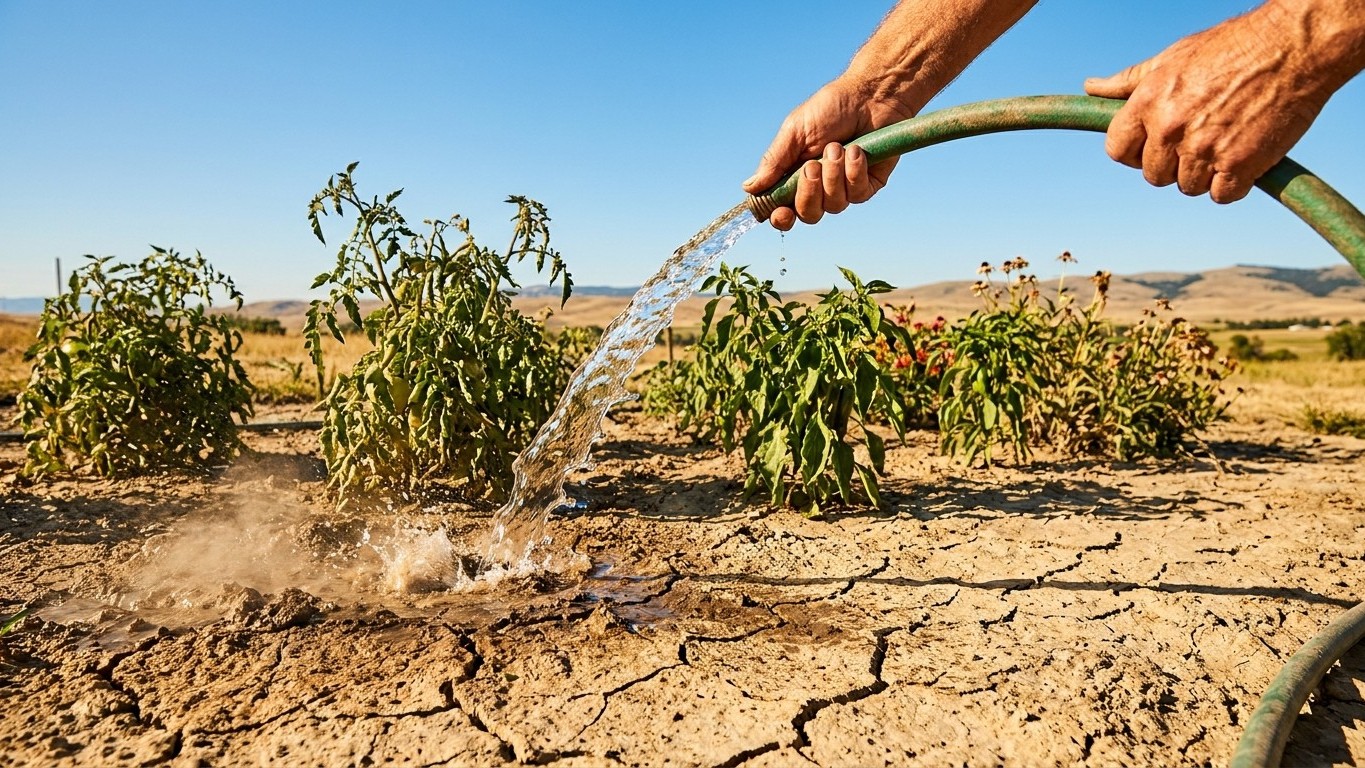

Montana’s growing season delivers barely a third of an inch of rain a week during its driest month, while nearly a month’s worth of days climb past 90F. That gap between what falls and what plants need is the whole story of summer watering here: the sky covers a small slice of the bill, and the gardener covers the rest, on a schedule dictated by heat rather than habit.
What changes here

August is the driest month of the Montana summer, averaging 0.87 inches of rain, and the region also averages 28.3 days a year at or above 90F. Put those two together and you get a simple working rule: the hottest stretch of summer is also the stretch when the sky contributes least, so irrigation has to fill nearly the whole gap rather than top off what rain already provided.
A vegetable bed or a young perennial planting generally wants about an inch of water a week. Spread August’s 0.87 inches over roughly 4.4 weeks in the month, and the sky is delivering something close to 0.2 inch in an average week, not the full inch. That leaves about 0.8 inch a week for the gardener to supply by hose or drip line, in a month when 90-degree days are also pulling moisture out of the soil faster than it would evaporate in June.
| Month | Average rainfall |
|---|---|
| June | 2.22 inches |
| July | 1.22 inches |
| August | 0.87 inches |
The table shows the slide isn’t gradual. June still carries more than two inches, close to what many beds want on their own. By August, rainfall has dropped to less than half of July’s total, right as the days-above-90 count is doing most of its work for the year. That’s the month irrigation habits actually get tested.
Soil changes how far that 0.8-inch gap stretches. A sandy bed lets water drain through within a day, so the same inch that would carry a clay bed for a week might be gone from sand in two or three days. Clay holds water far longer but also floods easily, drowning roots if it’s watered again before it has had the chance to dry out. Neither the exact sand content nor the clay content of your particular yard is something a regional average can tell you. A simple squeeze test, or a soil test through the local extension office, settles that question far better than a guess.
How to water when it matters
The method that works in a Montana August isn’t complicated, but it runs against a few instincts. Deep watering, done infrequently, at the base of the plant, in the morning, beats a daily sprinkle every time, because each element does something specific for the root system and the leaf.
Deep watering pushes moisture down where roots can follow it, training them to grow several inches into the soil instead of staying shallow near the surface. Morning watering gives the sun hours to dry any leaf splash before evening, when damp foliage overnight becomes an open invitation to fungal disease. Watering at the base, rather than overhead, means more of that water reaches the roots instead of evaporating off leaves in the middle of a 90-degree afternoon.
Checking the soil before watering matters more than checking a calendar. The surface can look bone dry an hour after a storm even though the root zone below is still soaked, and it can look fine on top while the roots are parched two inches down.
A starting rhythm to test against your soil
- Push a finger or a garden trowel two inches into the soil near the plant’s base; if it’s dry at that depth, it’s time to water.
- On sandy soil, water every two to three days during a hot week, since it drains fast and holds little reserve.
- On clay soil, water once every five to seven days, giving it time to dry partway before adding more, since it holds moisture far longer than sand.
- Apply enough at each session to soak six to eight inches down, roughly the equivalent of the week’s full inch delivered in one or two long sessions rather than several short ones.
- Water before 9 a.m. when possible, so the soil surface and any wet foliage dry out well before evening.
Treat that five-step rhythm as a place to start, not a fixed rule. The only way to know if it’s right for a specific yard is to check the soil at root depth a day or two after watering and adjust the interval from there.
What goes wrong
Watering a little bit every day
A quick daily sprinkle feels responsible, but it wets only the top inch or so of soil. Roots follow the water they find, so they stay shallow and close to the surface, exactly where a 90-degree afternoon bakes the ground hardest. Those roots have no reserve to draw on once a genuinely hot stretch hits.
Watering the leaves in the evening
An evening watering session feels like a kindness after a hot day, but wet foliage that sits overnight without sun or wind to dry it becomes a breeding ground for powdery mildew and other fungal problems. The plant pays for that evening relief for weeks afterward.
Trusting a rain shower that never soaked in
A summer thunderstorm can look convincing from the porch and still leave the ground dry an inch down, since a heavy, fast burst often runs off hardpacked or sloped soil rather than soaking in. The only way to know is the same finger test used before any scheduled watering, not a glance out the window.
Skipping mulch in the driest month
Bare soil in an August with 28.3 days a year above 90F gives the sun a direct path to pull back the moisture just applied. A two- to three-inch layer of mulch around the base of plants slows that evaporation and stretches the interval between waterings, which matters most in the exact month when rainfall is at its lowest point of the year.
Local help
The Montana State University Extension service offers soil testing, planting guidance, and local drought advice tailored to specific counties across the state. Watering restrictions vary by municipality and change from year to year depending on drought conditions, so check current rules with your own water provider or district before setting an irrigation schedule.
Common questions
How much should I water my garden during a Montana dry spell?
Aim for roughly an inch of water a week total, counting whatever rain falls. In August, when rainfall averages only 0.87 inches for the month, plan to supply most of that inch yourself through deep, infrequent watering.
What time of day should I water in hot weather?
Morning, before roughly 9 a.m., so the soil surface and any wet foliage have hours to dry before evening, cutting the risk of fungal disease overnight.
How often should I water clay versus sandy soil?
Clay holds moisture for about five to seven days before it needs watering again, since it drains slowly. Sandy soil drains fast and typically needs watering every two to three days during a hot stretch.
How do I know if my Montana lawn or garden is dry enough to need water?
Push a finger or trowel two inches into the soil near the plant’s base. If it’s dry at that depth, water; if it’s still moist, wait and check again the next day.