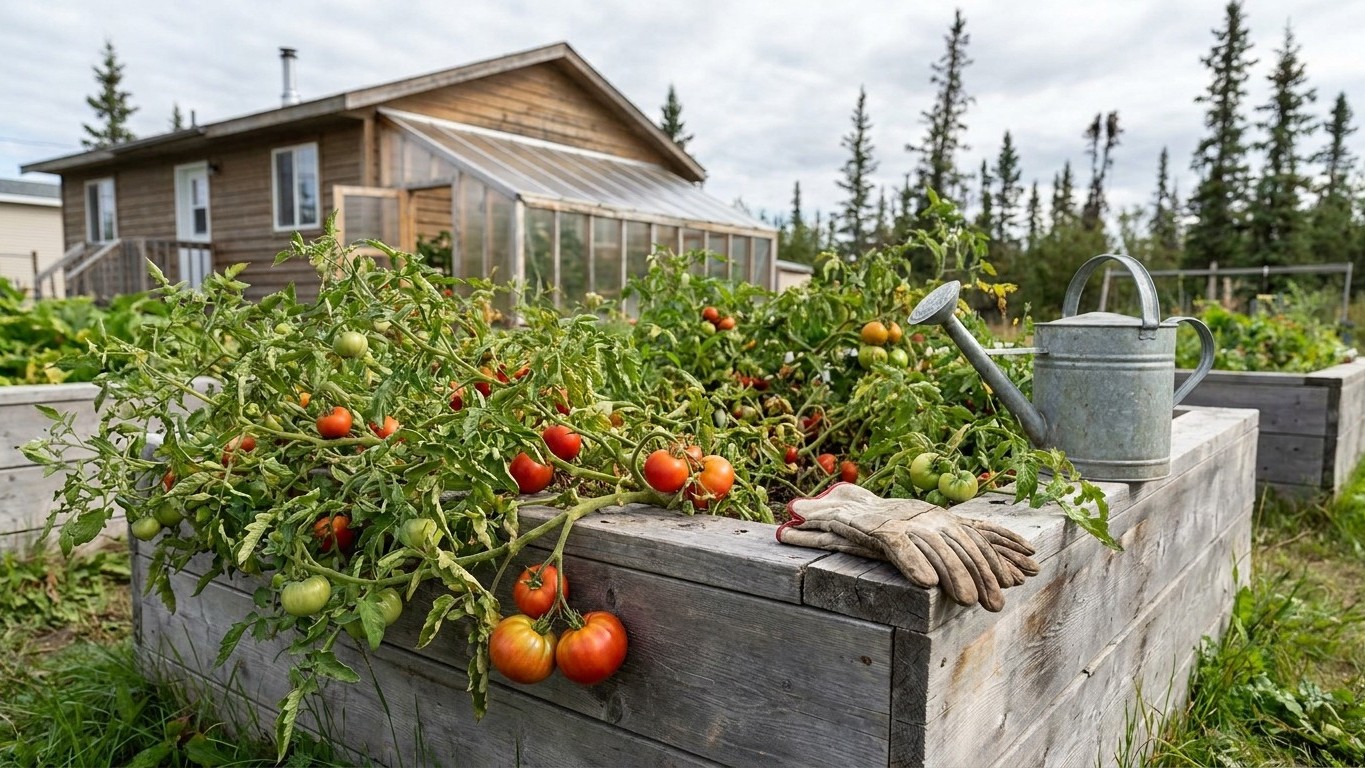

May 25 gets treated like a promise in Yellowknife gardens, the day frost supposedly packs up and leaves for the season. It’s actually just the midpoint of decades of records, which means half those years brought colder nights well past it. Tomatoes set out on faith in that date alone, especially in the colder ground beyond Great Slave Lake, can lose their first weeks of growth to a frost the average never warned you about.
What this comes down to in Northwest Territories

In Northwest Territories, the practical planting window for tomato transplants sits in early June, built around the May 25 average last frost recorded at Yellowknife by Environment and Climate Change Canada’s 1981-2010 climate normals. At the other end of the season, the same station puts the average first fall frost at September 18, which gives a mean frost-free stretch of roughly 116 days between the two. That number is a midpoint, not a guarantee. A late spring or an early fall can trim it sharply, so it pays to treat the season as shorter than it looks on paper.
These figures come from the Yellowknife A climate station, not from the territory as a whole. Communities north or east of Great Slave Lake, and ground at higher elevation, typically see frost hang on later in spring and return sooner in fall. A gardener in a colder pocket of the territory should budget extra weeks on both ends rather than lean on the Yellowknife normals directly.
Why the mean date isn’t a safe date
Because May 25 is a fifty-year average, roughly half of the years in the historical record saw frost land after that date, sometimes by a week or more. A gardener who plants right on the average date is betting on the better half of that split. Waiting several extra days past May 25, or watching the local forecast for a run of mild overnight lows before setting plants out, costs little compared with losing a full flat of transplants to a late frost. If you have not already worked through soil warmth, hardening off, and site selection, growing tomatoes in Northwest Territories covers that groundwork before you get to timing.
Working it out for your own garden
The frost window sets the boundaries, and days to maturity fills in the middle. Take the average last frost, May 25, and the average first fall frost, September 18, both from Environment and Climate Change Canada’s Yellowknife normals, and treat the gap between them as roughly four months, minus a buffer at each end since neither date is a certainty. Then work forward from your actual transplant date using the days-to-maturity figure printed on the seed packet, which is counted from the day of transplant outdoors, not from the day you sowed indoors.
A cultivar that clears the season with room to spare
Sakura, an indeterminate cherry tomato listed at 55 days from transplant, illustrates the arithmetic cleanly. Setting it out in early June and counting 55 days forward lands the first ripe fruit in early August, which leaves about 47 days of cushion before the Yellowknife area’s average September 18 first frost. That cushion matters because the September date, like the May one, is a midpoint. In a year when frost arrives earlier than average, a variety with 47 days to spare absorbs the swing without much trouble.
| Cultivar | Days from transplant | First ripe (approx.) | Margin before mean fall frost |
|---|---|---|---|
| Sakura | 55 | early August | 47 days |
| Sun Gold | 57 | early August | 45 days |
| Juliet | 60 | early August | 42 days |
| Amalfi | 68 | mid August | 34 days |
| Cherokee Purple | 72 | mid August | 30 days |
| San Marzano II | 78 | late August | 24 days |
| Celebrity Plus | 78 | late August | 24 days |
Where the margin runs thin
San Marzano II and Celebrity Plus, both listed at 78 days from transplant, show where the line sits. Set out in early June, they ripen their first fruit in late August, roughly 24 days ahead of the September 18 average frost date at Yellowknife. That gap looks workable in an average year, but it is thin. A transplant date pushed into mid-June by a cold, wet spring, or a frost that arrives before the average rather than after it, can erase most of that margin before the plant has carried much fruit. In a territory where the frost date itself is only a fifty-year mean, a 78-day tomato sits close to the edge of what the season allows, while a 55-day or 60-day cultivar does not.
The mistakes this state punishes

A few habits cost tomato growers here more than they cost gardeners farther south, because the season leaves so little slack to recover from a setback.
- Setting plants out the moment the calendar hits May 25, without checking that the soil itself has warmed.
- Choosing a long-season slicer or paste tomato for its catalogue looks, without checking its margin against the Yellowknife frost normals.
- Skipping frost cloth or a cold frame in the first two weeks after transplanting, on the assumption the average date is a guarantee.
- Starting seeds indoors too late to have a sturdy transplant ready for the early June window.
The biggest of these is treating May 25 as a finish line rather than a midpoint. A transplant set out on a night when soil and air are both still cold will simply stall, and a stalled tomato plant rarely catches up before the shorter half of the season closes it down. Warming the bed with black plastic or clear row cover for a week before transplanting, and waiting for a run of mild nights rather than a single mild day, does more for the eventual harvest than any other single decision.
The second mistake is picking a variety on days-to-maturity alone without checking it against the local margin. A 78-day cultivar such as Celebrity Plus or San Marzano II carries only about 24 days of cushion before the average first fall frost, which is fine in a normal year but leaves nothing for a cold spring or an early fall. Shorter-season cultivars carry the safest margin in this territory, and Tomato Varieties That Ripen in Time in Northwest Territories works through which ones ripen with the most room to spare.
Checking this against your county
Communities in the Dehcho, the Sahtu, or along the Arctic coast run on a different clock than Yellowknife, often colder and later in spring, sooner in fall. Before committing to a transplant date, check it against your own community’s conditions with the Department of Industry, Tourism and Investment’s agriculture services, which can point you toward local contacts and any community-specific guidance. Treat the Yellowknife normals as a starting point, not a final answer, especially if you garden north of Great Slave Lake or at higher elevation.
Some gardeners also time this by the Moon: when to plant tomatoes by the moon, as almanac tradition rather than fact.
Common questions
Can I just direct-seed tomatoes outside instead of using transplants?
Not in this territory. The frost-free season measured at Yellowknife averages about 116 days between the May 25 last frost and the September 18 first frost, and a tomato seed needs far longer than that to sprout, grow, and ripen fruit from scratch. Every cultivar named on this site’s Northwest Territories pages is timed from a transplant that is already several weeks old, not from a seed sown straight into the ground.
What if my last frost this year is later than May 25?
That happens in roughly half of all years, since May 25 is a fifty-year average rather than a hard date. Watch the extended forecast for a run of mild nights before you commit transplants outdoors, and keep frost cloth on hand into the first week of June as insurance.
Does a greenhouse or hoop house change these dates?
It can extend the season on both ends, but how much depends on the structure and how you manage it, so there is no single number to give here. Check with the territorial agriculture service for guidance suited to your particular setup rather than guessing at extra weeks.
How early should I start tomato seeds indoors for this window?
Most tomato seed packets call for starting seeds indoors five to seven weeks before the transplant date, which for an early June setout puts sowing somewhere in mid to late April. Count backward from whichever week in early June you actually plan to transplant, since a seedling started too early gets leggy and stressed sitting in a pot waiting for the soil to warm.