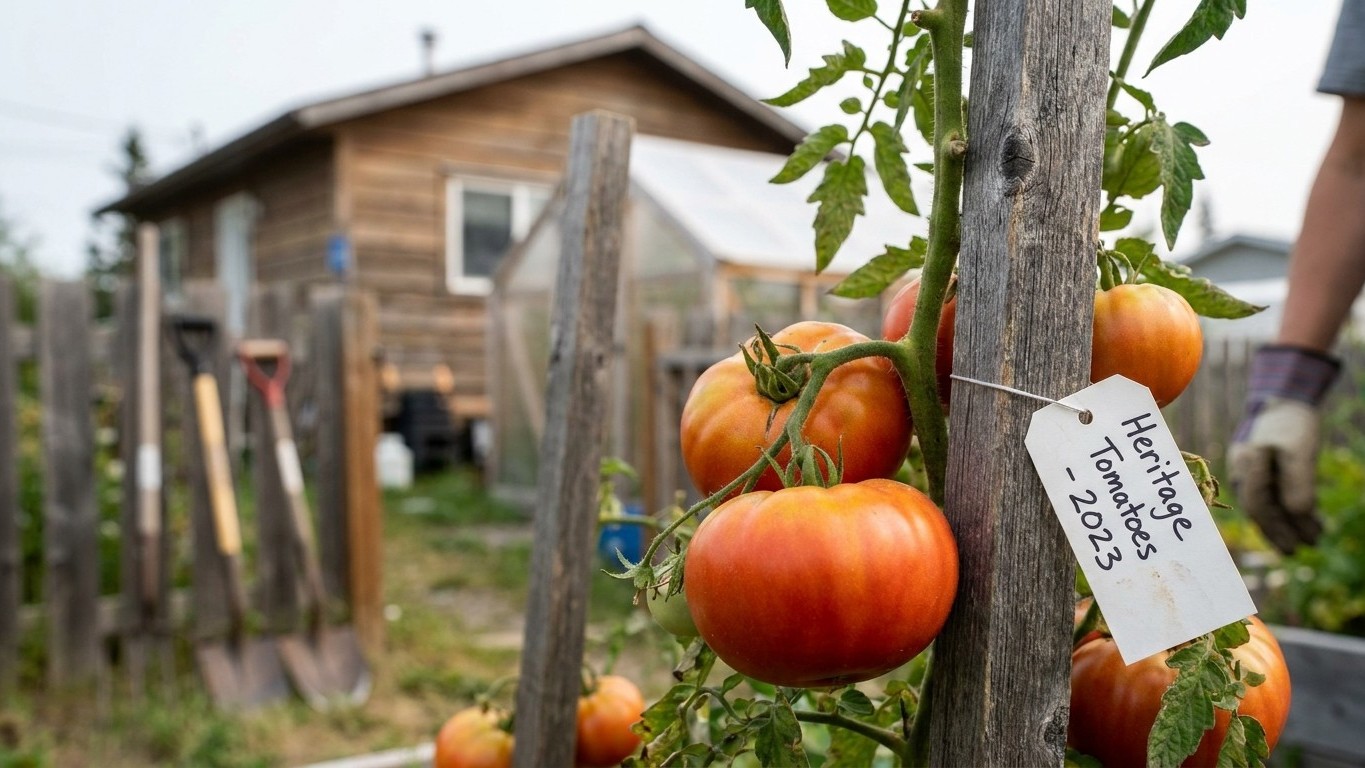

Yes, you can grow tomatoes in the Northwest Territories, but the season leaves almost no room to spare. Environment and Climate Change Canada’s 1981-2010 climate normals for Yellowknife A put the average last spring frost at May 25 and the average first fall frost at September 18, a frost-free window of about 115 days. That’s enough for a tomato that ripens in 55 to 60 days from transplant, and tight for anything slower. If you haven’t started seed indoors yet, do it now and check out these Tomato Varieties That Ripen in Time in Northwest Territories instead of a favorite heirloom.
When to plant Tomatoes in Northwest Territories

Everything about the Northwest Territories tomato calendar runs off two numbers from Environment and Climate Change Canada’s Yellowknife A station: an average last spring frost of May 25 and an average first fall frost of September 18. That’s a mean frost-free period of roughly 115 days, but a mean is not a promise. In half the years on record, the last frost at Yellowknife falls after May 25, sometimes well after. Treat that date as the middle of a range, not a green light, and if you garden north of Yellowknife or at higher elevation, push your own estimate later still. This region has no single climate, and a station reading from one city cannot speak for the whole territory.
Counting Back From transplant
Given how short the season already is, most Northwest Territories growers set tomato transplants out in early June, after the worst frost risk has passed and soil has had a few warm weeks to wake up. For a full breakdown of Tomato Planting Dates in Northwest Territories: Counting Back From Your Frost Window, seed needs to go indoors roughly six to eight weeks earlier than your transplant date, which lands in mid to late April. Sow into cell trays under grow lights or a bright south window, and keep the soil around 75 to 80 degrees Fahrenheit until germination, since cool starting media slows tomatoes down more than almost anything else you’ll do wrong.
Hardening off starts seven to ten days before you plan to transplant. Move trays outside for an hour or two on a still, mild day, then add an hour daily, keeping seedlings out of direct wind and afternoon sun until the last day or two. When you do set plants in the ground in early June, keep row cover, cloches or plastic jugs on hand, and it’s worth knowing ahead of time what you’ll be watching for once plants are established, since Tomato Pests in Northwest Territories: Which Ones Actually Show Up Here can differ from what southern gardening guides describe. The May 25 mean frost date means frost is a real possibility well into early June in a below-average year, and a single hard freeze on a young transplant can set it back two weeks or kill it outright.
Soil and site preparation
Tomatoes want the sunniest spot you have, a minimum of eight hours of direct light, and some shelter from wind, since a short growing season can’t afford the stress of getting whipped around all summer. A south-facing wall or the leeward side of a fence adds a surprising amount of stored daytime heat, which matters more here than in almost any other part of North America growing this crop.
Work compost or well-rotted manure into the bed a few weeks before you plant, not the day of, so it has time to break down and stop competing with roots for nitrogen. Tomatoes prefer loose, well-drained soil with a near-neutral pH. If your ground is heavy clay, which is common in much of the territory, build a raised bed instead of fighting the native soil. Raised beds and black plastic mulch both warm several degrees faster than open ground in spring, and in a 115-day season, every degree of soil warmth you gain in May pays back in earlier fruit in August.
Space plants 24 to 36 inches apart depending on whether you’re growing a sprawling indeterminate type or a compact determinate one, and leave enough room between rows to walk through for staking, pruning and picking without trampling the bed. Crowded plants stay wetter longer after rain, and wet foliage is what starts most fungal problems.
Varieties that suit Northwest Territories
With around 115 frost-free days at Yellowknife, the single trait that matters most is days to maturity, counted from transplant, not from seed. A tomato listed at 78 days needs 78 warm days after it goes in the ground before it ripens, and that number leaves very little buffer once you account for a transplant date in early June and a mean frost date in mid-September. Disease resistance and determinate versus indeterminate habit matter too, but they’re secondary to simply finishing in time.
Catalogue days-to-maturity figures are averages from milder growing regions and can run a week or two longer in a cool northern summer, so treat them as a starting point rather than a guarantee. The table below shows the math for a range of varieties, using an early-June transplant and the Yellowknife-area mean first frost of September 18.
| Variety | Days to maturity | Habit | Notable resistance | Approx. margin before mean frost |
|---|---|---|---|---|
| Sakura | 55 | Indeterminate | Nematodes, Tomato Mosaic Virus, Fusarium Wilt 1&2 | 47 days |
| Edox | 55 | Indeterminate | Nematodes, Tomato Mosaic Virus, Fusarium Wilt 1&2 | 47 days |
| Valentine | 55 | Indeterminate | Early Blight | 47 days |
| Glacier | 55 | Determinate | None listed | 47 days |
| Sun Gold | 57 | Indeterminate | Tobacco Mosaic Virus, Fusarium Wilt 1 | 45 days |
| Juliet | 60 | Indeterminate | Late Blight, Early Blight | 42 days |
| Supersweet 100 | 60 | Indeterminate | Verticillium Wilt, Fusarium Wilt 1 | 42 days |
| Amalfi | 68 | Determinate | Nematodes, Late Blight, Early Blight | 34 days |
| Cherokee Purple | 72 | Indeterminate | None listed | 30 days |
| Big Beef Plus | 72 | Indeterminate | Nematodes, Gray Leaf Spot, Tomato Mosaic Virus | 30 days |
| Tiren | 75 | Indeterminate | Verticillium Wilt, Tomato Mosaic Virus, Fusarium Wilt 1 | 27 days |
| Granadero | 75 | Indeterminate | Nematodes, Verticillium Wilt, Tomato Mosaic Virus | 27 days |
| San Marzano II | 78 | Indeterminate | None listed | 24 days |
| Celebrity Plus | 78 | Determinate | Nematodes, Gray Leaf Spot, Tomato Mosaic Virus | 24 days |
For a first attempt, the 55- to 60-day group (Sakura, Edox, Valentine, Glacier, Sun Gold, Juliet, Supersweet 100) carries the widest margin and the least risk if the season runs cool or the frost arrives early. Cherokee Purple, at 72 days, is worth the gamble for flavor if you’re willing to start seed a little earlier and finish the last fruit indoors. San Marzano II and Celebrity Plus, both at 78 days, are the ones to grow only under a tunnel or with a head start no state extension figure can guarantee here.
What to plant alongside
Basil is the classic tomato companion, and while the folklore claim that it improves tomato flavor has no real evidence behind it, it does share the same light, heat and water needs, so the two make efficient use of the same warm bed. Marigolds are worth including for a real, documented reason: certain types suppress root-knot nematodes in the soil around them, which matters for a bed you’ll replant year after year in a short-season garden where crop rotation space is limited.
Borage and other open, shallow flowers pull in pollinators and predatory insects, useful since a short, cool Northwest Territories summer already gives bees fewer good flying days to work with. Fast, shallow-rooted crops like radish or lettuce tucked between young tomato transplants make use of ground that would otherwise sit bare for the first few weeks, and they’re harvested and gone before the tomato canopy needs the space.
Keep tomatoes away from potatoes and eggplant, both nightshades that share the same fungal and bacterial diseases, including the early and late blights that can also affect tomatoes here. Corn competes for the same soil nitrogen and casts shade a tomato doesn’t want. Fennel is worth avoiding outright. It releases compounds that measurably stunt the growth of many garden vegetables, tomatoes included, and it’s one of the few companion-planting warnings with solid research behind it rather than tradition alone.
Watering, feeding and support
Tomatoes want deep, even water rather than frequent shallow sprinkles. Aim to soak the root zone thoroughly and let the top inch or two of soil dry before watering again, since consistently soggy soil encourages root rot and consistently dry-then-wet cycles are what crack fruit and cause blossom end rot. A three-inch mulch layer, straw or shredded leaves once the soil has warmed, holds that moisture steady and cuts down on the watering chores during the busiest weeks of summer.
Feeding and pruning for a short season
Feed with a balanced fertilizer at transplant, then switch to something lower in nitrogen and higher in phosphorus and potassium once flowers appear. Too much nitrogen late in the season pushes leafy growth at the expense of fruit, which is exactly the wrong trade when you’re racing a frost date. Suckering indeterminate varieties, pinching out the small shoots that form in the leaf joints, redirects the plant’s energy into the fruit that’s already set instead of new growth that won’t have time to ripen anyway.
Stake or cage plants early, before they sprawl, since disturbing an established root system to add support later sets the plant back. Indeterminate types like Sakura, Edox, Sun Gold, Juliet and Cherokee Purple keep growing and need a tall stake or cage all season. Determinate types like Glacier, Amalfi and Celebrity Plus stay more compact and manageable with a shorter cage. About four weeks before the Yellowknife-area mean first frost of September 18, top the growing tip of indeterminate plants, cutting off the topmost few inches of stem, so the plant stops setting new flowers that have no chance of ripening and instead finishes the fruit already on the vine.
Common problems

Cool nights cause more tomato trouble in the Northwest Territories than any pest does. Tomato flowers need reasonably warm night temperatures to set fruit, and a run of cold nights, common even in midsummer this far north, causes flowers to drop without ever forming a tomato. There’s no fix beyond patience and, if you have the setup for it, a row cover pulled over the plants on the coldest nights to hold in a few extra degrees of ground heat.
What to look for
- Blossom end rot: a flat, sunken, leathery brown-black patch on the bottom of the fruit, caused by uneven water supply interrupting calcium uptake, not by a lack of calcium in the soil itself. Fix the watering rhythm before you reach for a supplement.
- Fruit cracking: concentric or radial splits in the skin, usually after a heavy rain or watering following a dry spell. Even, mulched moisture prevents most of it.
- Leaf curl: upward-rolling leaves, often just a stress response to heat, wind or a dry spell rather than disease, and usually harmless if the plant is otherwise green and growing.
- Wilt diseases: yellowing that starts low on the plant and moves up, often on one side first. Fusarium and Verticillium wilt live in the soil for years, which is why the resistance codes in the variety table above, marked High or Intermediate for Fusarium and Verticillium, are worth checking before you buy seed for a bed that’s grown tomatoes before.
- Aphids: small, soft-bodied insects clustered on new growth and the undersides of leaves, often with a sticky residue on leaves below them. A strong water spray or insecticidal soap handles light infestations.
Poor fruit set from cool nights is a complaint you’ll also hear from gardeners on Canada’s Atlantic coast, where similar cool, damp summers keep pollination inconsistent even without the far shorter frost-free window; see our guide to Growing Tomatoes in Nova Scotia for how that region handles the same issue.
Ripening before the frost comes back
This is the question that decides whether a Northwest Territories tomato patch is worth the effort: does the fruit actually have time to ripen. Environment and Climate Change Canada’s Yellowknife A normals put the frost-free period at about 115 days on average, running from a May 25 mean last frost to a September 18 mean first frost. An early-June transplant, set out after that spring frost risk has mostly passed, leaves roughly 100 to 105 days of growing time before the mean fall frost arrives.
Against that window, a 55-day variety like Sakura, Edox, Valentine or Glacier needs 55 of those days to reach first ripe fruit, leaving close to 47 days of margin, room enough for a cool summer or a frost that shows up ahead of the average date. A 78-day variety like San Marzano II or Celebrity Plus needs nearly all of the available season just to reach first fruit, leaving only about 24 days of margin, and that’s assuming the frost holds off until the mean date rather than arriving early, which it does in roughly half of all years on record.
Three things buy extra weeks in a season this tight: starting seed indoors a week earlier than the six-to-eight-week baseline, running a low tunnel or row cover over the bed through the cooler nights of both spring and fall, and using black plastic mulch to push soil temperature up several degrees before and after transplant. None of those turn a 78-day tomato into a sure thing at Yellowknife, but stacked together they can add one to three weeks, which is often the difference between a full harvest and a bowl of green tomatoes. Saskatchewan growers work through a similar tight-margin calculation on the prairies further south; our guide to Growing Tomatoes in Saskatchewan walks through the same math for that province’s frost dates.
Harvest and end of season
Pick tomatoes as soon as they show full color, whether that’s the deep red of Big Beef Plus, the near-black mahogany of Cherokee Purple, or the golden orange of Sun Gold, rather than waiting for them to soften on the vine. Fruit that’s begun to blush, sometimes called the breaker stage, will finish ripening perfectly well on a counter indoors, which matters a great deal in a season where the calendar doesn’t leave room to wait.
Store ripening tomatoes at room temperature out of direct sun, never in the refrigerator, since cold temperatures below about 55 degrees Fahrenheit dull both texture and flavor and can stop the ripening process outright. A tomato with a hint of ethylene help, sealed in a paper bag with a banana, ripens noticeably faster than one left loose on a windowsill.
When the frost warning comes
As the Yellowknife-area mean first frost date of September 18 approaches, or sooner if you’re gardening further north or at elevation, watch the overnight forecast rather than the calendar. On the first night a frost warning is issued, either cover plants completely with row cover or old sheets, or pull entire plants and hang them upside down in a garage or shed. Green fruit left on a hanging plant will continue to ripen slowly over several weeks, using up the sugars already stored in the vine, and it’s a far better outcome than fruit caught on the plant when the first hard freeze hits.
Local help
For county-level frost dates, soil testing and advice specific to your district, contact the Government of the Northwest Territories’ Department of Industry, Tourism and Investment through its agriculture services page. You can also browse our broader Northwest Territories guides for other crops suited to this same short, intense growing season.
Common questions
Can I grow tomatoes outdoors in Yellowknife without any cover at all?
You can try it with a fast 55-day variety like Sakura or Glacier, but given that frost falls after the May 25 mean date in roughly half of all years and returns before the September 18 mean in the other half, growing without row cover or a cloche on hand for cold nights is a real gamble rather than a reliable plan.
Do I need to buy a greenhouse to get ripe tomatoes this far north?
No, a greenhouse helps but isn’t required if you choose a 55- to 60-day variety and start seed indoors on schedule. A simple low tunnel or row cover over the outdoor bed captures much of the same benefit at a fraction of the cost and effort.
Why did all my flowers drop without setting fruit?
This is almost always cool night temperatures rather than a disease or a watering mistake, and it’s one of the most common complaints from Northwest Territories tomato growers. There’s no cure beyond waiting for a warmer stretch, though a row cover on the coldest nights can hold in a few extra degrees.
Is it worth starting tomato seed even earlier than six weeks before transplant?
Starting eight weeks ahead instead of six can help with slower varieties, but starting much earlier than that tends to produce leggy, root-bound seedlings that transplant poorly and don’t actually catch up to a properly timed six-to-eight-week start. Size at transplant matters less than root health.
Can I just grow tomatoes in containers and move them indoors on cold nights?
Yes, and it’s one of the more reliable strategies in a climate this tight, since a container lets you dodge an early cold snap entirely by wheeling or carrying the plant indoors or into a garage overnight. Choose a compact determinate variety like Glacier or Amalfi for a container, since sprawling indeterminate types outgrow most pots by midsummer.
Related guides
- Growing Tomatoes in Yukon: Planting Dates, Varieties and Ripening Before Frost
- Growing Tomatoes in Nunavut: Planting Dates, Varieties and Ripening Before Frost
- Growing Tomatoes in Nova Scotia: Planting Dates, Varieties and Ripening Before Frost
- What to Plant in Northwest Territories in November
- Northwest Territories Soil
- What to Plant in Northwest Territories in March