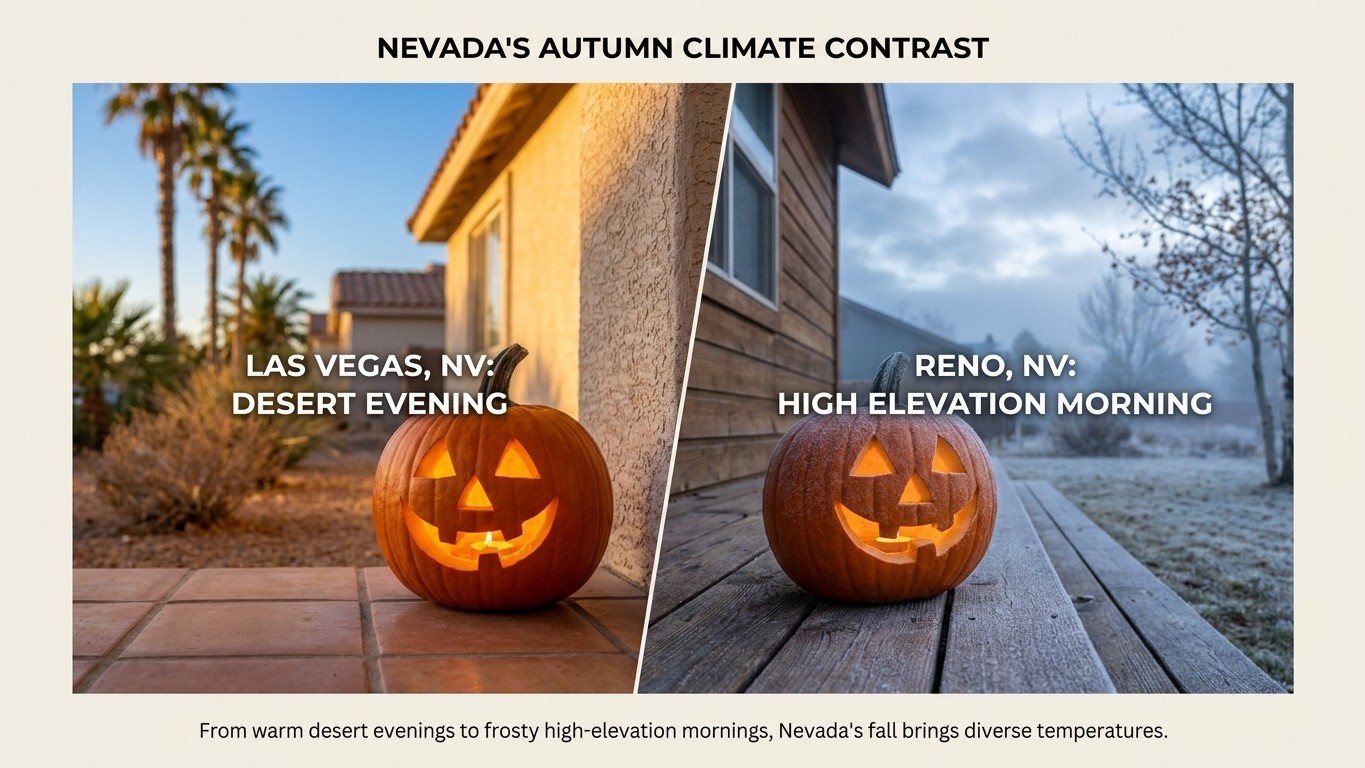

Nevada’s mean first fall frost swings from around December in the low desert around Las Vegas to months earlier at elevation in places like Reno or Carson City. That gap decides whether your porch pumpkin faces a freeze problem, a heat problem, or almost no problem at all before Halloween.
The short answer

At the Las Vegas airport reference station, NOAA’s 1991-2020 climate normals put the mean first fall frost (32°F, in the 30-70% probability band) somewhere around December 8 to December 23. That’s not a typo and it’s not close to Halloween. In the low desert, frost usually shows up six to eight weeks after October 31, which means a pumpkin sitting on a porch in Las Vegas that night faces essentially zero frost risk. The window to carve there is wide open all the way up to Halloween itself.
But that figure comes with a hard caveat. Las Vegas sits in an urban heat island, wrapped in pavement and reflected warmth, and it is the most extreme low-desert example in the state, not a stand-in for Nevada as a whole. Drive two hours north to Reno or up into Carson City, and the calendar changes completely. Higher elevation and drier, thinner air let heat escape fast after sunset, so those areas see their first frost months earlier than the desert floor does, often well before Halloween arrives. A pumpkin carved on October 31 in Reno can already have survived several frosty nights by the time the holiday gets there, while the same night in Las Vegas is still shirt-sleeve weather.
So there isn’t one statewide window, and treating Las Vegas’s numbers as a Nevada-wide answer would be misleading. What you can say with confidence is this: in the low desert, frost is not a factor for Halloween carving at all, and the limiting factor becomes heat and storage, not cold. In northern Nevada and anywhere at elevation, frost is very much a factor, and it can arrive around, or sometimes before, Halloween depending on the year and the site. A mean frost date is an average built from thirty years of data, not a promise for this particular October, so even in the north it’s a guide for planning, not a guarantee of a specific night.
The practical takeaway: if you’re in the Las Vegas valley or another low-desert pocket, carve whenever it suits your plans, right up to Halloween, since frost isn’t the constraint. If you’re in Reno, Carson City, or anywhere with real elevation, carve later rather than earlier and keep an eye on the forecast in the two weeks before Halloween, because a hard freeze can beat the calendar to your porch.
Frost or heat: which one gets it here
The cold end: what happens in northern and high-elevation Nevada
A whole pumpkin is meant to be stored between 45 and 50°F, according to University of Illinois Extension. That’s a narrow, cool band, and it’s exactly the kind of Temperature you’d find in an unheated but insulated space in early fall. The trouble in northern Nevada and at elevation is that late October air can drop well below that band overnight, sometimes into the 20s, long before the calendar reaches Halloween. A pumpkin left outside on a stoop in Reno on a clear, cold night can freeze solid, and once the flesh has frozen and thawed, it turns soft and collapses fast. Up there, the risk that gets a pumpkin is cold, plain and simple, and it’s a real risk well before Halloween itself.
The warm end: what happens in the low desert around Las Vegas
Flip to the south, and the same 45-50°F band becomes hard to hit for a different reason. Even the coldest month of the year at the Las Vegas reference station averages a daily minimum of only 39.6°F, and that’s January, the depth of winter there. Late October, weeks earlier in the season, runs noticeably warmer than that, often with afternoon highs still in the 70s or 80s and overnight lows well above the storage band. A pumpkin sitting on a sunny porch or in a closed car in the low desert isn’t fighting frost, it’s fighting warmth, and warmth speeds up softening and rot the same way an unrefrigerated kitchen counter would. Here, heat is the risk, not cold, and it’s present right through the period when a northern Nevada pumpkin would already be worried about freezing.
Where to keep it until you carve
Where you park a whole pumpkin before carving matters as much in Nevada as the calendar does, because the two ends of the state need almost opposite strategies. Here’s a practical order of preference, adjusted for whichever climate applies to you.
- A detached, unheated garage or shed is close to ideal in most of the state. In the north it stays warmer than the open yard on a frosty night; in the south it stays cooler and shadier than a sun-facing porch.
- A basement, cellar, or interior closet away from exterior walls works well anywhere in Nevada that has one, since these spaces naturally sit closer to that 45-50°F range than a room with windows or a porch.
- A shaded, north-facing porch or entryway is a reasonable choice in the low desert, where the goal is avoiding direct sun and afternoon heat rather than avoiding cold.
- Avoid an attached garage that shares a wall with a heated house in the north, since it may not get cold enough at night to slow ripening, and avoid an unshaded south- or west-facing porch in the desert for the opposite reason.
- Keep it away from any ripening fruit or vegetables, including apples, potatoes, and tomatoes, no matter which part of the state you’re in. Ripening produce gives off a gas that ages a pumpkin faster, so the crate of apples on the same porch is doing quiet damage.
Handle it by the body, not the stem. A pumpkin with 1 to 2 inches of stem left is what you want at the patch, because that stem acts as a seal over the exposed area at the top. Snap it off, whether by carrying the pumpkin by it or bumping it loose, and that spot becomes an open door for rot to get in early.
Checking this against your own county
Nevada’s terrain does the opposite of what a single statewide date could describe, so the numbers above are a starting point, not a local forecast. Elevation, local microclimate, and even which side of a valley you’re on can shift your first frost by weeks in either direction. For a reading that matches your actual address, contact University of Nevada, Reno Extension, the state’s land-grant extension service, and ask for the frost data specific to your county. That’s the number worth planning your carving day around, not a statewide average that has to stretch from the Las Vegas Strip to the Sierra foothills.
Common questions
How long does a carved pumpkin actually last in Nevada?
Neither University of Illinois Extension nor Utah State University Extension publishes a shelf life for a carved pumpkin, and there’s no research-backed preservation protocol either, so treat any specific number of days you see elsewhere with skepticism. What is published is guidance for the whole pumpkin: pick one with an intact stem, keep it in that 45-50°F range, and carve as close to Halloween as your plans allow so the cut pumpkin has less time to sit before the big night.
Should I worry about frost if I live in the Las Vegas valley?
Based on the NOAA normals for that reference station, frost typically doesn’t arrive until December, weeks after Halloween. Frost isn’t your concern there; keeping the pumpkin cool and out of direct heat is.
Is Reno’s carving window different from Las Vegas?
Yes, and meaningfully so. Elevation and drier air let Reno and similar northern or high-elevation spots cool off much faster in fall, so frost risk there can be present right around Halloween, unlike the desert floor further south.
Can I carve early and just refrigerate the pumpkin?
A whole, uncarved pumpkin keeps for three to six months in a cool, dark spot in that 45-50°F band, so there’s no rush to carve early. Since no extension service publishes a reliable way to slow decay once it’s cut, the simplest approach is to leave it whole until close to the day you plan to display it.