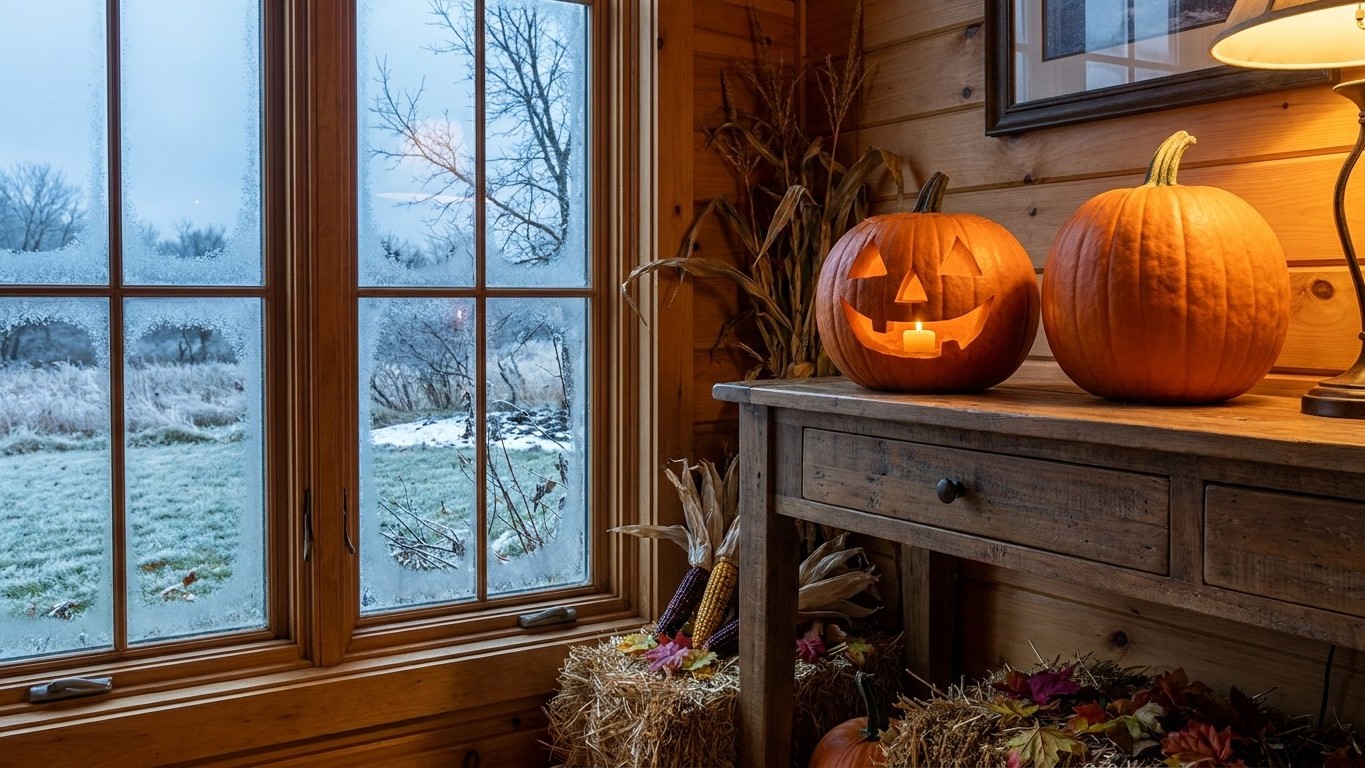

Wyoming’s mean first fall frost lands around September 24 to October 5, weeks before Halloween arrives on October 31. That gap between frost and jack-o’-lantern night is the whole story here: pumpkins left outside will meet freezing air long before trick-or-treaters show up, so the real question isn’t whether frost beats Halloween in Wyoming. It’s how you keep a pumpkin intact until carving day finally comes.
The short answer

At a station near Cheyenne, NOAA’s 1991-2020 climate data puts the average first fall frost somewhere between September 24 and October 5. That’s around three to five weeks ahead of Halloween, depending on where you land in that window and where you live in the state. Around, not on a fixed day, because a mean frost date is an average drawn from thirty years of records, not a guarantee for any single October.
What that means in practical terms: if you buy or pick your pumpkin in late September, expecting it to sit untouched on an open porch until Halloween is asking for trouble. Frost will very likely arrive first, and a pumpkin left exposed to repeated hard freezes softens, weeps, and eventually collapses from the inside before you ever pick up a knife.
The workable window looks like this: bring the pumpkin home whole as soon as you’ve chosen it, store it somewhere cool and dark and above freezing, and save the actual carving for the final stretch before Halloween, ideally the last week leading up to October 31 rather than the day you bought it. That way the pumpkin spends most of its life whole and protected, and only faces open air, warmth, and light exposure for the handful of days it needs to look good on the step.
One caution matters more in Wyoming than almost anywhere else in the country: at elevations above 6,000 feet, the growing season runs only about 130 frost-free days, and frost is possible in any month once you’re up in the higher valleys and mountain towns. That’s not a detail specific to pumpkin carving so much as a reminder that Wyoming’s climate doesn’t behave like a lowland state’s. Whatever window you plan around, build in a margin, because the state’s elevation swings mean your actual local frost date could arrive earlier than the statewide average suggests.
There’s no published research from any university extension on how many days a carved pumpkin lasts once you’ve cut into it. That figure simply doesn’t exist in the agricultural literature, whatever you may have read elsewhere. What does exist is guidance on choosing a sound pumpkin and storing it whole, and that’s the part worth building your timeline around.
Frost or heat: which one gets it here
The cold end
Wyoming’s cold side of the equation is unambiguous. The coldest month’s mean daily minimum, measured at the Cheyenne reference station, runs 18.1 degrees Fahrenheit. That’s not the record low and not a monthly average temperature; it’s the figure that decides whether anything survives a Wyoming winter outdoors at all, and it tells you plainly that once real winter arrives, nothing organic is surviving unprotected.
A whole pumpkin keeps best between 45 and 50 degrees Fahrenheit. Compare that band to what late October actually looks like across most of Wyoming: nighttime lows are already flirting with or dropping below freezing in many areas by the third or fourth week of the month, well under that 45-50 degree target. Leave a pumpkin on an open porch or a north-facing step through that stretch and it’s getting hit by temperatures 15 to 25 degrees colder than what keeps it in good shape. Freezing, not warmth, is the threat that applies here.
The warm end
Heat simply isn’t the enemy in Wyoming the way it might be in a Gulf Coast state. Even during an unusually mild late-October stretch, daytime highs might climb into the 50s or low 60s in the lower-elevation valleys, but nights still drop hard once the sun goes down, especially at the 5,000- to 7,000-foot elevations where most of the state’s population lives. A pumpkin isn’t going to overheat on a Wyoming porch in October. It’s going to freeze on one. That asymmetry is worth remembering when you’re deciding where to store yours: the goal is finding somewhere that blocks the cold, not somewhere that stays cool.
Where to keep it until you carve
- Choose an unheated but enclosed space first. An attached garage, an insulated shed, or a mudroom that doesn’t get direct furnace heat will often sit closer to that 45-50 degree band than any spot outdoors once frost has set in.
- Basements and root cellars work well in Wyoming homes. Many older houses in the state have a cellar or below-grade storage area that stays naturally cool and dark year-round, which is close to ideal.
- Skip the open porch entirely once frost is likely. Even a covered porch offers little protection against a hard freeze at Wyoming elevations; treat it as fine for the final day or two before carving, not for weeks of storage.
- Keep the pumpkin off bare concrete. A board, a towel, or a shelf under it prevents direct cold transfer from a concrete garage or basement floor.
- Store it away from ripening fruit and vegetables. Apples, potatoes, and tomatoes give off a natural gas as they ripen that ages a pumpkin faster, so keep the two separate even if they’re both destined for a fall display.
- Handle it by the body, never by the stem. A pumpkin with 1 to 2 inches of stem left on is a good sign of freshness, but that stem is a seal against spoilage, not a handle. Break it off carrying the pumpkin around and you’ve opened exactly the spot where rot gets started.
A whole pumpkin stored this way, in that 45-50 degree range and out of direct light, can hold for three to six months. That’s more than enough time to buy early in the season and still have a sound pumpkin waiting when Halloween arrives.
Checking this against your own county
Statewide frost averages only get you so far in a state where elevation swings from around 3,100 feet near the Nebraska border to well over 6,000 feet in Cheyenne and much higher still in mountain towns like Jackson. Your actual first frost could arrive a week or two earlier or later than the statewide figure depending on exactly where you live and how your property sits relative to valley floors and cold-air drainage.
For county-level frost dates and growing-season guidance specific to your area, the University of Wyoming Extension is the authority to check. Their local offices track conditions county by county and can tell you how your area’s frost timing compares to the statewide average used here.
Common questions
How long does a carved pumpkin actually last?
No university extension publishes a number for this, and there’s no research-backed preservation method either, despite what you might read elsewhere. The reliable approach is choosing a sound pumpkin with an intact stem, keeping it whole as long as possible, and carving close to the day you’ll display it.
Should I carve before or after the first frost hits?
Neither, really. A whole, uncarved pumpkin can tolerate being stored properly right through the period when frost arrives, since it’s kept indoors above freezing rather than left outside. Carving timing should be based on Halloween itself, not on when frost happens to show up.
Can a whole pumpkin survive a light frost outdoors?
A brief, light frost may not destroy a whole pumpkin outright, but repeated freezing overnight followed by thawing during the day breaks down the flesh over time. Given how early Wyoming’s frost typically arrives relative to Halloween, it’s not worth the risk when indoor storage is a simple alternative.
Does living at high elevation, like in Jackson, change any of this?
Yes. Higher elevations in Wyoming see a shorter frost-free season and a real chance of frost outside the usual fall window entirely. If you’re at higher elevation, treat the statewide frost range as a late estimate rather than an early one, and lean on your local University of Wyoming Extension office for numbers specific to your area.