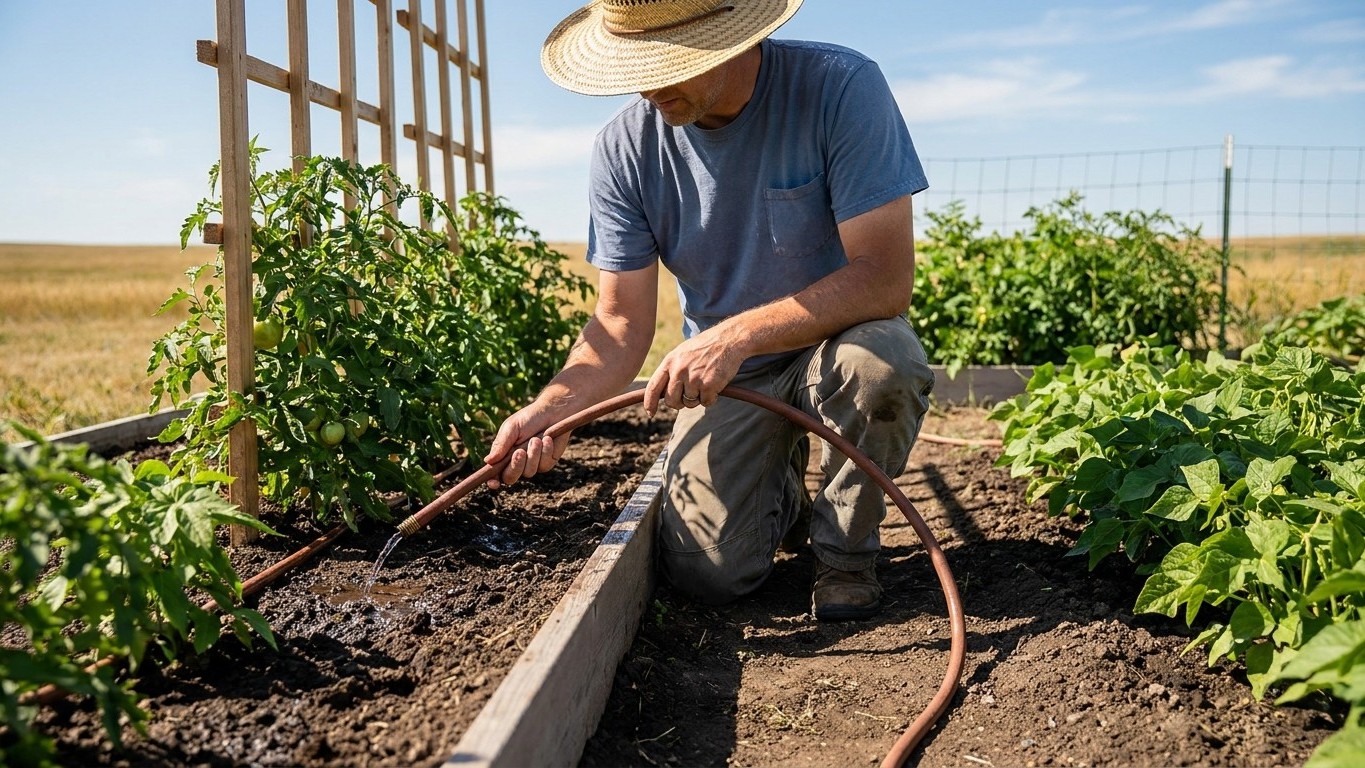

North Dakota gardens face a short, hot growing season and rainfall that can’t be counted on. The short answer: give beds about an inch of water a week, delivered deep and slow rather than in daily sips, and check with your local water utility before you set a schedule, since restrictions shift year to year depending on drought conditions.
What the climate asks of you

Two numbers set the terms here. At the reference station in Fargo, the state averages 11.7 days a year at 90F or hotter, according to NOAA NCEI Climate Normals for 1991-2020. That’s not a brutal number by Southern standards, but it’s enough heat stress, packed into the peak of summer, to push a garden bed past wilting point fast if the soil underneath is dry. The other number that matters is the USDA hardiness range for the state, 3a to 4b, which tells you the winters are long and the frost-free window is tight, not how much water falls in July.
North Dakota’s summer rainfall pattern is uneven across the state and from year to year, with drier stretches common enough that gardeners here shouldn’t assume the sky will cover the deficit. Rather than guess at a monthly rainfall figure for your exact location, pull the current normals for your county from NOAA or from NDSU Extension, since totals vary meaningfully between the Red River Valley and the western part of the state.
The frost window frames the season
At the Fargo airport station, the last spring frost typically falls between May 4 and May 15, and the first fall frost arrives between September 25 and October 5. That’s the window you’re irrigating inside of. Suburban and rural gardens away from that station often see frost linger later in spring and arrive earlier in fall, sometimes by a week or two, more at higher elevation, so treat these dates as a starting point and confirm timing for your own county.
Put those two facts together and the picture is clear: a compressed frost-free season with a real run of 90-degree days somewhere inside it. That combination means a garden here can go from comfortable to drought-stressed in the space of a week once the heat sets in, and the standard rule of thumb, roughly an inch of water a week for most vegetable and flower beds, becomes the baseline you plan around rather than an average you assume is being met by rain alone.
Soil texture changes how far that inch goes. Sandy or sandy-loam ground, common in parts of the Red River Valley and elsewhere in the state, lets water drain through quickly, so the same weekly inch might need splitting into two shorter sessions. Heavier clay ground holds water longer but drowns roots if it’s soaked again before it dries out. Knowing which one you’re gardening in matters more than any single rainfall figure.
How much, how often
Deep and infrequent beats daily and shallow, every time. A quick daily splash wets the top inch of soil and trains roots to stay near the surface, right where the day’s heat bakes them. Water that reaches six to eight inches down pulls roots deeper, into soil that stays cooler and moister longer between waterings. That’s the difference between a plant that shrugs off a 90-degree afternoon and one that wilts by noon.
The test for whether to water isn’t the calendar, it’s the soil. Push a finger or a trowel two inches down near the root zone. Dry at that depth, water. Still damp, wait a day and check again. This beats any fixed schedule because it accounts for the swings between a cool, damp week and a stretch of 90-degree days.
- Check soil moisture two inches down before watering, using a finger or trowel at the base of the plant, not just the surface.
- Water in the morning, before the heat of the day, so moisture soaks in rather than evaporating off wet leaves.
- Aim at the base of the plant, not the foliage, to cut down on fungal disease that spreads on wet leaves overnight.
- Deliver about an inch a week in one or two sessions rather than several light ones, adjusting the split based on whether your ground is sandy or clay.
- On sandy soil, water more often in shorter amounts, since it holds far less moisture between sessions.
- On clay soil, water less often but let it soak in fully, and never work or water clay that’s still wet from the last session, since that compacts it and suffocates roots.
The frost-free window here is short enough that you don’t have all season to recover from a stretch of neglect. Once the reliable rains of spring taper off and the days above 90 start showing up, plan on irrigation carrying the load rather than counting on the sky to catch up. That’s a mindset shift for gardeners used to wetter climates, where a dry week or two evens out. Here, it often doesn’t.
Restrictions and rules
Watering restrictions are common across North Dakota municipalities, especially in drought years, and they change from one season to the next depending on reservoir and aquifer conditions. Some water districts limit outdoor watering to specific days of the week or hours of the day during dry spells; others only step in with restrictions when conditions get severe. Because these rules are set locally and revised as conditions change, there’s no single statewide schedule that applies to every yard.
The only reliable way to know what applies to your address is to check with your city or rural water district directly before you set an irrigation timer or schedule for the season. NDSU Extension is a good starting point for current guidance and can often point you toward your local water authority’s specific rules.
Given how uneven summer rainfall is across the state, and how many days a typical North Dakota summer spends at 90F or above, restrictions here are a real possibility worth checking before you plant, not an afterthought to deal with once a hose ban notice shows up on your door. Building a garden plan that assumes some restriction, rather than unlimited water, tends to hold up better.
Using less
Cutting water use in a North Dakota garden isn’t about doing without, it’s about making every gallon count for more. A few techniques do most of the work, and they’re worth treating individually rather than lumping into a single “be more efficient” instruction.
- Mulch, two to three inches deep: cuts evaporation from bare soil dramatically and keeps root zones cooler on the days that hit 90F, which matters given how many of those days show up in a typical Fargo-area summer.
- Drip irrigation or soaker hoses: deliver water at the base of the plant slowly, cutting runoff and evaporation loss compared to overhead sprinklers, and pairing well with the deep-and-infrequent approach.
- Group plants by water need: put thirsty vegetables together and drought-tolerant perennials elsewhere, so you’re not overwatering the tough plants to keep the thirsty ones alive.
- Work organic matter into the soil: compost improves both sandy soil’s ability to hold water and clay soil’s ability to drain, softening the extremes either texture creates.
- Rain barrels, where local rules allow them: a roof catching an inch of rain over 1,000 square feet yields roughly 600 gallons, a useful figure for sizing a barrel setup, though how often that inch falls depends heavily on which part of the state and which month you’re in, so check current rainfall totals for your area rather than assuming a barrel will refill on any fixed schedule.
None of these replace watering altogether, but stacked together, they reduce how often you need to reach for the hose and how much water each session takes. In a state where summer rainfall doesn’t arrive on a predictable schedule, that margin matters.
Common questions
What time of day should I water my North Dakota garden?
Morning is best, before the heat of the day sets in. Watering at the base rather than overhead cuts down on evaporation loss and reduces the risk of fungal disease on wet leaves overnight.
How do I know if my soil is sandy or clay?
Squeeze a moist handful. If it crumbles apart easily, it’s likely sandy or loamy. If it holds a firm shape and feels sticky, it’s clay-heavy. This matters more for your watering schedule than any general state average.
Are there statewide watering restrictions in North Dakota?
No single statewide schedule applies everywhere. Restrictions are set at the municipal or water district level and change based on drought conditions, so check with your local water authority or NDSU Extension before setting an irrigation schedule.
When should I stop watering in the fall?
Near Fargo, the first fall frost typically arrives between September 25 and October 5, though rural and outlying areas often see it a week or two earlier. Taper watering as growth slows and frost dates approach, but confirm the pattern for your own county rather than relying on the reference-station dates alone.