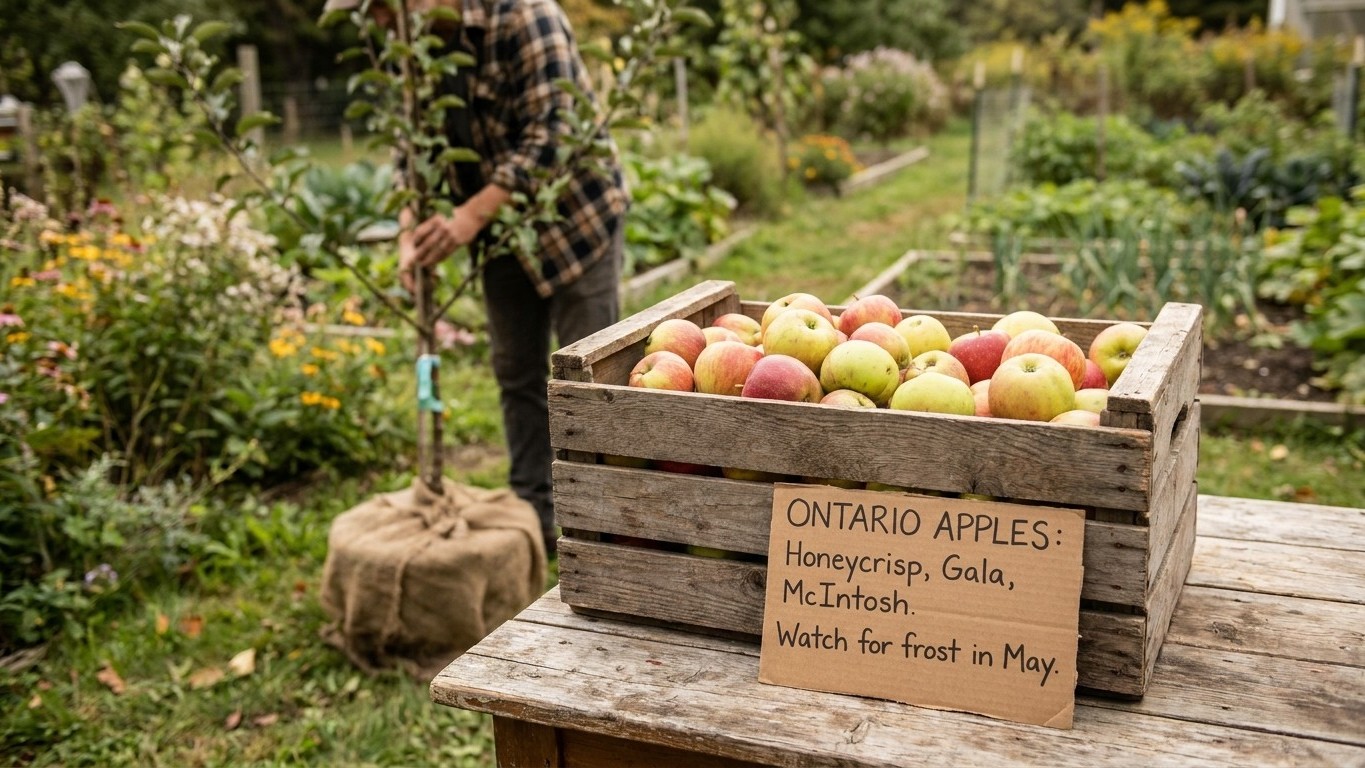

Apples grow well across most of Ontario, and winter cold is rarely the problem. At the Toronto reference station, Environment and Climate Change Canada’s 1981-2010 climate normals put the average last spring frost at April 30, a date that in roughly half of all years is beaten by an even later frost. That single fact does more to decide a good or bad apple year here than variety choice on its own. Before ordering a tree, check how the average last frost date at your own site compares to Toronto’s, since inland and northern parts of the province typically run later still, and consult an Ontario apple Calendar to plan the season’s key tasks around your local timing.
Which varieties suit this climate

Winter cold is the first filter, and it is a low bar in most of Ontario compared to a lot of the apple map. At the Toronto reference station, Environment and Climate Change Canada’s 1981-2010 climate normals put the mean daily minimum of the coldest month at -10.2 °C. That figure comes from a single station near Lake Ontario, and inland or northern parts of the province run colder in a normal winter, so a tree that only just survives at Toronto is not a safe bet further north. Any variety marketed for a cold-climate orchard, not a mild-winter one, is the starting point here.
Named cultivars bred or long grown for northern climates include ‘Honeycrisp’, ‘Cortland’, ‘McIntosh’, ‘Liberty’, ‘Northern Spy’, ‘Haralson’, ‘Goodland’ and ‘Wealthy’. All of these are catalogued as hardy well into short-season, cold-winter regions, and ‘Haralson’ and ‘Goodland’ were bred specifically at northern prairie research stations for close to the winter Ontario delivers. A cultivar’s cold tolerance is a fixed trait of the tree, printed the same on a nursery tag in Ontario as it is anywhere else, and this list of Ontario apple Best varieties is a good starting point when narrowing down a choice.
| Variety | Bloom timing | Chill requirement | Notable trait |
|---|---|---|---|
| ‘Honeycrisp’ | Mid-season | Long | Crisp, sweet-tart, stores well |
| ‘Cortland’ | Mid-season | Long | Flesh slow to brown when cut |
| ‘McIntosh’ | Early to mid | Long | Reliable pollen source |
| ‘Liberty’ | Mid-season | Long | Bred for scab resistance |
| ‘Northern Spy’ | Late | Long | Late bloom, long-keeping fruit |
Winter chill: the second filter
Cold hardiness tells you whether the tree survives January. Winter chill tells you whether it flowers properly in May, and it is a separate number entirely: the count of hours a tree spends below roughly 45°F over the whole dormant season, which it needs to complete before it will break bud cleanly. Ontario sits at the long-chill end of the apple-growing range, not the short one. A variety bred for a mild winter, carrying a low chill requirement, can satisfy that requirement during an ordinary Ontario winter and then respond to a mid-winter warm spell by pushing bud too early, well ahead of the last frost. The result is not a dead tree. It is a thin, ragged bloom, a crop lost to a frost the tree should never have been exposed to, or both. Every variety named above carries a long chill requirement that matches an Ontario winter, which is a large part of why they keep showing up in northern nursery catalogues rather than southern ones.
No Ontario-specific source in this article’s figures names an official recommended variety list for the province, so treat the cultivars above as catalogue-hardy choices to confirm against your own nursery’s tag, not as a provincial recommendation. Growers in other cold-winter regions face the identical two-step filter, cold hardiness first, then chill requirement, and that is exactly the logic behind growing apples in Prince Edward Island, another region where winter survival alone does not guarantee a good bloom.
Planting a pair that works here
A single apple tree, whatever the variety, rarely sets a full crop on its own. Plant two varieties that flower at the same time, and make sure at least one produces fertile pollen, because a handful of well-known cultivars carry pollen that cannot fertilize any apple flower, including their own.
Among the cold-hardy varieties that suit an Ontario winter, ‘McIntosh’ is one of the more dependable pollen sources and blooms early to mid-season, which makes it a workable partner for ‘Cortland’ or ‘Liberty’, both of which bloom in the same window. ‘Honeycrisp’ also blooms mid-season and pairs well with either. ‘Northern Spy’ blooms later than the others in that list, so pairing it with an early bloomer can mean the two trees are not actually in flower together in a given year, especially if a cool spring pushes the later variety’s bloom out further. Check the bloom timing listed for the specific cultivar and rootstock combination you buy, since timing can shift by several days depending on rootstock and site.
A few widely sold heritage varieties, and most flowering crabapples grown as pure ornamentals, carry sterile or otherwise unusable pollen and need two other, fertile varieties nearby to produce fruit at all, on themselves and often on their neighbor too. Buying two trees of the same sterile-pollen variety, or one sterile variety plus a seedling of unknown type, is a common way to end up with a tree that flowers well and fruits poorly. A flowering crabapple chosen for a long bloom period, rather than for its own fruit, is a common insurance choice for the opposite reason: its bloom window usually overlaps with most apple varieties regardless of which one you plant nearby.
The frost that costs a crop here

The frost date to watch is the one after bloom starts, not the one before planting. Environment and Climate Change Canada’s 1981-2010 climate normals put the average last spring frost at April 30 for the Toronto Lester B. Pearson Int’l A station, and that figure is a mean, not a safe cutoff. In about half of all years, the last frost at that station falls later than April 30, and the province is not one climate, so sites north or east of Toronto typically clear frost even later than that average suggests.
Why a late frost is worse than an early one
A frost that arrives while the tree is still bare or at green tip does little damage, because the wood itself tolerates cold well below anything Ontario sees in spring. The risk starts once the flower buds show pink, and it peaks during open bloom and just after. A frost at that stage does not kill the tree. It kills the flowers, and a flower killed by frost cannot set fruit. The tree leafs out fine, looks perfectly healthy all summer, and simply carries no crop, or a much lighter one than it should. That is the outcome growers lose sleep over: not a dead tree, a dead year.
There is not much a home grower can do about a frost that arrives across an entire region overnight, but small measures help at the margins. Covering a young or espaliered tree with a bedsheet or frost cloth overnight when a pink-stage or bloom-stage frost is forecast can hold a few degrees of protection. Avoiding a planting site at the bottom of a slope helps too, since cold air pools in low ground on a calm, clear night, and that low spot is reliably the coldest few feet of the whole property. A home gardener is better served by site choice made before planting than by scrambling on a frost-warning night.
The more durable fix is variety choice. Of the cultivars suited to Ontario’s winter, ‘Northern Spy’ blooms later than ‘McIntosh’, ‘Cortland’ or ‘Honeycrisp’, which pushes its flowering closer to, or past, the point where frost risk has genuinely dropped for the season. In a region where the average last frost date already means real risk into late April, a late-blooming variety is close to the only insurance the tree itself can provide. The same trade-off between early bloom and frost exposure shows up in apple-growing regions of Wyoming, where a short season and a late, unpredictable spring push growers toward the same late-blooming varieties for the same reason.
The apple year in Ontario
Every stage below is timed by what the buds and flowers actually look like, not by a date on the wall. Use the Toronto averages as a rough anchor: Environment and Climate Change Canada’s 1981-2010 normals put the last spring frost at April 30 and the first fall frost at October 16, both for the Toronto Lester B. Pearson Int’l A station, and a site north, inland or at higher elevation than Toronto will run behind that on both ends.
Dormancy

The tree is bare from leaf fall through late winter. This is the window for pruning, dormant oil sprays and planting bare-root stock, since none of those disturb a tree that is not yet active.
Green tip

The first green leaf tips push through the bud scales. Frost at this stage rarely causes real damage. This is the last easy stage to finish any dormant spraying before the tree moves into active growth.
Pink

Unopened flower buds turn visibly pink before they open. From here on, frost risk to the crop is real, and it is worth checking the overnight forecast every evening through bloom.
Bloom

Open white flowers, blushed pink at the base, cover the tree. This is when a frost does its damage, and also when cross-pollination actually happens, so it is when bees need to be flying, which a cold, wet spell can prevent as surely as a frost can.
Petal fall

Petals brown and drop, and small green fruitlets appear at the base of each flower cluster. Frost risk drops sharply once petal fall is underway, though it is not zero until the average frost window has passed.
Fruit set

The fruitlets that survive pollination begin to swell. This is the point to thin crowded clusters down to one or two fruit each, which improves the size and quality of what is left.
Harvest
Fruit reaches full size and its mature color, which varies by variety from deep red to green to a yellow blush. Most Ontario apple varieties finish well before the average first fall frost on October 16, but a late-ripening cultivar left on the tree into a hard fall frost can still take cosmetic damage to the skin.
Local help
For a variety list built around specific Ontario counties, and for spray timing tuned to the pest and disease pressure in a given region, check the province’s agriculture and food resources through the Ontario government’s agriculture and food page. Nothing in this article substitutes for a local spray calendar, since scab, fire blight and codling moth pressure all vary by region and by year, and a current provincial advisory reflects the season in a way a general guide cannot.
Common questions
Can I grow apples in Ontario without spraying anything?
You can, but expect more scab, fire blight and worm damage in the fruit than on a sprayed tree, especially on varieties without built-in resistance. ‘Liberty’ is bred for scab resistance and is the easiest of the varieties named above to grow with little or no fungicide.
Why did my apple tree bloom but not set any fruit?
The most common reasons are a frost during or just after bloom, no compatible pollen source flowering at the same time, or poor bee activity during a cold, wet bloom period. Check whether a second variety was actually in flower on the same days as the first before assuming the tree itself is at fault.
How many years before a new apple tree bears fruit?
Catalogue figures for most nursery apple trees put the first light crop at around three to five years from planting, depending on rootstock, with a full crop taking longer still. A dwarfing rootstock generally bears sooner than a standard one.
Is Ontario too cold for apples compared to warmer states?
No. Apples need real winter cold to grow well, and Ontario’s winter falls within the range that named cold-hardy varieties are bred for. The bigger risk here is a late spring frost catching an early bloom, not the winter cold itself.
Should I plant a full-size tree or a dwarf for a small yard?
A dwarf or semi-dwarf rootstock keeps the tree small enough to spray, prune and pick by hand from the ground, and it usually bears its first fruit sooner than a full-size tree on standard rootstock. The tradeoff is a shorter-lived tree and a root system that needs staking on a windy site.