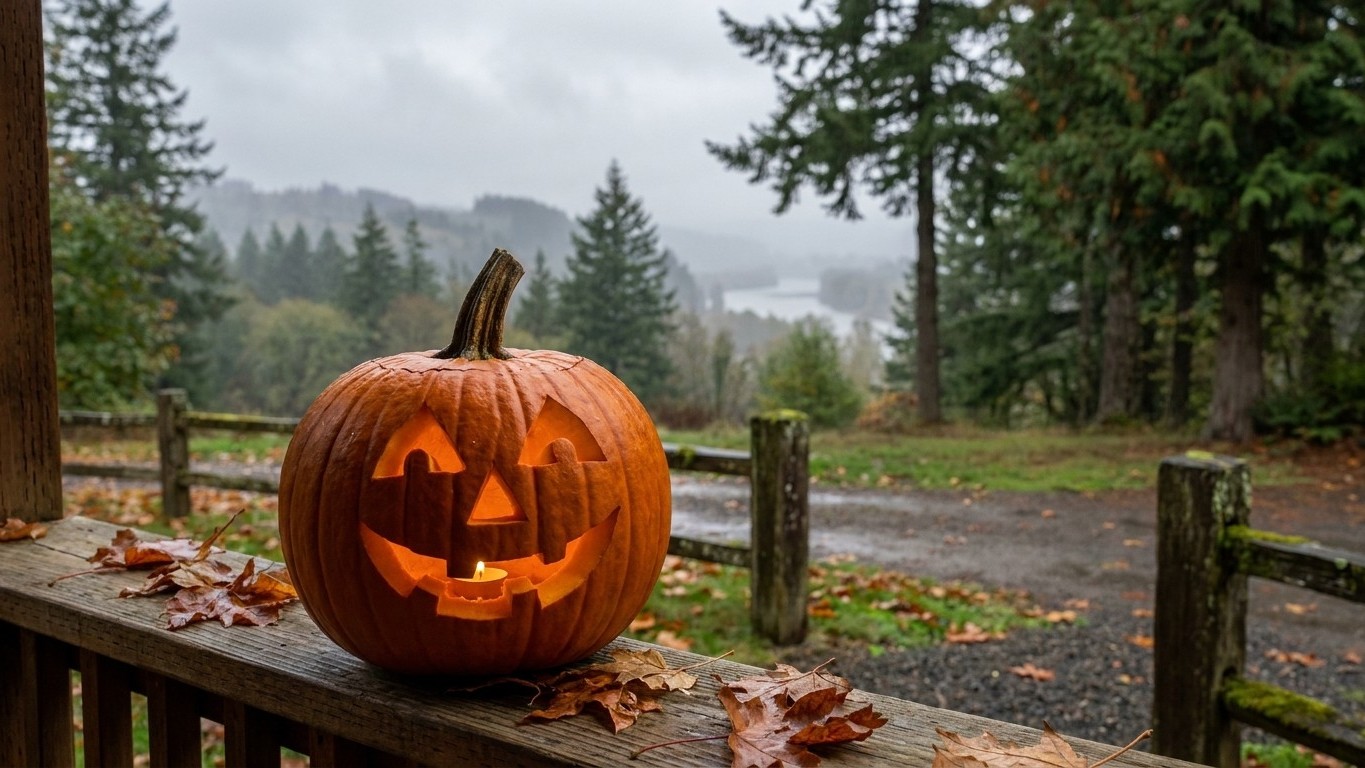

Western Washington’s mean first fall frost lands somewhere between November 13 and November 30, based on the region’s long-term climate data. That’s not a typo: Halloween usually comes and goes under clear skies with no freeze in sight. For anyone carving a pumpkin here, the weather isn’t the limiting factor. What matters more is how you store the thing once it’s cut, and how far in advance you buy it.
The short answer

If you live on the wet, mild side of the Cascades, in Seattle, Tacoma, Olympia, or anywhere along the I-5 corridor, frost is not going to force your hand. The region’s mean first fall frost falls around mid-to-late November, meaning the entire month of October, Halloween included, typically passes without a hard freeze. That gives you a wide window: you could Carve a Pumpkin the last week of September or wait until October 30, and the outdoor air temperature alone won’t be the reason it fails.
This is a big departure from what gardeners in colder states deal with, where an early freeze can force pumpkins off the vine and onto the porch weeks ahead of schedule. Here, the vine itself isn’t under frost pressure through most of October, so if you’re growing your own, you have more flexibility in when to bring it in. If you’re buying from a patch or a stand, the pumpkin has already been cut from the vine, and the clock that matters now is the one tied to storage conditions, not weather.
What “around” really means
A mean frost date is an average pulled from three decades of records, not a guarantee for any single year. Some years the first frost in western Washington shows up closer to mid-November, other years it slides toward the end of the month. Either way, it’s consistently after Halloween, which is the detail that matters for pumpkin timing. Don’t read this as “frost hits on November 20.” Read it as “frost is unlikely to be a factor before Halloween, most years.”
So the practical window for carving in western Washington isn’t dictated by cold snaps. It’s dictated by how long a whole pumpkin holds up once it’s off the vine, and how well you manage the space where you keep it until you’re ready to cut into it. That’s really the whole ballgame here: buy a sound pumpkin, keep it in the right spot, and carve close to when you plan to display it.
Frost or heat: which one gets it here
A whole pumpkin keeps best between 45 and 50 degrees Fahrenheit, in a cool, dark spot, according to University of Illinois Extension. That’s the target. The question for any state is whether the local climate makes hitting that range easy, or whether you have to fight against either end of the thermometer to get there.
The cold end
In western Washington, freezing isn’t the concern in October. The mean first fall frost doesn’t arrive until well into November, so a pumpkin sitting on an unheated porch through most of the pumpkin season isn’t at risk of a hard freeze cracking it open or turning it to mush. Compare that to the region’s coldest month, which runs a mean daily minimum of 37.1 degrees Fahrenheit, a mark reached in the depths of winter, not in October. By the time real cold shows up, Halloween is long past and most carved pumpkins have already done their job on the porch.
The warm end
The actual challenge in western Washington is the opposite: the climate here rarely gets cold enough outdoors, on its own, to sit right in that 45-50 degree band during pumpkin season. Maritime air keeps daytime and even overnight temperatures milder than the ideal storage range through most of October. A pumpkin left out on a covered porch or in an open garage might sit in the mid-50s or warmer more often than not, which speeds up softening and shortens how long a whole pumpkin holds. This is the piece that catches people off guard: the risk here isn’t frost damage, it’s a pumpkin aging faster because the ambient air simply isn’t cool enough. Add in the region’s damp reputation, and moisture becomes a second factor working against you, since dampness against the skin encourages soft spots regardless of temperature.
Where to keep it until you carve
Given that western Washington’s climate skews mild and damp rather than cold, the goal is finding a spot that’s cooler and drier than the average porch or yard, ideally landing close to that 45-50 degree range.
- An unheated garage or detached shed is usually the best bet in this climate, since it stays cooler than the house but is shielded from rain and direct sun, both of which speed up spoilage.
- A basement or cool interior closet works well if it stays dark and isn’t near heating vents; western Washington homes with daylight basements often run close to the ideal range without any extra effort.
- A covered but unheated porch can work in the cooler weeks of fall, but check it against the warm-end problem above: if afternoon temperatures are running into the 60s, the porch may be too warm for long-term storage even though it feels “outdoors cool.”
- Keep it away from ripening fruit, apples, potatoes, and tomatoes included, since these release a gas that speeds up a pumpkin’s aging, a detail most people never hear about until their pumpkin goes soft early.
- Keep it off wet ground entirely. Western Washington’s fall dampness means a pumpkin sitting directly on soil or a wet porch board is more likely to develop a soft spot where it touches the moisture, regardless of the air temperature around it.
- Check the stem before you buy or store it. Look for 1 to 2 inches of stem still attached. Once that stem breaks off, the exposed spot becomes an easy entry point for rot, and it’s the one thing you can actually inspect before you bring a pumpkin home. Never lift or carry a pumpkin by the stem; that’s exactly how it snaps off.
Nobody publishes a specific number of days a carved pumpkin lasts, and no extension service offers a preservation protocol involving bleach dips or petroleum jelly. Those claims circulate online but don’t come from research. What’s actually documented is simpler: choose a pumpkin with a firm stem and no soft spots, keep the whole pumpkin cool and dark until you’re ready, and carve as close to your display day as you can manage, especially given how mild western Washington’s fall air tends to run.
Checking this against your own county
Everything above is built around the western side of the state, mild, maritime, and slow to frost. Eastern Washington, on the other side of the Cascades, is high desert country with a much shorter growing season and an earlier frost pattern entirely. If you’re gardening or buying pumpkins anywhere east of the mountains, the timeline won’t match your conditions, and there’s no substitute for checking locally.
Washington State University Extension (extension.wsu.edu) publishes county-level guidance and can point you toward frost data specific to your area, whether that’s the Puget Sound lowlands, the Columbia Basin, or somewhere in between. A quick call or search through your county’s extension office is the most reliable way to confirm how the general pattern here applies to your exact backyard.
Common questions
Does western Washington ever get an early frost before Halloween?
It’s possible in an unusual year, since a mean frost date is an average, not a fixed rule. But historical data puts the typical first frost well into November, so an early freeze before October 31 would be uncommon for this region.
Is it too warm in western Washington to store a pumpkin outside?
Often, yes, relative to the ideal 45-50 degree range. The region’s mild fall air tends to run warmer than that target, which is why an unheated garage or basement usually works better than an open porch.
Can I carve early and expect it to last until Halloween?
There’s no published timeline for how long a carved pumpkin holds up, so it’s safer to carve close to when you plan to display it and keep the whole, uncarved pumpkin in cool storage until then.
What should I check before buying a pumpkin at a Washington stand or patch?
Look for 1 to 2 inches of intact stem, a firm surface with no soft spots or blemishes, and enough heft for its size. Shape doesn’t matter, but the stem and skin condition tell you the most about how well it will hold up in storage.