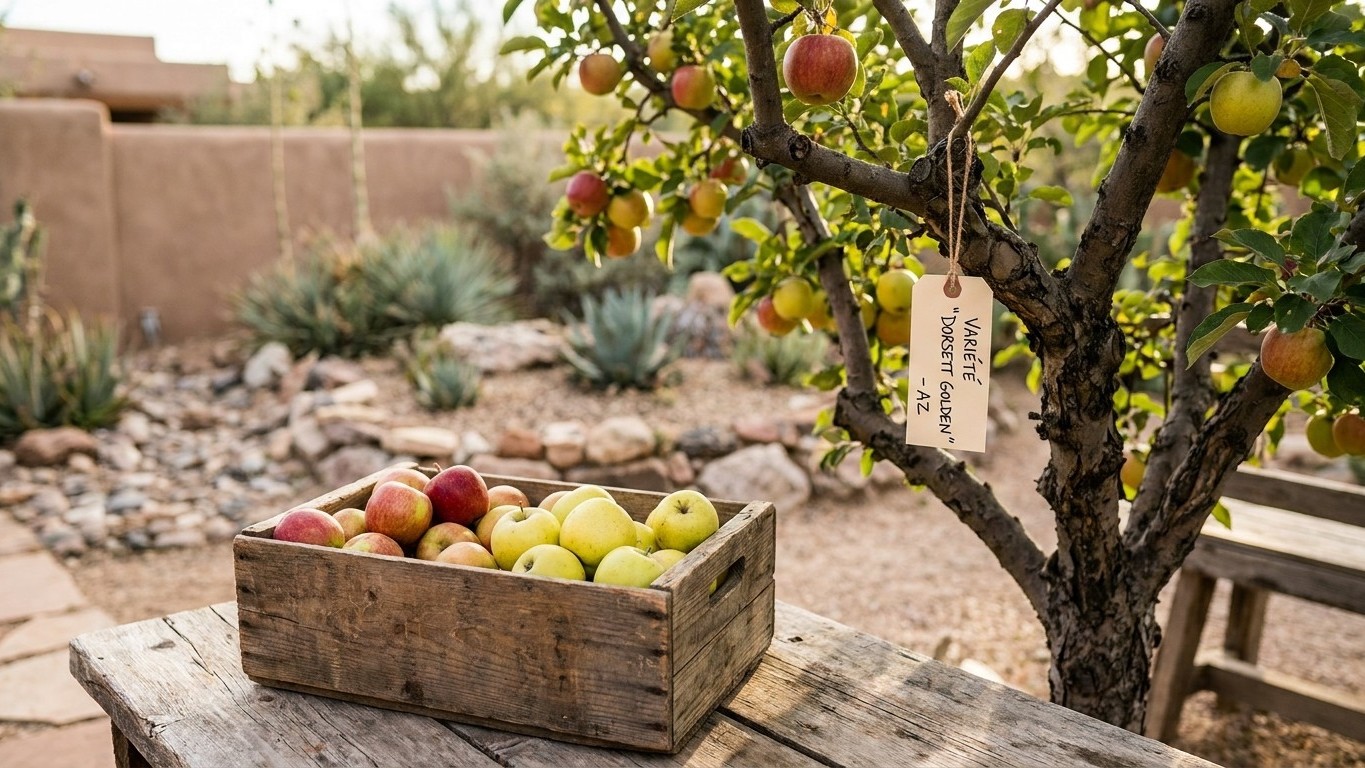

Arizona’s low desert will kill an apple tree with kindness, not cold — most winters here are too mild to ever really put the tree to sleep, so it wakes up patchy, blooms thin, and skips fruiting altogether. The variety that works isn’t the toughest one on the shelf, it’s the one bred to need the least winter chill, because that’s the number actually working against you in Phoenix and the valley floor around it. Before you buy anything, find the chill-hour figure printed under the hardiness zone and check it against your own elevation, not a nursery tag written for somewhere colder.
The short answer for Arizona
In the low desert around Phoenix, winter cold, not frost, is what decides whether an apple tree fruits at all. NOAA’s 1991-2020 climate normals put the coldest month’s average daily low at 44.8°F at the Phoenix reference station, and the same data set lists the frost-free season there at 365 days. NOAA’s NCEI 1991-2020 normals, combined with NOAA’s RCC ACIS daily records, show the station actually dipped to 32°F in only 6 of the last 30 springs, and only between late December and mid-January when it happened at all. A tree planted in the low desert is almost never going to freeze to death.
Why frost isn’t the limiting factor
That is the problem, not the reassurance it sounds like. Apple trees need a certain number of cumulative cold hours each winter to break dormancy evenly and flower on schedule, a trait known as winter chill. A cultivar bred for a cold climate can sit through a Phoenix winter and never accumulate enough of it, so it leafs out patchy, blooms late and thin, or skips fruiting some years altogether. The right variety for Arizona is defined by how little chill it needs, not by how cold-hardy it is, because cold hardiness in the low desert is rarely tested.
What the answer depends on
Higher ground changes the calculation. Areas well above the low desert floor get colder nights and accumulate more chill hours over a winter, which opens the door to cultivars that would sulk in Phoenix. What a tree needs in your yard depends on your elevation and how much afternoon shade or reflected building heat it absorbs, both of which shift the effective chill it experiences. If you haven’t already sited and prepared the planting hole, Growing Apples in Arizona covers that groundwork before you get to picking a cultivar.
Working through it

Apple cultivars are commonly grouped by how many chill hours they need before they’ll flower and set fruit reliably. Catalogs and nursery tags list this requirement, and it’s the single most useful figure on the tag for an Arizona buyer, more useful than the hardiness zone printed next to it. Matching that number to where you actually garden is the whole exercise.
Low-chill cultivars
These are bred for mild-winter regions and need the least cumulative cold. They’re the category most likely to flower and fruit in the low desert around Phoenix, where NOAA’s 44.8°F average winter low means chill accumulates slowly. The trade-off is fruit quality and storage life: low-chill apples tend to run softer, less crisp, and shorter-keeping than the classic cold-country cultivars, and they still need irrigation and shade management to get through the desert’s long, hot fruiting season.
Moderate-chill cultivars
These need a longer, steadier cold spell than the Phoenix valley usually delivers, and they do better at elevation, where nights run colder for longer. In the low desert, a moderate-chill tree may bloom unevenly some years, setting a partial crop instead of a full one. Planted higher up, the same tree can perform closer to its catalog description, which is why the label alone doesn’t tell you whether a variety will work. The planting site decides that, not the tag.
High-chill cultivars
These are the cultivars most home gardeners picture when they think of a classic apple, and they’re the least realistic choice for the low desert. They need sustained winter cold well beyond what the Phoenix station’s 44.8°F winter mean minimum ever supplies, so they either fail to break dormancy properly or bloom so late and thin that fruit set is a gamble every year. They belong at higher elevation in the state, not on the valley floor.
| Chill category | Where it realistically fruits | What you give up |
|---|---|---|
| Low-chill | Low desert valleys, including the Phoenix area | Softer fruit, shorter storage life |
| Moderate-chill | Mid-elevation sites away from the valley floor | Uneven bloom and partial crops in mild winters |
| High-chill | Higher elevation country | Impractical anywhere the winter stays this mild |
Because no single cultivar list is right for every Arizona address, the Arizona Apple Calendar, Stage by Stage is worth reading before you buy anything. It walks through bloom and fruit-set timing stage by stage, which is where a mismatched chill category actually shows up in the orchard.
What changes across Arizona
Every figure in this article is measured at the Phoenix reference station, and Phoenix is the mildest end of the state’s growing conditions, not the average of it. The low desert around Phoenix shares that same pattern with other low-elevation valleys nearby: warm nights, a coldest-month average minimum of 44.8°F by NOAA’s 1991-2020 normals, and winters too short and too mild to satisfy anything but a low-chill apple.
Low desert versus high country
Elevation is the biggest lever in the state. Areas that sit well above the valley floor, including Flagstaff and the White Mountains, run a genuinely different climate, one that freezes hard and holds cold long enough to satisfy moderate and even high-chill cultivars. No station used in this article covers those elevations, so treat every chill or frost figure above as a Phoenix number only, and confirm your own county’s winter before choosing a cultivar. Areas around Prescott and Sedona sit somewhere between the two extremes, cold enough in some winters to help a moderate-chill tree along and mild enough in others that it doesn’t, without a station reading of their own here to say which way a given year will fall.
Local terrain effects
Even within the low desert, terrain moves the number a little. A wash bottom or a low spot where cold air settles overnight runs colder than the open valley the weather station sits in, and a walled courtyard or a spot against a south-facing wall runs warmer. Neither swing is large enough to turn the low desert into high-chill country, but it can be the difference between a low-chill tree that blooms cleanly and one that blooms thin in a particular year.
The mistakes this climate punishes
Chill mismatch and skipped winter care
The costliest mistake is buying on hardiness zone alone and ignoring chill hours. A high-chill or moderate-chill cultivar planted in the low desert can look perfectly healthy for two or three years, since NOAA’s data shows the Phoenix station rarely freezes hard enough to damage the tree itself. The mistake shows up at bloom time, not at planting: the tree leafs out unevenly, flowers thin and late, and the crop that should have filled out by year three or four never does, because the valley floor never delivered the cold hours the cultivar’s tag promised.
The second mistake is treating the state’s near-frost-free winter as a reason to skip cold-season care altogether. Because the Phoenix station reached 32°F in only 6 of the last 30 springs, per NOAA’s NCEI normals and RCC ACIS daily records, it’s easy to assume the tree needs no attention through winter. But the tree still needs its dormant period respected. Pruning and any dormant spray still belong in the cold months, whether or not an actual freeze shows up that year, because the tree’s own internal clock runs on chill accumulation, not on visible frost.
Late feeding and elevation reversal
The third mistake is feeding or irrigating heavily late in the season, which pushes soft new growth right as the rare cold snap arrives. NOAA’s data puts that window between late December and mid-January in most years it happens at all, and soft, actively growing tissue is far more vulnerable to a sudden 32°F night than mature wood is. Stop nitrogen feeding well before that window and let growth harden off, even in a climate that skips the freeze most winters, because the one year it doesn’t skip it is the year that matters.
The reverse mistake shows up at elevation. A low-chill cultivar chosen because it’s easy to find at a big-box nursery can break dormancy and bloom early in a Flagstaff-area garden, right into a hard freeze that the high country genuinely gets and the low desert doesn’t. That mismatch costs the bloom, not the tree, but a tree that loses its flowers every spring never produces fruit either.
Checking this against your county
Every figure above comes from the Phoenix reference station, and your own county’s winter is the only one that decides which apple actually works on your property. Chill hours, the rare freeze window, and even elevation swing enough across Arizona that a Phoenix-based answer is a starting point, not a final one. The Arizona Cooperative Extension maintains county offices that track local conditions and can confirm what fruits reliably in your specific area before you commit to a tree.
Common questions
Can apples actually grow in Phoenix?
Yes, but only low-chill cultivars perform reliably there. NOAA’s 1991-2020 climate normals put the Phoenix area’s coldest month at a 44.8°F average daily minimum, which is enough winter cold for a low-chill apple to flower properly but not enough for a moderate or high-chill one.
Do apple trees need a second tree nearby to fruit?
Most apple cultivars need cross-pollination from a second cultivar, or at least a compatible tree within bee range, to set a full crop. A few are described as partially self-fertile, but even those tend to crop heavier with a second tree nearby, so check the pollination note on the tag before assuming one tree is enough.
How do I find out how many chill hours my yard actually gets?
There’s no substitute for a local reading. Ask the Arizona Cooperative Extension office in your county whether it tracks chill-hour accumulation for your elevation before you buy a moderate or high-chill cultivar.
Will a rare freeze in Phoenix kill my apple tree?
No, not the tree itself. NOAA’s NCEI normals combined with RCC ACIS daily records show the Phoenix station only reached 32°F in 6 of the last 30 springs, and mature apple wood tolerates far colder than that without dying. What a freeze can damage is open blossom or soft new growth, which is a timing problem, not a survival problem.