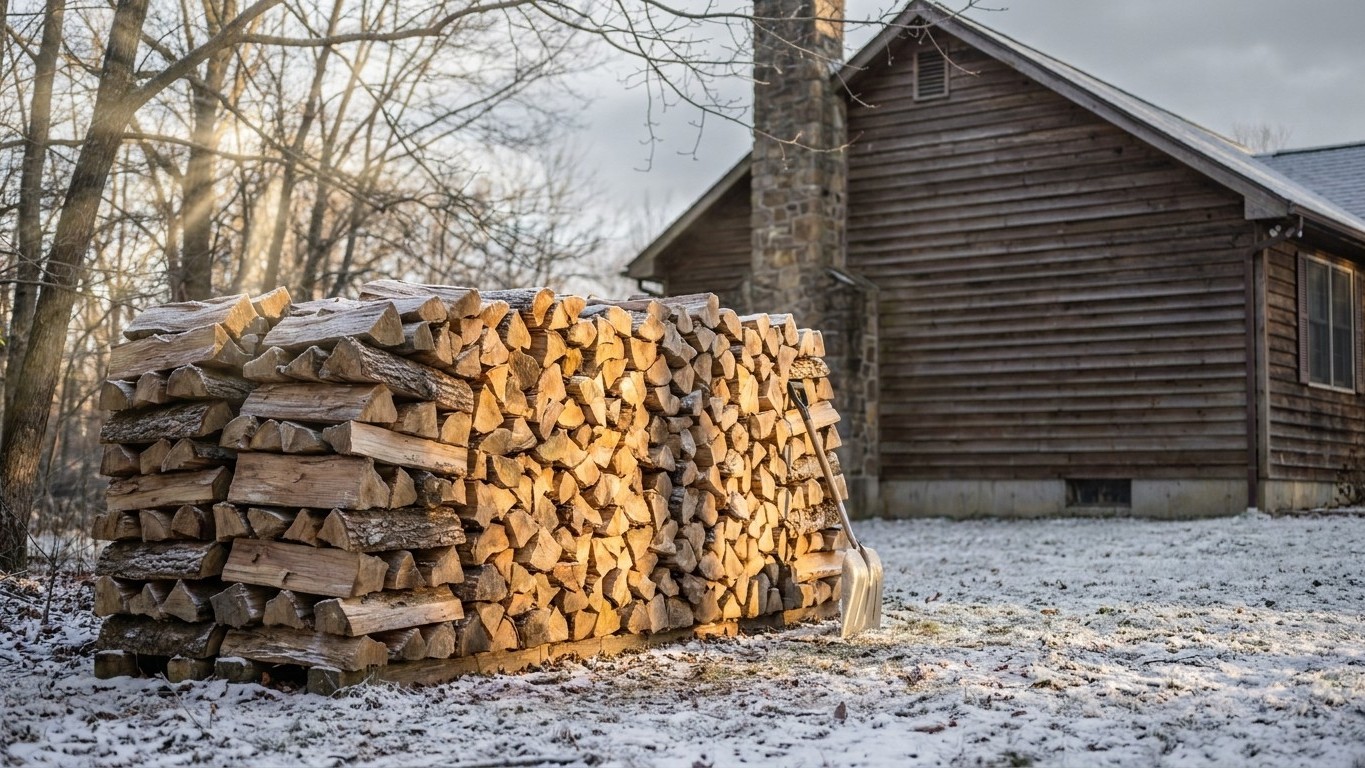

Winter in Delaware asks a real question of anyone burning wood: is this heat you need, or heat you enjoy? The answer starts with one number, the average low of the coldest month at Wilmington, and it shapes everything from which species you should chase to how many cords you’ll stack before spring.
How cold it actually gets here

The average daily low during Delaware’s coldest month sits at 25.6°F, measured at the Wilmington reference station under NOAA’s 1991-2020 Climate Normals. That’s not a record cold snap or a single brutal night. It’s the typical low, night after night, for the coldest stretch of the season. And 25.6°F is well below the point where firewood becomes optional.
Anything under 40°F pushes a home’s heating system into real work, and 25.6°F means the furnace, heat pump, or wood stove is fighting a genuine temperature gap for weeks at a time, not just a few cold snaps. If you’re burning wood in Delaware to take the edge off a chilly evening, that’s a fine use of a fireplace. But the mean minimum here tells a different story for anyone leaning on wood as a real heat source: this is a climate where a stove has to hold a fire overnight and still have coals in the morning.
Compare that 25.6°F to a milder mid-Atlantic winter and the gap is obvious. Some coastal and southern regions barely dip below 40°F on their coldest nights, which turns firewood into ambiance. Delaware isn’t that. The state sits in a transition zone, cold enough that a poorly stocked woodpile gets noticed by February, not decorative enough that species choice stops mattering.
What this means practically: the wood you buy or cut this fall has a job to do past midnight, not just at dusk. A fire that burns hot and fast for two hours looks great over dinner but leaves a cold stove by 3 a.m. when the outside temperature is sitting in the mid-20s. That’s the gap dense hardwood is built to close, and it’s why the next question, which species actually earn their space in your woodshed, matters more here than it would in a warmer state.
There’s also a practical side effect of that 25.6°F figure: it sets the pace for how much wood a household actually burns through a season, which is a separate calculation from species selection. But before getting to volume, it helps to know which wood is worth stacking in the first place.
Which woods are worth the effort here
Density decides more in a Delaware winter than in a milder one, because a cord is a fixed volume, 4 feet by 4 feet by 8 feet, or 128 cubic feet, no matter what species fills it. A cord of a dense hardwood packs more actual wood fiber into that same box than a cord of a light, airy species. More fiber per cord means more stored energy per cord, even though the commonly cited average of about 20 million BTU per cord of well-seasoned hardwood, per Michigan State University Extension, is just that: an average across species and moisture levels, not a fixed value you can assume for any particular load.
Red oak is the species worth knowing by name here, because it’s common across Delaware woodlots and it behaves differently from most other hardwoods in one important way: MSU Extension notes that red oak’s cell structure makes it dry slower than most species, so it needs more time seasoned before it’s ready to burn efficiently. That’s not a reason to avoid it. Dense, slow-drying woods like red oak are exactly what a 25.6°F January calls for, wood that burns long and holds coals overnight. The catch is patience. A red oak round split this spring is not the same as a red oak round split two years ago, even if both look dry from the outside.
The lighter, faster-burning species have their place too, just not as the main event. Softer woods catch fast and burn hot for a short stretch, which makes them useful for starting a fire or getting through a mild shoulder-season evening in October or April, when the goal is quick warmth rather than an overnight burn. Nobody should build a winter’s supply around a species that burns out in ninety minutes if the plan is to sleep through a 25-degree night on one load.
For the full comparison of species by density and heat output, a species-by-species firewood BTU guide is worth checking before buying, since the specific numbers vary by exact species in ways a general rule can’t capture. But here’s the part the chart won’t tell you: availability beats theory. A species with excellent density on paper is worthless if the only supply you can find locally is green, unseasoned, and sold three weeks before you need it. A modest but well-seasoned local hardwood, cut and split last year, will outperform a “better” species you can’t get dry. In Delaware, that usually means asking a local seller directly how long a specific load has been split and stacked, not just what species it is.
How much wood a winter takes
There’s no honest single number for how many cords a Delaware winter takes, and any published figure that ignores your specific situation should be treated with suspicion. What actually determines the answer are three things working together: how cold it gets where you live (that 25.6°F average low is the starting point), how well your house holds heat once it’s warm, and whether wood is carrying the whole heating load or just supplementing a furnace or heat pump.
A published “you’ll need three cords” figure assumes a specific house, a specific stove efficiency, and a specific role for wood in that home’s heating plan, and almost none of those match your situation exactly. A drafty 1920s farmhouse with single-pane windows and no attic insulation loses heat constantly, which means the stove is refueling around the clock just to hold steady. A newer, tightly built home with modern insulation and sealed windows can coast on far less wood to hit the same indoor temperature, even sitting under the identical 25.6°F outdoor low.
That gap isn’t small. A poorly insulated house in a hard winter can burn through roughly double what a well-sealed house uses in the exact same climate, simply because so much of that heat is leaking out through walls, windows, and an uninsulated attic before it ever does its job. Two neighbors on the same street, same winter, same woodpile quality, can end up with wildly different consumption because one house holds heat and the other bleeds it.
The role wood plays matters just as much. A household using a wood stove as the sole heat source for the winter needs enough supply to carry every cold night from November through March. A household burning wood in a fireplace a few evenings a week, with a furnace doing the real work, needs a fraction of that, closer to seasonal enjoyment than seasonal survival. Before ordering or cutting a set number of cords, it’s worth actually tracking a few weeks of real usage in your specific house, at your specific stove, during a cold stretch. That gives a far better estimate than any generic number floating online.
Drying wood in this climate
Seasoning matters more than species, full stop, and Delaware’s climate has its own timeline for getting there. The target is the same everywhere: wood needs to reach 20 percent moisture content or less before it burns efficiently, according to Michigan State University Extension. Green, freshly cut wood can carry over 60 percent moisture, and every bit of that water has to boil off inside the firebox before the wood actually starts giving off usable heat, which is exactly why a green log hisses, smokes, and refuses to catch.
What dries wood isn’t sunshine sitting on top of a pile. It’s air moving through split wood that’s stacked with gaps, for enough time to pull the internal moisture out. Delaware’s humid summers slow that process compared to a drier climate, so wood that might season in four months somewhere arid can need a full summer or longer here, split and stacked the whole time so air can actually reach the wood fibers, not left in round, unsplit logs where the bark seals moisture in.
Red oak deserves a second mention here specifically because of how it dries. MSU Extension flags it as a slow seasoner due to its dense cell structure, meaning a red oak round split this past spring is very likely not ready to burn well by this coming winter, even after months on a rack. That’s not a flaw in the wood. It’s a reason to plan a year ahead rather than a season ahead.
The single most common mistake in Delaware firewood planning follows directly from that timeline: cutting and splitting wood in spring, assuming it’ll be ready by the following winter, and finding out in December that it still hisses on the fire. Wood meant for this coming winter should have been split and stacked at least by the previous spring, ideally earlier, with red oak pushed even further back given how slowly it releases moisture. Anyone starting a woodpile from scratch this season should treat this winter’s purchase as bought wood, already seasoned by someone else, and start their own stack now for next year.