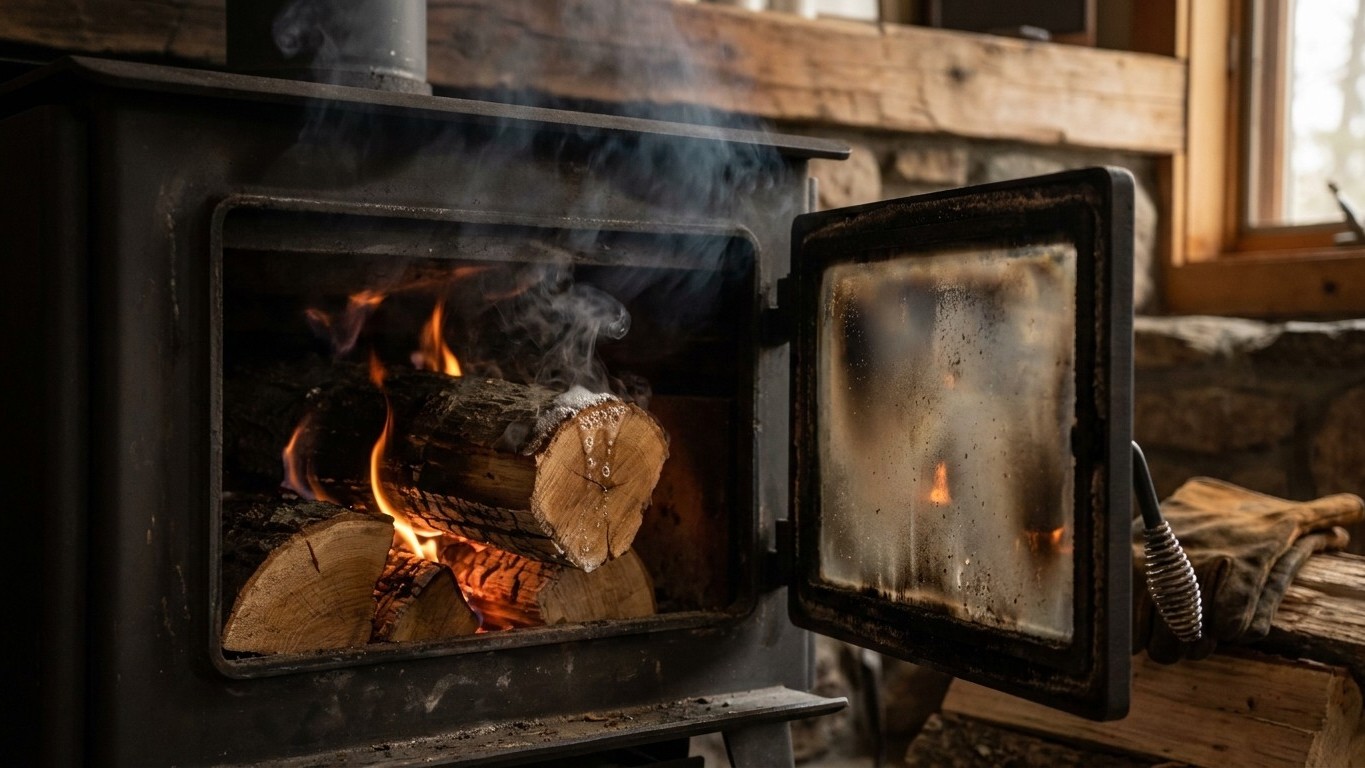

Hissing, popping, and little bubbles of moisture seeping out of the log ends while it’s supposed to be burning: that’s not a defective piece of wood, and it’s not dangerous by itself. It’s a sign the fire is spending its energy boiling water instead of heating your house. The fix isn’t complicated, but it starts before the wood ever hits the firebox.
What you are seeing

You load a split, close the door, and instead of a clean catch you get a wet sizzle, sometimes a faint hiss like a kettle, sometimes actual foam or bubbles pushing out of the cut ends. The flame looks weak, orange rather than the bright yellow-white you’d expect, and it struggles to spread past the piece you just added. Smoke tends to be heavier than usual, and the glass on a stove door (if you have one) fogs and blackens faster than it should.
This is not urgent in the sense of an emergency. You are not about to have a chimney fire from this one load, and the stove isn’t damaged by a hissing log. But it is a real problem, not a cosmetic one. That moisture has to go somewhere, and it’s your heat paying for it. Every ounce of water in that log has to be turned to steam before the wood itself can start releasing usable heat, and that conversion eats a large share of the energy the log would otherwise be giving you. So the room stays colder than it should for the amount of wood you’re burning through.
There’s also a slower, quieter cost. Wood that’s still full of water burns cooler, which means the smoke leaving the fire carries more unburned particles and creosote-forming compounds up the flue. Over a season, that adds up on the walls of the chimney. A single hissing log tonight isn’t a hazard. A whole winter of hissing logs is how deposits build.
So the honest read on what you’re seeing: annoying, wasteful, and worth fixing, but not an alarm-bells situation for tonight. Pull that piece, look at it, and keep reading before you decide what to burn next.
Why it happens
The wood is wet. That’s the whole mechanism, and it’s almost always the answer even when it seems like it shouldn’t be. The hissing and bubbling you’re watching is water boiling out of the end grain under heat, and that is water being paid for with the heat you wanted from the fire.
Here’s where most people get tripped up: they assume that because the log has been sitting outside, stacked, covered, “for a while,” it must be seasoned. It usually isn’t, and the reason has to do with how wood actually loses moisture. Wood dries from the ends and from split faces, not through the bark. Bark is nature’s water-resistant coating, built to keep moisture in the living tree and keep it from drying out on the stump. It does the same job after the tree is cut. So a round log with the bark still on, even one that’s been rained on and dried a hundred times over two years, can still be wet in the middle. The surface looks weathered and gray, which people read as “seasoned,” but that graying is just sun and moisture cycling on the bark. It tells you almost nothing about the moisture content six inches inside.
That’s why a log that has sat in the round for two years can still be wet in the middle. Two years sounds like plenty of time, and for split, stacked wood exposed on the cut faces, it usually is. But for a whole round, unsplit, the water has nowhere to escape except through the two end faces, and wood is a poor conductor of moisture along its length compared to across a fresh split. The middle of a thick round can stay saturated for years past when the same piece, split in half, would have been ready to burn.
A less common but real contributor is storage that keeps rain or ground moisture reaching the wood, an uncovered top or a stack sitting directly on dirt. That adds water back faster than the wood can shed it, especially over a wet spring. But even a well-stored stack fails if the wood was never split down small enough, or never given enough time from a fresh split face to actually dry. The seller’s word on how long it’s “been seasoning” is worth very little if you don’t know whether it was split and how it was stacked during that time.
What it isn’t, almost ever: a defect in the species, a bad batch, or something wrong with your stove. The mechanism is water, plain and simple, and the fix has to happen before the wood is anywhere near a flame.
What to do about it
Tonight, the only real move is to stop burning that piece and go find out what you actually have in your stack. Take one split, and instead of judging it by the outside, split it again and look at the fresh face. That’s the test that matters: color, feel, and whether it’s noticeably cool and damp to the touch compared to a piece you know is dry. Wood that hisses in the fire is not seasoned, whatever the seller told you and however long it’s supposedly been stacked. The freshly split face doesn’t lie the way the weathered outside does.
If you have a stack of unsplit rounds, especially anything wider than about six inches across, that’s likely your source. There is no way to dry a log inside the firebox. It has to happen before the burn, over months, with the wood already split and stacked with air moving through it. Trying to “cook off” the moisture by running it hotter or longer in the stove just wastes more heat and pushes more moisture-laden smoke up the flue. Pull those rounds, split them down now, and set them aside for next season rather than fighting them tonight.
For the wood you need to burn this week, the practical workaround is mixing: use your driest, oldest splits as the base of the fire and add anything questionable in small amounts once the fire is already established and hot. A hot, established bed of coals can burn off surface moisture on a marginal piece far better than a cold or newly lit fire can, though it’s still not ideal and you’ll still lose some heat to it.
Where this stops being a wood problem and becomes a chimney problem: if you’ve been burning wet wood regularly for a season or more, or you’re noticing a lot of dark, oily buildup on a stovepipe or flue liner where you can see it, that’s a job for a chimney sweep, not a firewood fix. Creosote that’s already deposited doesn’t go away because you switch to dry wood next month. A sweep can tell you how much has built up and whether it needs to be removed before you keep burning through the winter. That inspection and any cleaning is outside what you can fix by choosing better logs, and it’s not something to guess about or put off if you’ve had a season of smoky, hissing fires.
How to keep it from coming back
The upstream habit here is almost entirely about seasoning and splitting, not about the stove or how you build the fire. Wood needs to be split to size while it’s still fresh, not left in the round “to season,” because splitting exposes the interior faces that actually let moisture escape. A round sitting whole is barely drying at all compared to the same wood split into standard-size pieces.
Split wood needs stacking that lets air move through it: raised off the ground, spaced enough for airflow, and ideally with a top cover that keeps rain off without wrapping the sides in plastic (which traps moisture instead of releasing it). Full sun and wind exposure on the split faces does more for drying than any amount of time spent covered and shaded.
Timing matters more than most people expect. Wood split and stacked in spring has a full summer of heat and airflow working on it before the following winter, which is usually enough for many species. Wood split in late summer or fall is racing the clock, and often isn’t ready by the time cold weather arrives, no matter how good the stack looks.
If you want to go deeper into how to actually judge whether a piece is ready, rather than guessing from the outside or trusting what you were told at the woodlot, that’s covered in detail in the sibling page on how to tell if firewood is really dry. That’s the piece to read before your next delivery arrives, so you’re not finding out the hard way, mid-winter, with a hissing log in hand.