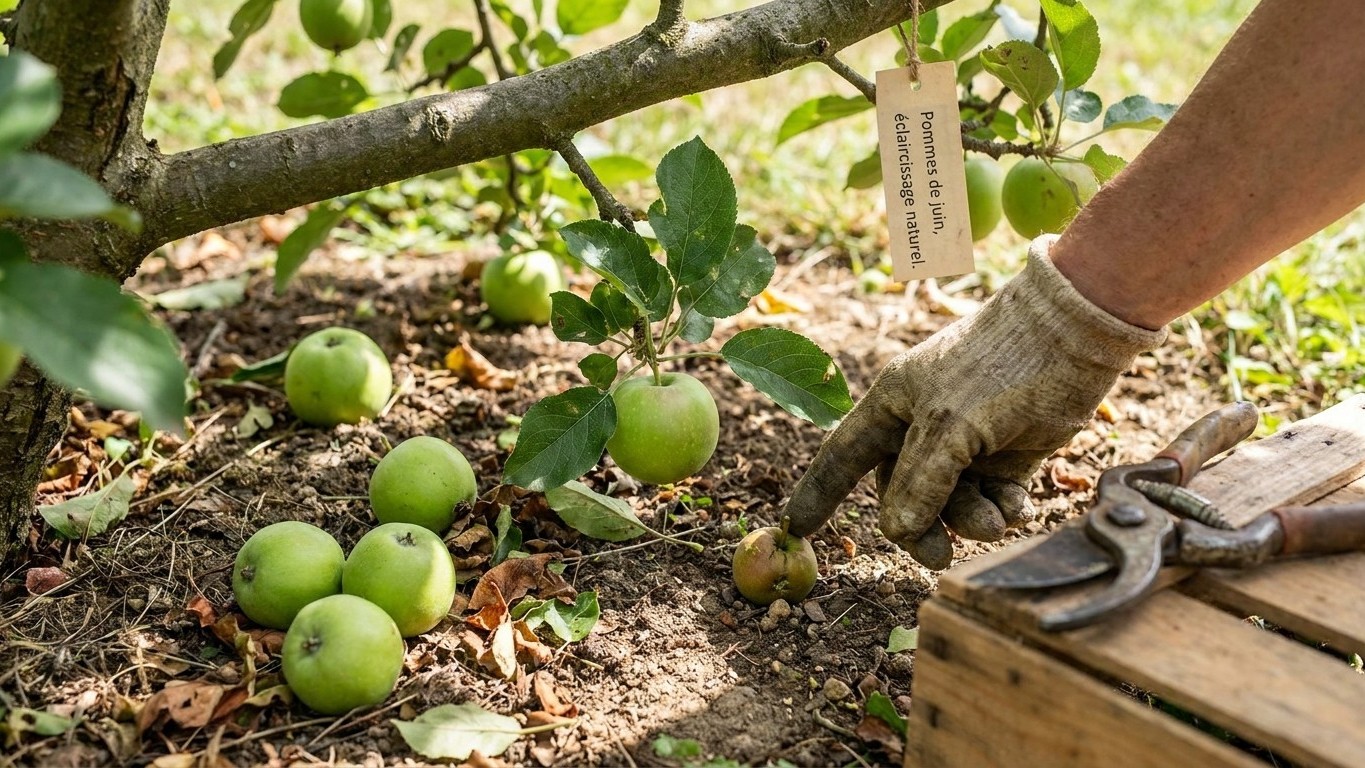

June drop is the tree shedding its own excess fruit, not a disease or a feeding problem. Apple trees routinely set far more fruitlets at bloom than they can carry to harvest, and a few weeks after petal fall they let a portion of the smallest ones go so the rest can size up properly. Pick up a handful of what has fallen: if each fruitlet still has its stem attached and a small seed inside, that is ordinary self-thinning and needs no treatment. If the fruit is scarred, tunneled, or dropping before petal fall has even finished, look further before assuming it is normal.
What you are seeing

The stage it happens at
June drop shows up in the weeks following petal fall, once the flower petals have gone and the small fruitlets left behind are still green and roughly marble to thumbnail sized. They fall still attached to a short stem, and some carry the shriveled remains of the flower parts at the blossom end. You will usually find them scattered under the canopy over a period of days rather than all at once.
What is normal about it
This is the tree correcting an over-set from a heavy bloom, and it is more visible after a season of good pollination weather, on young vigorous trees, and on heavy-blooming varieties that set more flowers than the tree can support to harvest. The fruit dropping is disproportionately the smallest fruitlets in each cluster, the ones with the fewest seeds developing inside, because a fruitlet’s ability to hold on is tied directly to how well it was fertilized. The volume varies a great deal tree to tree. A tree that overset heavily at bloom may drop a visible layer under the canopy, while a lightly set tree drops almost nothing at all. Not seeing an obvious June drop is not a problem either, it just means the tree did not set more fruit than it could carry in the first place.
What it is not
June drop gets blamed for a few things it is not. It is not a fungal or bacterial disease: there is no sunken lesion, no black or brown spotting, no oozing on the fruit skin. If the fallen fruitlets are discolored, soft, or leaking, that is a separate rot problem, not June drop.
It is also not frost injury. A late freeze around bloom leaves a corky, sunken patch or a ring scar right at the base of the young fruit, and affected fruitlets generally stall out or drop within days of the cold event, not several weeks after petal fall. Sunscald looks different again, a bleached or blistered patch on the side of the fruit facing the sun, and it does not cause the whole fruitlet to drop.
Rule out simple wind damage too. A hard blow can knock loose fruit that was already marginal and mimic the timing of a natural drop, but wind usually also strips leaves and small twigs at the same time, which June drop alone does not do. And if the leaves themselves look scorched or curled along with the fruit loss, that points toward drought stress compounding an ordinary drop rather than a separate cause on its own.
What actually causes it
Natural self-thinning
The baseline cause is the tree’s own hormonal thinning after setting more fruit at bloom than it can carry. This is the process described above, and on most home trees it accounts for the bulk of what falls in June.
Poor or partial pollination
A flower that received only partial pollination often develops into a fruitlet with too few seeds to hold on, and it aborts and falls in June even though it looked fine right after bloom. Fruit that does survive with a low seed count more often finishes lopsided or lumpy instead of dropping outright, a symptom covered in Lopsided Apples: What Poor Pollination Looks Like. Pollination trouble is common where pollinizer varieties were mismatched from the start. Jonagold, Mutsu, Stayman and Winesap all carry sterile pollen, according to Clemson Cooperative Extension’s HGIC 1350, the University of Georgia Extension’s Circular 740, and USU Extension: each of these can be pollinated by another variety but produces none of its own that will set fruit on a neighbor. A garden planted with only two of these varieties together will see fruit set fail broadly, not just a heavier June drop.
Even when neither variety has sterile pollen, they still need to bloom at overlapping times. Clemson’s HGIC 1350 groups apples by relative bloom order:
| Bloom group | Varieties |
|---|---|
| A (earliest) | Anna, Dorsett Golden |
| B (mid-season) | Fuji, Gala, Ginger Gold, Granny Smith, Jerseymac, Mollie’s Delicious, Mutsu, Red Delicious, Yates |
| C (latest) | Arkansas Black, Golden Delicious, Jonagold, Ozark Gold, Priscilla, Rome Beauty, Stayman |
That order holds regardless of climate, even though the actual calendar dates shift from one region to another. A group A tree paired only with a group C partner can miss its overlap most years, which shows up later as a heavier than usual June drop on top of thin pollination.
Heavy crop load or biennial bearing
A tree that carried an unusually heavy crop the previous year, or is heading into one this year, often thins itself hard in June as part of tipping toward alternating a big year with a bare one. That pattern, and the steps to break it, are covered in A Heavy Crop, Then Nothing: Breaking the Two-Year Cycle.
Pest stings
Plum curculio and early codling moth activity can also cause fruitlets to drop in June, usually leaving a crescent-shaped scar or a small entry hole on the skin before the fruit falls. Because the pests present and the timing of any control differ by region, check with your state’s extension service for identification and a local spray schedule rather than guessing at either.
What to do this season
Normal June drop needs no action at all. Do not spray anything to try to stop it, and do not assume the tree is failing because the ground under it is littered with small green apples. Commercial orchards sometimes use chemical thinning timed to petal fall, but that is an orchard-scale practice with rates set for specific conditions, and it is not something to improvise in a backyard without guidance from your extension service.
Once the natural drop has slowed, you can hand-thin what remains, leaving one fruit per cluster, to improve the size of what is left and ease the weight on the branch. This step helps the current crop but it does not fix whatever triggered a heavier than usual drop in the first place. If a pest sting looks like the cause, clean up and discard the dropped fruitlets rather than leaving them to sit under the tree, and check with your extension office about the timing of controls for whatever pest is active in your area this year.
If drought or nutrient stress played a part, water deeply now, but understand that the fruit already on the ground will not come back this season. The benefit of correcting soil moisture or fertility shows up in next year’s set, not this one. And if the orchard’s whole pollination plan turns out to rest on two sterile-pollen varieties paired with nothing else, this year’s low set is likely fixed for the season. The real correction there is a new pollinizer tree or a graft added at next dormancy.
Stopping it happening again
Fix pollination before the tree even goes in the ground, or graft in a fix at the next dormant season if it is already planted. Choose two or more varieties from the same or overlapping bloom groups per Clemson’s HGIC 1350, and make sure the pairing is not two sterile-pollen varieties standing alone. The basics of choosing and siting apple trees for good pollination are covered in Growing Apples.
Rootstock choice matters too, because it sets both the mature size of the tree and, indirectly, how much fruit it is carrying when June drop hits. USU Extension’s figures for mature height show the range clearly:
| Rootstock | Mature height (USU Extension) |
|---|---|
| M.9 | 8-12 feet |
| M.26 | 12-15 feet |
| G.11 | 12-15 feet |
| G.30 | 18-20 feet |
| M.7 | 18-20 feet |
| M.106 | 25-30 feet |
| MM.111 | 30-35 feet |
| Seedling | 35-40 feet |
A tree on a tall rootstock like MM.111 or a seedling carries a much bigger canopy and often a heavier total fruit load, so a visible layer of dropped fruitlets under it in June is proportionate and expected. A dwarfing tree on M.9, topping out at 8-12 feet, is carrying far fewer fruitlets to begin with, so the same amount of drop would be a much bigger share of its crop. Once bloom is over each year, do not rely on natural thinning alone. Deliberate hand-thinning at petal fall is also the main lever against tipping into biennial bearing, since a tree carrying a lighter, well-spaced crop one year is far less likely to skip the next.
Common questions
Should I thin the apples that are left after June drop?
Yes, once the natural drop has slowed down, thinning to one fruit per cluster gives the remaining apples more room to size up and reduces the weight pulling on each branch. Thin by hand rather than waiting for a second wave of drop to do the job.
My tree dropped almost all its apples, is that still normal?
Losing most of a crop is a heavier drop than typical self-thinning, and usually points to a specific trigger such as poor pollination, a pest sting, or a tree recovering from an especially heavy crop the year before. Check the fallen fruit for stings, scars, or very low seed counts before assuming it is just ordinary thinning.
Can I spray something to stop June drop from happening?
There is no home-garden spray that reliably stops the tree’s own natural thinning, and trying to override it is not worth the risk. If you are trying to prevent a different problem, such as a pest sting, get the pest identified and get a control recommendation from your local extension service rather than spraying speculatively.
How do I tell June drop apart from a pest causing the fruit to fall?
Check the fruit itself before deciding. Fruit dropping from ordinary self-thinning is usually smooth-skinned and simply small for its stage, while pest-related drop often shows a crescent-shaped scar, a small hole, or visible tunneling. When in doubt, a photo and a description sent to your extension office will get you a faster answer than guessing.