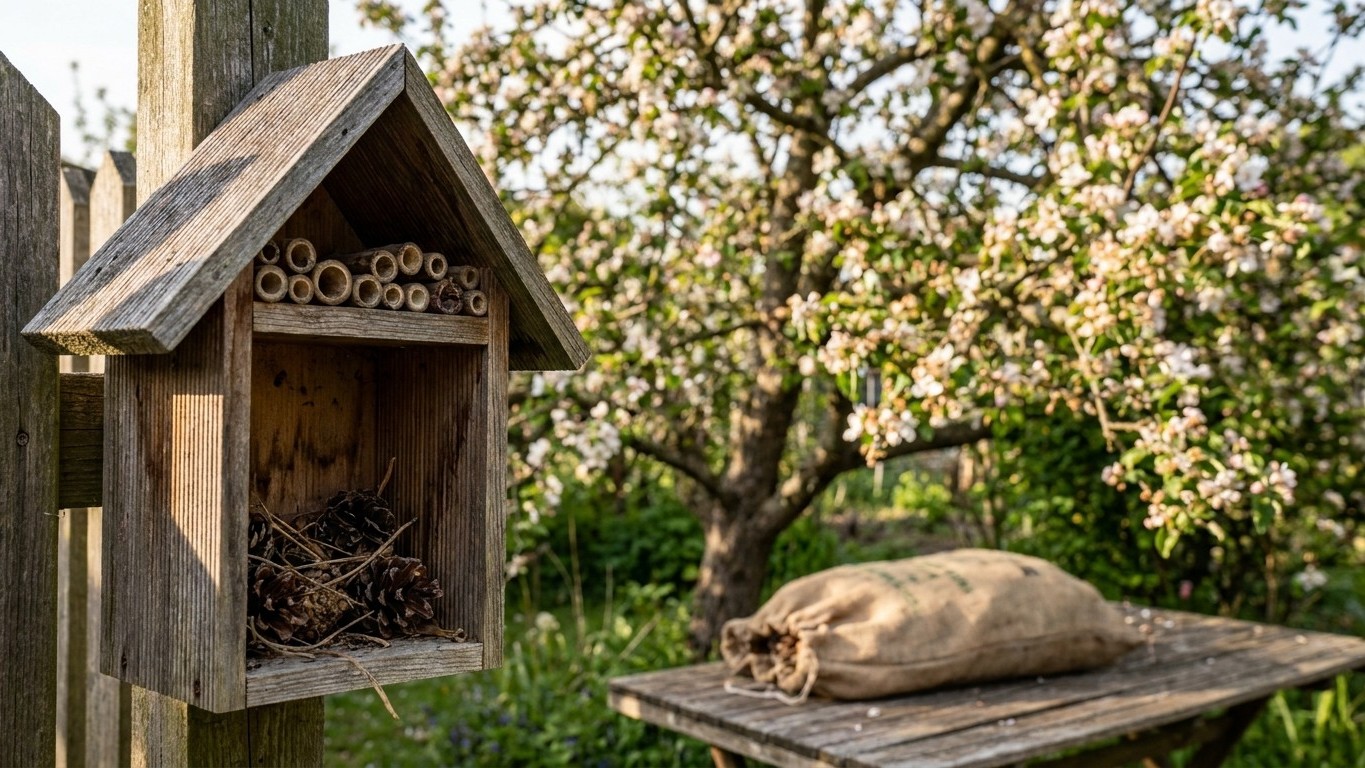

Bare branches after a spring full of blossoms almost always means one thing: nothing pollinated those flowers, and this isn’t a sick tree, it’s a lonely one. Go out and look at what’s blooming near it right now, and think back to what’s actually planted in reach of the bees. If your tree is a Jonagold, Mutsu, Stayman, or Winesap standing by itself, or paired only with another variety that flowers weeks off schedule, that’s your answer. Check what’s flowering nearby before you do anything else.
What you are seeing

The tree flowers on schedule, sometimes generously. The blossoms open fully and look healthy, bees or other insects visit them, and then the petals fall and nothing follows. No pea-sized fruitlet swells behind the flower cluster, or a few fruitlets form and then shrivel and drop within a week or two of petal fall, well before the tree would normally be shedding excess fruit. From a distance the tree looks fine all spring. The disappointment shows up later, when the branches that should be carrying young apples are bare.
What this does not mean
This is not a sign that the tree is sick or dying. A tree that blooms reliably every year has enough stored carbohydrate and the right winter chilling to initiate flower buds, and flowering itself proves that. The failure happens after that point, at fertilization, not before it.
It also does not mean every flower on the tree needs to set fruit. An apple tree opens far more blossoms than it could ever mature into full-sized apples, and even on a properly pollinated tree most flowers are shed naturally as the tree thins itself. What separates a normal year from a no-fruit year is the near-total absence of any fruitlets at all, not simply a lighter crop than you hoped for.
- Flowers open and look normal, no browning or distortion of the petals
- Pollinating insects are present and visibly working the blossoms
- Petals fall on schedule but no green swelling appears at the base of the flower
- Any fruitlets that do form drop within one to two weeks, not in the later, larger June drop
Heavy bloom is not a promise of a heavy crop. A tree can flower for two or three weeks straight and still finish the season with an empty canopy if fertilization never took place.
What it is not
June drop looks similar at a glance but happens later, and to fruit that already set. If you can find small apples, even marble-sized ones, that formed after bloom and then dropped a few weeks on, that is the tree’s normal early thinning, not a pollination failure. Why Small Apples Fall in June covers that separately, and it is worth ruling out before you assume nothing set at all.
Cracked or split fruit is a different problem entirely, and it only happens once fruit has already formed and sized up, usually after heavy rain following a dry spell. If your tree has no fruit to crack, that is not the issue here, but it helps to know what Apples That Split After Rain looks like so you can tell the two apart in future seasons.
Pest or disease damage to the flowers themselves, such as browning petals, distorted blossoms, or webbing in the cluster, points to something like fire blight or frost injury rather than a pollination gap. Those problems usually show visible damage on the flower itself, rather than a clean bloom followed by silence.
A young tree that has never fruited is not necessarily failing either. Apple trees take a few seasons after planting before they settle into regular bearing, and a young tree blooming without setting fruit in its first couple of years is common, not on its own a sign of a pollination problem.
What actually causes it
Four distinct problems produce the same blank result, and telling them apart matters because the fix for one does nothing for another.
No compatible pollen partner
Most apple varieties cannot fertilize their own flowers and need pollen from a different variety nearby. Worse, four widely planted varieties, Jonagold, Mutsu, Stayman and Winesap, produce pollen that cannot fertilize any apple flower at all, according to Clemson HGIC 1350, UGA Circular 740 and USU Extension. A garden holding only two of those four, or one of them paired with nothing else, will bloom every year and set nothing.
Bloom timing that does not overlap
Even a fertile pollen source is useless if it flowers weeks apart from the tree that needs it. Clemson HGIC groups common varieties into three relative bloom windows, and the order holds everywhere even though the actual calendar dates shift with climate.
| Bloom group | Varieties | Pollen note |
|---|---|---|
| A | Anna, Dorsett Golden | Fertile |
| B | Fuji, Gala, Ginger Gold, Granny Smith, Jerseymac, Mollie’s Delicious, Mutsu, Red Delicious, Yates | Mutsu is pollen-sterile |
| C | Arkansas Black, Golden Delicious, Jonagold, Ozark Gold, Priscilla, Rome Beauty, Stayman | Jonagold and Stayman are pollen-sterile |
Pair a variety with a partner in the same group or an adjacent one, and avoid resting a whole planting on two varieties from the sterile list above.
Weather during the bloom window
Bees fly poorly below a certain temperature and not at all in steady rain or wind, and a cold snap during bloom can damage the flower’s internal parts even when the petals look fine from outside. A week of poor pollinating weather at the exact time the tree is open can wipe out the whole crop even with a good partner variety nearby.
Biennial bearing
A tree that carried a very heavy crop the previous year sometimes blooms normally the following spring but sets little or nothing, because the reserves that would have supported fruit development went into the prior year’s crop and into building the current year’s flower buds at the same time. This shows up as a boom-and-bust pattern across years rather than a single bad season, and it corrects itself over a couple of cycles once the tree is thinned properly.
What to do this season
If bloom is still underway
If bloom is still open when you notice the problem, you have a narrow window to act. Hand pollination works on a small backyard tree: collect fresh pollen from an open flower on a compatible variety, a small paintbrush or cotton swab will do, and dab it into the center of open flowers on the tree that needs it, ideally in the morning while flowers are freshly open. It will not save a whole orchard, but it can put a season’s worth of apples on a single small or espaliered tree.
Hold off on any insecticide spray while the tree is in bloom. Even a product otherwise labeled for use on apples can kill the bees and other insects doing the pollinating work if applied while flowers are open. Check your own state extension service for the specific products and timing allowed where you garden, since registrations and rules differ by state.
Once petals have already fallen
If the flowers have already dropped and no fruit set, there is nothing left to correct this year. The fertilization window closes within days of petal fall, and no amount of watering, feeding or spraying afterward brings fruit back once it has passed. Resist the urge to over-fertilize a tree that failed to set. A tree pushed hard with nitrogen after a no-fruit spring tends to respond with excess leafy growth rather than better flowering next year.
What you can do now is document what happened. Note the bloom date, the weather that week, and whether you saw bees working the flowers, because that record is what will tell you next spring whether this year’s cause was a timing gap, a weather event, or a straightforward missing pollen partner.
Stopping it happening again
Choosing a compatible partner
The fix almost always starts at the planting stage, not the bloom stage. If you are adding a new tree or a new pollen partner, choose a variety in the same bloom group or the one next to it, per the Clemson HGIC groupings above, and confirm it is not one of the four pollen-sterile varieties standing in as your only partner. A crabapple with a long bloom period is a reliable backstop where there is not room for a second full-sized tree.
Rootstock, spacing and pruning
Rootstock choice affects how soon and how reliably a tree settles into bearing, and it fixes the tree’s mature size, which decides how close together you can plant a partner variety. USU Extension lists mature heights from about 8 to 12 feet on M.9 up to 35 to 40 feet on seedling rootstock, with M.26 and G.11 at 12 to 15 feet, G.30 and M.7 at 18 to 20 feet, M.106 at 25 to 30 feet, and MM.111 at 30 to 35 feet. A smaller rootstock lets you fit two compatible varieties into the same space a single large tree would otherwise take. The basics of choosing rootstock and spacing when you are still setting up the planting are covered in Growing Apples.
At the pruning stage, avoid removing all the oldest wood in one season on a tree that already struggles to fruit, since some varieties carry more of their flower buds on older spurs than others. Ask your county extension office about timing if you are not sure what to leave.
Where biennial bearing is the pattern, thin the heavy year’s crop by hand while the fruit is still small, so the tree carries less weight and has reserves left to build flower buds for the following spring. This single change is the most reliable way to smooth out a boom-and-bust cycle over two or three seasons.
Common questions
How many years does it take for a new apple tree to fruit?
It varies by rootstock and variety, and a young tree may bloom well before it is ready to carry fruit through to maturity. Give a newly planted tree a few full growing seasons before treating a lack of fruit as a problem rather than normal establishment.
Can I plant just one apple tree and still get fruit?
Only if a compatible variety is already blooming nearby on a neighboring property, since most apple varieties need cross-pollination from a different variety. Planting from scratch with no other apple trees in bee range means planning for at least two compatible varieties, or one variety plus a crabapple.
Do I need to keep honeybees to get apples to set?
No, honeybees are not required specifically. Wild bees, mason bees and other pollinating insects will do the job, and the more of them are active during bloom, the better your odds of a full set. What matters is that some pollinating insect is present and active while the flowers are open.
My tree set fruit fine last year with the same neighbor tree, why not this year?
The pollen partner probably has not changed, so look at the weather during this year’s bloom window and whether the two trees’ bloom dates lined up as closely as they did last year. A cold, wet, or windy spell during bloom, or a shift so the two trees flowered slightly out of sync this year, can produce a no-fruit season even when the same pair worked well the year before.