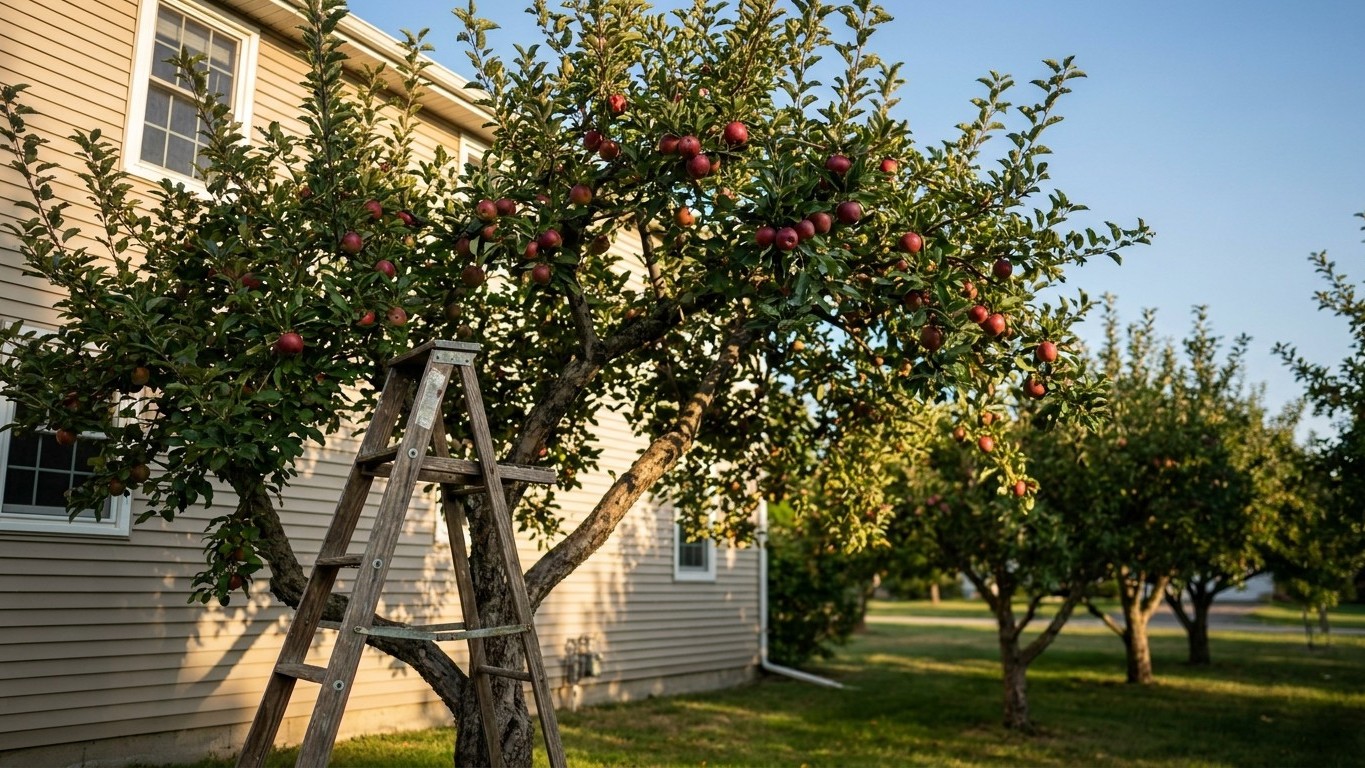

A G.30 apple tree tops out at 18 to 20 feet, according to Utah State University Extension’s rootstock size chart for home orchards. That single figure decides how tall a ladder you’ll need, how far apart to plant your trees, and how many years you’ll wait for a first apple. Here’s what that number means on the ground, and who should plant this rootstock instead of something smaller or larger.
What G.30 does to the tree

Eighteen to twenty feet sounds abstract until you picture it against a house. That’s roughly the height of a two-story roofline, tall enough that the top third of the canopy sits well beyond reach of a standard 6-foot stepladder. Utah State University Extension places G.30 in the same size class as M.7, both classified as semi-dwarfing rootstocks that split the difference between a compact dwarf tree and a full-size seedling tree that can push past 35 feet.
The height figure isn’t cosmetic. It reorganizes four practical decisions a grower has to make before the tree ever goes in the ground:
- The ladder you’ll need for pruning and picking the upper canopy
- The spacing between trees, since a semi-dwarf canopy needs more room than a dwarf
- The yield per tree, which scales up with the larger canopy volume
- The year the tree starts bearing a meaningful crop
A tree this size demands an orchard ladder or a pole pruner for the top growth, not the little tripod stool that works fine under an 8-to-12-foot M.9 tree. Spacing typically runs wider than for dwarf plantings, since roots and branches both claim more territory. On yield, the tradeoff runs in the tree’s favor over time: a bigger canopy eventually carries more fruit per tree than a dwarf, even if it takes longer to fill in. What the nursery tag often leaves out is that G.30 belongs to the Geneva rootstock series bred through the Cornell and USDA apple rootstock program, developed specifically to correct weaknesses growers ran into with older dwarfing stocks. That breeding history is worth knowing before you compare it against M.7, its closest size match.
Staking, and for how long
Anchorage tends to track with size: the smaller the rootstock, the shallower and weaker the root system, and the more permanent the staking requirement. A full dwarf like M.9 typically needs a stake for the tree’s entire life, because its root system never grows large enough to hold a mature canopy upright on its own.
G.30, sitting in the semi-dwarf category alongside M.7, generally needs support only through its establishment years rather than permanently. Once the root system matures and spreads, a G.30 tree develops enough anchorage to stand on its own in most home garden conditions. The stake matters most in the first few seasons, when the young root system is still small relative to the top growth it has to support.
Skip the stake on a young tree and the risk shows up exactly when you don’t want it: during a wind event with a full crop hanging on the branches. A loaded canopy acts like a sail, and an unstaked young tree can lean, split at the graft union, or blow over entirely before the roots have caught up to the weight above them. The fix is simple and cheap compared to losing a tree: drive a stake at planting, tie loosely enough for the trunk to flex and thicken naturally, and plan to remove the stake once the tree has a few seasons of established root growth behind it.
How soon it fruits, how long it lives
Dwarfing rootstocks and vigorous rootstocks pull against each other on two different clocks, and the two clocks move in opposite directions for a straightforward reason: a smaller root system directs less energy into wood and root growth, so the tree redirects more of its resources into flowering and fruiting sooner, at the cost of a shorter overall lifespan.
Years to first crop
Rootstocks on the dwarfing end of the scale, such as G.11 or M.9, tend to bring a tree into bearing earlier than a semi-dwarf like G.30. G.30 still fruits sooner than a tree grown on vigorous stock such as MM.111 or a seedling rootstock, both of which spend more of their early years building root mass and trunk before they turn attention to fruit.
How long the tree lives
The tradeoff reverses on the back end. Vigorous rootstocks like MM.111 and seedling stock generally outlast dwarfing rootstocks by a wide margin, since a larger root system supports the tree through more decades of freeze-thaw stress, disease pressure, and storm damage. A semi-dwarf like G.30 sits in the middle of that spectrum too, neither the quickest to fruit nor the longest-lived, which is part of why it’s a common compromise pick for home gardens that want fruit within a reasonable number of years without giving up decades of tree life entirely.
The soil and site it suits
Root system size also determines how forgiving a rootstock is of a rough site. Shallow-rooted dwarfing stocks tend to struggle first when soil turns thin, rocky, or drought-prone, since there’s less root volume to reach reserves of water and nutrients deeper down. Vigorous rootstocks tolerate poorer ground better, precisely because their root systems spread wider and dig deeper.
G.30, as a semi-dwarf, lands closer to the tolerant end of that range than a full dwarf like M.9 or G.11, though it still isn’t as forgiving as MM.111 or seedling rootstock in genuinely difficult soil. The Geneva rootstock breeding program at Cornell has also focused on disease resistance, and fire blight tolerance is one of the traits growers frequently cite as a reason to choose a Geneva-series rootstock over older stocks like M.26, which has a known susceptibility to the disease. Confirm current disease-resistance ratings with your local extension office before planting, since regional strains of fire blight can vary.
- Well-drained soil: without it, the root system is prone to rot, a particular risk for any rootstock without an extensive root mass to compensate
- Consistent watering during establishment: skip it, and a young semi-dwarf tree with a still-developing root system stalls or drops fruit under drought stress
- Full sun exposure: without at least six hours a day, flowering and fruit set both drop off regardless of rootstock vigor
- Reasonable soil depth: shallow soil over bedrock or hardpan limits root spread and makes staking more important for longer, even on a semi-dwarf
Who should choose it
The decision comes down to how much space you have, how high you’re willing to climb, and how many years you’re willing to wait. G.30 fits a specific gap: bigger than a patio-scale dwarf, smaller and faster-fruiting than a full-size seedling tree.
Remember that the rootstock only sets the size and vigor. The variety grafted onto it decides the fruit, the bloom timing, and whether it needs a pollinator partner. A Gala on G.30 and a Gala on M.9 are two very different trees to manage, even though the apples taste the same. Check bloom group compatibility and pollen sterility before choosing a variety. Nearly all apple varieties crop better with a compatible partner nearby, and a few, including Jonagold, Mutsu, Stayman, and Winesap, produce sterile pollen: those trees can be pollinated by another variety but can’t pollinate one in return, so a garden planted only with two sterile varieties sets little to no fruit.
- Choose it if you have room for an 18-to-20-foot tree and want fruit sooner than a vigorous seedling rootstock would give you
- Choose it if your site has decent but not perfect soil, since G.30 tolerates more than a full dwarf would
- Choose it if fire blight has been a problem in your area and you want a Geneva-series option
- Avoid it if your space is limited to a patio or small yard, where a dwarf rootstock like G.11 or M.9 fits better
- Avoid it if you’re unwilling to stake a young tree for its first few seasons
- Avoid it if you want the longest possible tree lifespan and have the room for a vigorous rootstock like MM.111 instead
Common questions
Is G.30 the same size as M.7?
Yes, according to Utah State University Extension, both rootstocks put mature trees in the 18-to-20-foot range, making them comparable choices for growers who want a semi-dwarf tree.
Does G.30 need a permanent stake like a full dwarf tree?
No. As a semi-dwarf rootstock, G.30 generally needs staking only through its establishment years rather than for the tree’s entire life, unlike full dwarf stocks such as M.9.
Can I plant just one apple tree on G.30 rootstock and expect fruit?
Nearly all apple varieties crop better with a compatible pollinator partner nearby. Check the variety’s bloom group and confirm it isn’t one of the pollen-sterile types, such as Jonagold, Mutsu, Stayman, or Winesap, before planting a single tree alone.
Does G.30 resist fire blight?
Fire blight tolerance is a trait commonly associated with the Geneva rootstock series, which was bred in part to address disease weaknesses in older stocks. Confirm current resistance ratings and local disease pressure with your regional extension office before planting.