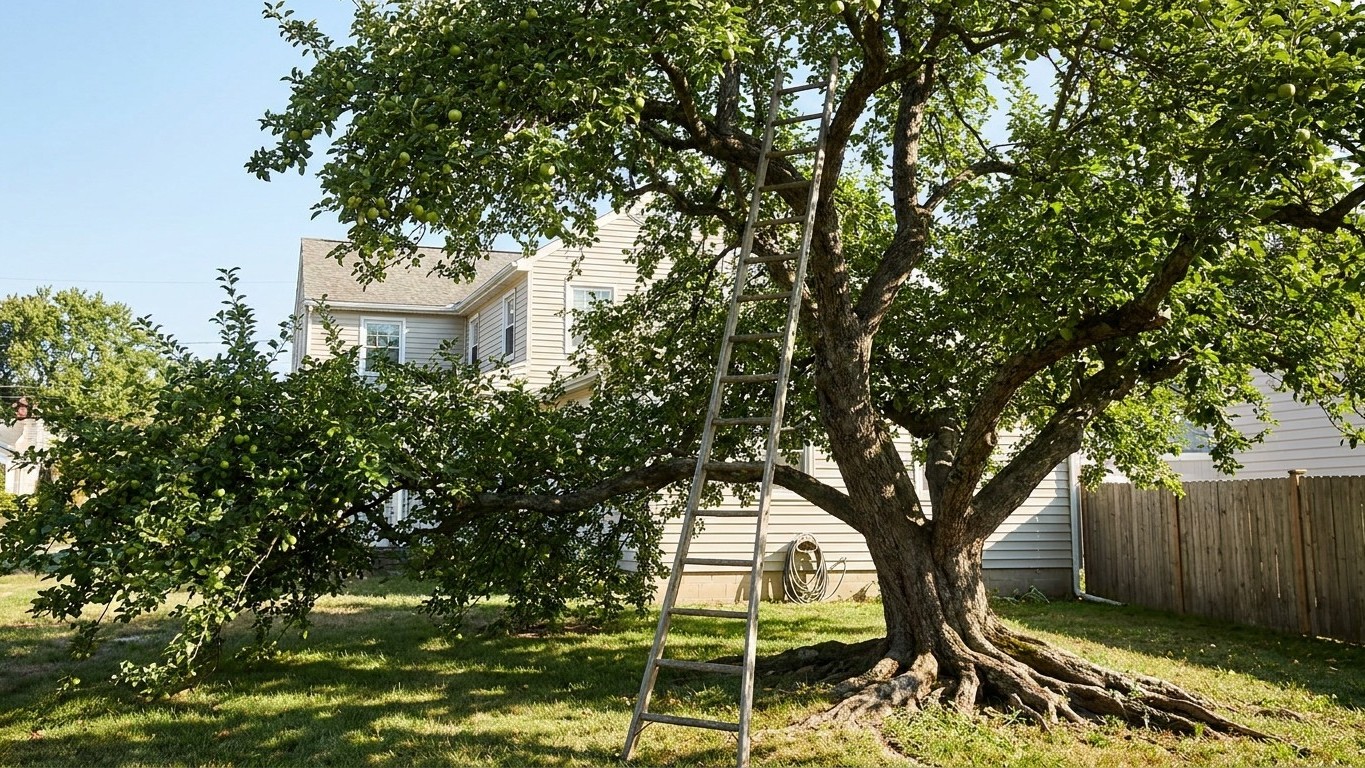

Seedling apple rootstock is the least controlled choice a grower can make: it produces a full-size, 35-40 foot tree, needs no staking once established, and outlives every dwarfing option on the market. It also makes the grower wait the longest for a first apple.
What Seedling does to the tree

The number that decides everything here is 35-40 feet at maturity, according to Utah State University Extension’s guide to apple production for the home garden. That is a tree taller than most two-story houses, with a canopy wide enough to shade a good chunk of a suburban backyard. Picking fruit from the top means an orchard ladder, not a kitchen step stool, and pruning the upper limbs is a job for someone comfortable off the ground.
What the nursery tag rarely explains is that “seedling” rootstock is not a named clone at all. It is grown from a pip, so no two seedling rootstocks are genetically identical, and the vigor of the resulting tree can vary somewhat from one specimen to the next, even under the same graft. That variability is the trade for the deepest root system and the strongest anchorage of any rootstock on the list.
Four practical things change with this rootstock choice, before a single variety is even picked:
- The ladder needed to reach the top of the canopy
- The spacing left between trees at planting
- The total yield harvested from a single mature tree
- The number of years before that tree bears its first apples
A seedling tree needs far more elbow room than a dwarf, easily 25 to 35 feet between trees, because the roots and the canopy both spread wide. In exchange, one mature seedling tree can outproduce several dwarf trees combined, simply because there is so much more wood to carry fruit. Here is how the mature height compares across the rootstocks covered in this cocon, per USU Extension:
| Rootstock | Mature height |
|---|---|
| M.9 | 8-12 feet |
| M.26 | 12-15 feet |
| G.11 | 12-15 feet |
| G.30 | 18-20 feet |
| M.7 | 18-20 feet |
| M.106 | 25-30 feet |
| MM.111 | 30-35 feet |
| Seedling | 35-40 feet |
Staking, and for how long
Seedling rootstock is the one entry on this list that generally needs no stake at all once it is past its first year or two in the ground. The taproot it develops anchors the tree deep into the soil, unlike the shallow, fibrous roots of a dwarfing stock such as M.9 or M.26, which stay brittle and shallow for the tree’s entire life. A young M.9 tree loaded with fruit can lean or snap at the graft union in a strong summer storm if the stake ever comes out. A seedling tree carrying the same crop load simply does not have that problem past its establishment years.
That does not mean a brand-new seedling whip needs nothing. In the first one to two seasons after planting, before the root system has spread and anchored, a temporary stake protects the young trunk from wind rock and keeps the graft union from being stressed while the roots are still finding their footing. Once that root system is established, the stake comes out and stays out. This is the opposite trajectory of a dwarfing rootstock, which often needs a permanent stake or trellis wire for the tree’s entire productive life because the root system never grows strong enough to stand alone under a full crop.
How soon it fruits, how long it lives
First crop, the wait
Vigorous, full-size rootstocks like this one push most of their early energy into roots, trunk, and scaffold branches rather than into flower buds. That means a longer wait for the first meaningful harvest compared to a dwarfing stock grafted with the same variety. Extension guides on home apple production consistently note this pattern without attaching a fixed number of years to it, since the wait also depends on the variety grafted onto the rootstock and on local growing conditions.
Lifespan, the reward
The payoff for that patience is longevity. A seedling-rooted tree, with its deep, well-anchored root system, is built to outlast dwarfing stocks by a wide margin and can remain productive for decades, often outliving the person who planted it. Dwarfing rootstocks trade that lifespan away in exchange for an early first crop, because a smaller root system simply cannot sustain a tree’s wood and fruiting structure for as many years. The two figures move in opposite directions for the same reason: energy a young tree spends building bulk and roots is energy it is not spending on flower buds, and vice versa.
The soil and site it suits
The deep taproot that makes seedling rootstock self-supporting also makes it far more forgiving of imperfect ground than any dwarfing stock. A shallow-rooted tree on M.9 or M.26 struggles the moment the topsoil dries out or turns thin over clay or rock. Seedling rootstock can send roots down past that shallow layer to find moisture and nutrients that a dwarf tree simply cannot reach. None of the reference sheets used for this cocon (Clemson HGIC 1350, UGA Circular 740, USU Extension) credit seedling rootstock with fire blight resistance specifically, so that decision should rest on the variety grafted onto it, not on the rootstock itself.
- Drought or sandy soil: a seedling tree’s deep taproot keeps drawing moisture long after a dwarf tree on the same site would show scorched leaves and dropped fruit.
- Thin or rocky topsoil: the taproot pushes past a shallow layer that would stunt a dwarfing rootstock outright.
- Small garden or tight lot: without 25 to 35 feet of clearance, a seedling tree’s canopy will crowd fences, structures, and neighboring trees within a decade.
- Wind-exposed sites: the strong root anchorage holds up where a staked dwarf tree would need constant support.
Who should choose it
Seedling rootstock fits the grower with real acreage, patience for a slow start, and no interest in fussing with stakes or trellis wire for the life of the tree. It does not fit a suburban yard with a 20-foot side lot or a gardener who wants apples within a couple of seasons. Remember that the rootstock only sets the size; the same variety grafted onto MM.111 or M.106 instead becomes a noticeably smaller, earlier-bearing tree, so the rootstock choice should come before the variety choice, not after.
- Choose it if: the property has open space, minimal irrigation is available, the soil is thin or rocky, and a decades-long orchard tree is the goal.
- Choose it if: permanent staking or trellising is not something the grower wants to maintain for 20 years.
- Avoid it if: the planting site is under 25 feet from structures, fences, or other trees.
- Avoid it if: an early harvest, within the first few years, matters more than a large, long-lived tree.
Whatever variety goes on this rootstock, check its bloom group and pollination needs before planting just one tree; a seedling tree’s long lifespan is only worth the wait if it actually sets fruit.
Common questions
Does seedling rootstock ever stay small?
No. Per USU Extension, seedling rootstock produces a 35-40 foot mature tree regardless of the variety grafted onto it. Size is controlled by the rootstock, not the scion.
Can one seedling apple tree pollinate itself?
Nearly all varieties crop better with a compatible partner nearby, and a seedling’s own parent tree cannot pollinate it even if they bloom at the same time. A second, different variety in the same bloom group (per Clemson HGIC 1350) usually solves this.
Is a seedling rootstock tree ever grafted with a sterile-pollen variety?
Yes, varieties such as Jonagold, Mutsu, Stayman, and Winesap can be grafted onto any rootstock, including seedling. These varieties can be pollinated but cannot pollinate another tree, so a second, fertile variety is needed nearby.
How much space should be left around a seedling apple tree?
Plan for 25 to 35 feet between trees or from structures, based on the 35-40 foot mature height USU Extension reports for this rootstock. Less space leads to crowding and shading within a decade.