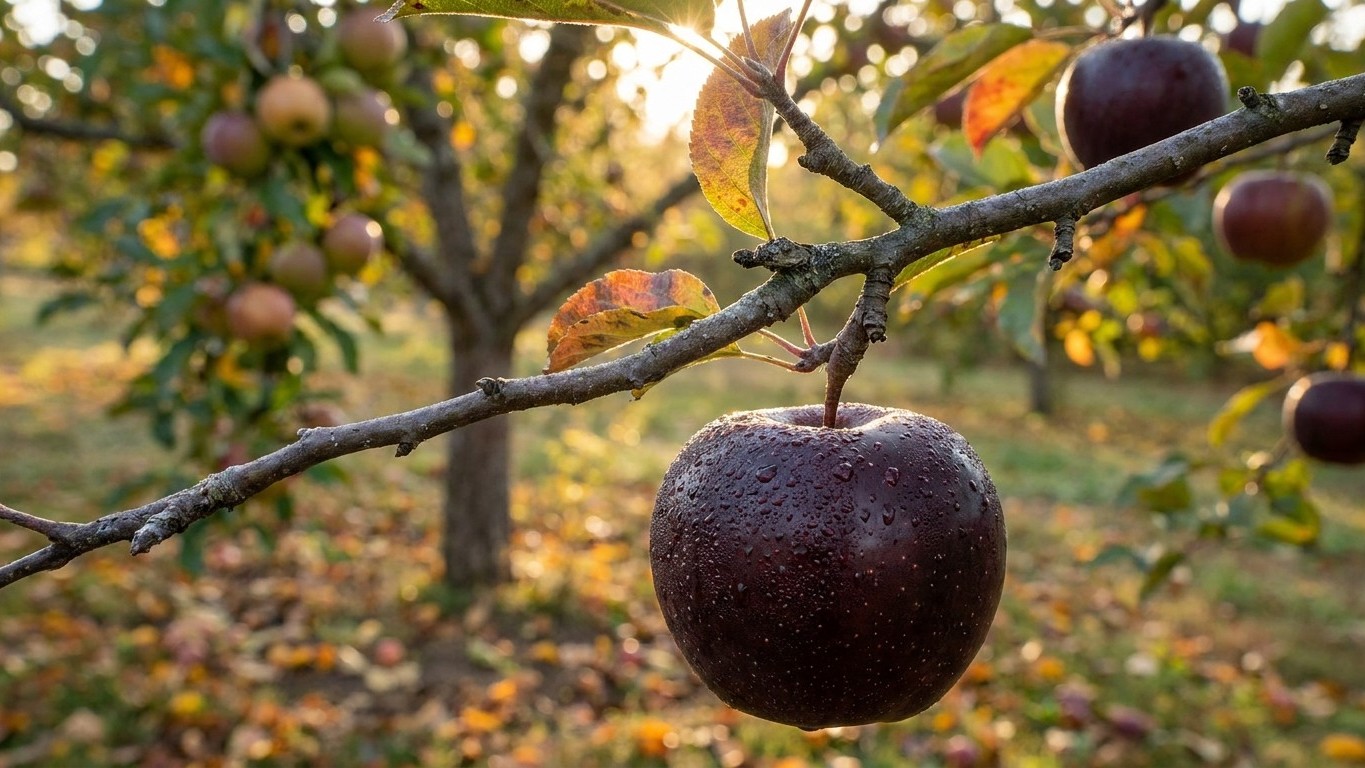

Arkansas Black is a mid-to-late season apple with very firm, tart flesh that holds up in the kitchen as well as in a lunch bag. It’s hardy across USDA zones 4 through 8, blooms in the mid-season group, and carries a moderate resistance to fire blight, which matters more than most catalog descriptions let on. It also needs a pollinator partner nearby to fruit well. Here’s what a grower actually gets, and What to Plant Beside It.
What Arkansas Black actually is

- Ripens: Mid to Late October
- Taste: Very firm, tart, juicy
- Best for: Cooking, eating, and baking
- Keeps: Long-term storage variety (see storage section below)
Nothing about this apple is subtle. The flesh is dense enough that a bite feels closer to biting into a raw potato than a soft dessert apple, and the tartness stays sharp even after months in storage. According to Clemson Cooperative Extension’s HGIC 1350 variety table, that firmness and acidity are exactly why it crosses over between the fruit bowl and the pie dish. A flesh that keeps its shape under heat, and an acid level that doesn’t wash out during baking, is the physical reason this variety works for both eating and cooking, where a softer, sweeter apple would turn to mush in the oven and taste flat once cooled.
USU Extension lists the harvest window as Mid to Late October, placing it firmly among the late-season apples, picked well after the early varieties are already gone from the tree. That late pick, combined with the dense flesh, is part of what gives it a storage life longer than most apples grown in home orchards.
Unlike Mutsu (sold commercially as Crispin) or Pink Lady (sold as Cripps Pink), Arkansas Black doesn’t appear to carry a widely used alternate market name in the sources reviewed here. If a nursery tag or grocery bin uses a different label for what looks like this apple, it’s worth double-checking with the seller rather than assuming a rebrand, since no alternate name is documented in the extension data used for this page.
Will it grow where you are
Hardiness zones
USU Extension places Arkansas Black in USDA hardiness zones 4(5) through 8. That’s a wide band, running from parts of the upper Midwest and interior Northeast down through the mid-South, and it’s worth reading as a range rather than picking the middle number and calling it good. The “(5)” notation suggests some marginal risk at the zone 4 edge, meaning a grower right on that line should expect more winter dieback risk than someone solidly in zone 6 or 7.
Winter chill
Hardiness zone only answers half the question. The other half is winter chill, the number of cold hours a tree needs during dormancy before it will break bud and flower reliably in spring. Apples in general lean toward the higher end of chill requirements compared to other tree fruit, which is part of why they’re associated with northern and mid-latitude states rather than the Deep South or low-desert Southwest. No specific chill-hour figure for Arkansas Black is published in the sources used for this page, so none is given here rather than guessing. A grower in a marginal or low-chill climate, coastal California or the Gulf Coast for instance, should treat the hardiness zone range as a starting point and confirm local chill accumulation with a county extension office before planting, since a tree can sit inside the correct hardiness zone and still bloom poorly if the winter never gets cold enough for long enough.
What to plant beside it
Nearly all apple varieties crop better with a compatible partner nearby, and Arkansas Black is no exception. It falls into bloom group C, a mid-season bloomer, which narrows the pollinator search to varieties flowering at roughly the same point in spring. According to Clemson HGIC 1350 and UGA Circular C740, the following varieties are documented as capable of pollinating Arkansas Black:
- Golden Delicious
- Ozark Gold
- Priscilla
- Rome Beauty
Any one of these planted within pollinating distance should supply the cross-pollination Arkansas Black needs to set a full crop. But two varieties deserve a specific warning here: Jonagold and Stayman both flower at the same time as Arkansas Black, which makes them look like obvious partners on a bloom chart. They aren’t. Both carry sterile pollen, meaning their flowers can receive pollen and fruit normally, but their own pollen can’t fertilize another tree’s blossoms. Plant only Arkansas Black alongside Jonagold or Stayman and none of the three will set fruit reliably, because the two sterile-pollen varieties are essentially just taking up space in the pollination equation. A garden built around any of these three needs a fourth tree, one of the four confirmed pollinators listed above, to actually close the loop.
This is also a good moment to flag the parent-seedling exclusion rule that trips up a lot of backyard orchard plans: a parent variety generally cannot pollinate its own seedling, even when the bloom timing lines up perfectly. No such parent-offspring relationship is documented between Arkansas Black and the varieties above in the sources reviewed for this page, but it’s the kind of detail worth checking before assuming any two mid-season bloomers will work together. For a fuller breakdown of how bloom groups, sterile pollen, and self-fertility interact across apple varieties, see our pollination guide.
Growing it well
Fire blight
USU Extension rates Arkansas Black as Moderately Resistant to fire blight, a bacterial disease that can blacken and kill blossoms, shoots, and entire limbs in warm, wet spring weather. Moderate resistance doesn’t mean immune. In practice, it means a grower is less likely to see the disease sweep through the whole tree the way it might on a highly susceptible variety, but scattered blossom or shoot infections can still show up during a wet bloom period, especially if the tree sits near other, more susceptible apples or nearby pear trees. Pruning out infected wood promptly, well below the visible damage, and disinfecting tools between cuts, remains the standard response regardless of the resistance rating.
Growth habit and thinning
Late-ripening, firm-fleshed apples like this one tend to hang on the tree through several weeks of fall weather, which means the crop needs adequate spacing on the branch to size up properly and to avoid limb breakage under the combined weight of a heavy set. Thinning young fruit down to one apple per cluster, spaced several inches apart along the branch, is standard practice for most apple varieties and applies here as well, since crowded fruit tends to come in smaller and more prone to disease where the apples touch.
Biennial bearing
No biennial bearing tendency is documented for Arkansas Black in the sources used for this page. That’s worth mentioning because plenty of apple varieties do swing between a heavy crop one year and a light one the next, and thinning is one of the standard tools growers use to smooth that pattern out regardless of variety.
Picking it and keeping it
USU Extension places the harvest window at Mid to Late October, among the latest picks of the home orchard season. A calendar date is a starting point, not a verdict, since weather shifts the actual ripening window from year to year. The more reliable approach is checking the fruit itself, in this order:
- Lift and twist an apple gently upward. If it separates from the spur easily, with the stem staying attached to the fruit, it’s likely ready. Fruit that resists and has to be yanked or cut free usually needs more time.
- Cut one test apple open and check the seed color. Ripe apples generally show brown to dark brown seeds; pale or greenish seeds mean the fruit needs more days on the tree.
- Check the ground color, the background skin color beneath any red blush. As the apple ripens, that background shifts from a hard green toward a softer yellow-green or cream tone.
Storage
The very firm flesh and late harvest timing that define this variety also make it one of the better keepers among home-orchard apples. Cold, humid storage, ideally near 32°F with high humidity, such as a refrigerator crisper drawer or a root cellar, slows the ripening process and preserves that dense texture for extended periods compared to earlier-season, softer varieties. Checking stored fruit periodically and removing any apple that starts to soften or show decay keeps a single spoiled apple from spreading rot through the whole batch.
Common questions
Is Arkansas Black self-pollinating?
No self-fertility data is given in the sources used for this page, and like nearly all apple varieties, it crops better with a compatible pollinator nearby rather than relying on its own pollen.
Can Jonagold pollinate Arkansas Black?
No. Jonagold blooms at the same time but carries sterile pollen, so it can’t fertilize Arkansas Black or any other apple. The same applies to Stayman.
What’s the best pollinator for Arkansas Black?
Golden Delicious, Ozark Gold, Priscilla, and Rome Beauty are all documented as compatible pollinators, based on Clemson HGIC 1350 and UGA C740.
Is Arkansas Black a good apple for pie?
Yes. Its very firm flesh holds its shape under heat and its tartness carries through baking, which is exactly the combination Clemson’s variety data flags for cooking and baking uses.
How long does Arkansas Black store?
Sources don’t give a specific number of storage months, but its firm texture and late harvest place it among the longer-keeping home orchard apples when held cold and humid.