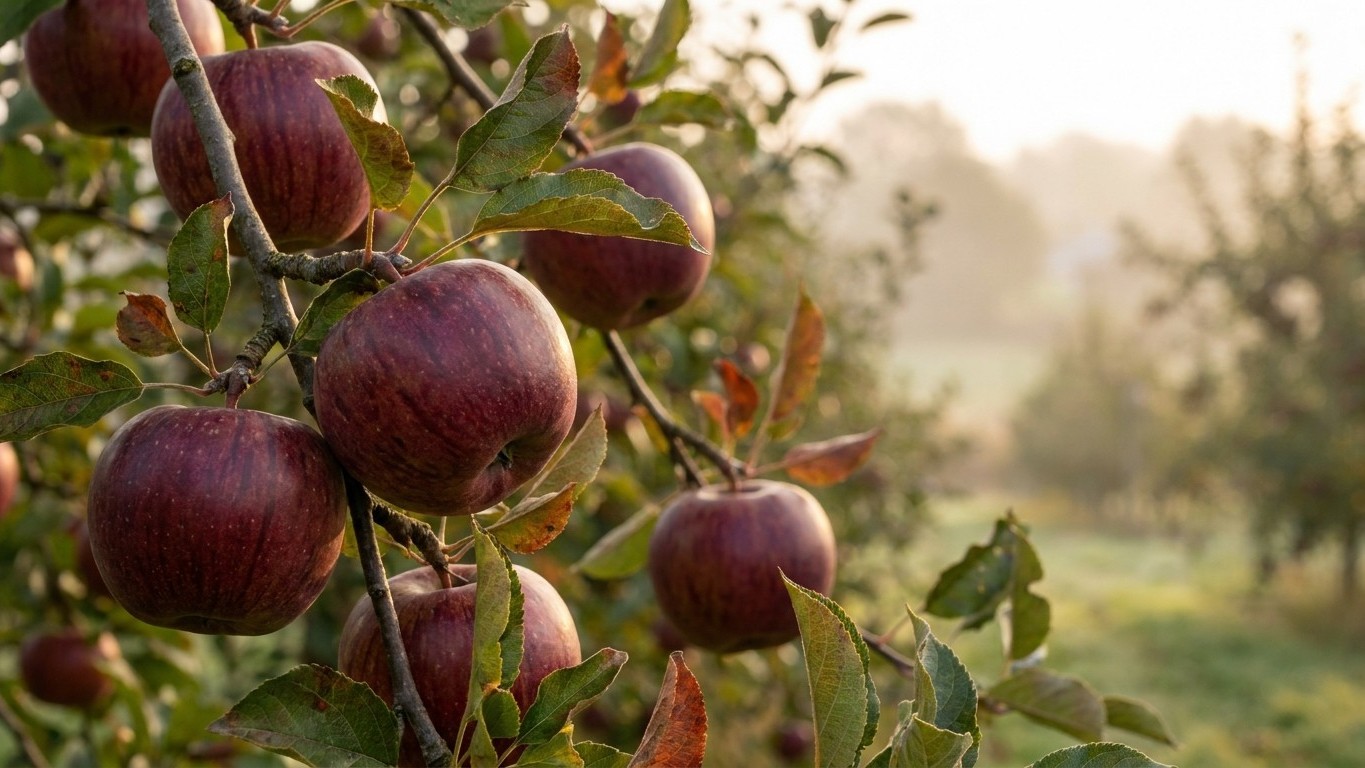

The McIntosh apple ripens in October, carries a soft, sweet-tart bite that softens further once cooked, and does best in USDA zones 5 through 8. It is not sold under another name in the sources checked for this guide, so if you have bought one labeled McIntosh, that is the apple you had. What follows covers what the fruit is good for, whether your yard can grow it, which trees to plant nearby, and how to tell when to pick.
What McIntosh actually is

A grower planting McIntosh is signing up for four specific things, and it helps to see them together before digging into any one:
- When it ripens: October
- What it tastes like: sweet and juicy, with a texture less firm than most apples
- What it is good for: snacking, pies, sauce, and salads
- How long it keeps: shorter than firmer varieties, given its soft flesh
The eating quality is documented by University of Maine Cooperative Extension (Bulletin #4262) as sweet and juicy, with flesh that is less firm than the average apple on a grocery shelf. That softness is not a flaw to work around. It is the reason McIntosh earns a spot in a pie and, even more, in sauce: the flesh breaks down readily when heated, so a pot of McIntosh apples turns to sauce with barely any mashing. A firmer apple like a Granny Smith holds its cubes together in a pie filling; McIntosh collapses into itself, which is exactly what you want in applesauce and exactly why bakers sometimes blend it with a firmer variety when they want filling that keeps its shape.
That same softness explains why it belongs in salads rather than in long storage. A bite of raw McIntosh has snap when picked at the right moment, but the cell structure that makes it collapse so easily under heat also makes it bruise and soften faster in the fruit bowl than a Fuji or a Rome. USU Extension’s Utah home garden guide lists McIntosh among varieties suited to home orchards with an October harvest, which puts it in the mid-to-late fall picking window alongside many classic New England and mountain-region apples.
Will it grow where you are
Hardiness zones 5-8
USU Extension lists McIntosh as hardy in USDA zones 5 through 8. That is a wide band, running from cold interior valleys where winter lows regularly drop below zero, through the mid-Atlantic and much of the transition zone between cool and warm climates. If your zip code falls inside that range, winter cold alone will not rule out this tree. Outside it, in zone 4 and colder, or in zone 9 and warmer, you are outside the range this source documents, and that alone is reason to check with a local extension office before ordering a tree.
Winter chill
Hardiness zone only tells half the story. Apple trees also need a minimum number of hours below about 45°F each winter to break dormancy properly and flower on schedule. That chill requirement is what actually separates apple country from places where apples struggle even in mild winters, since a warm-winter yard can sit comfortably inside a hardiness zone and still fail to give the tree enough cold hours. No chill-hour figure for McIntosh appears in the sources used for this guide, so none is given here rather than guessed at. In practice, McIntosh is a variety with deep roots in the northern tier, New England, the upper Midwest, and similarly cold-winter regions, which is a reasonable clue that it wants a real winter rather than a mild one. Gardeners in zones 7 and 8, at the warm edge of its hardiness range, are the ones who should ask a local extension office about chill hours specifically before planting, since that is the detail hardiness zone maps do not capture.
What to plant beside it
Nearly all apple varieties crop better with a compatible partner nearby, and McIntosh is not documented as an exception. But the specific list of pollination partners for McIntosh is not published in the sources used for this guide, so no partner names are given here rather than guessed at. What can be said with confidence is the general rule that governs every apple orchard, including one built around a single McIntosh tree.
Apple trees are almost never fully self-fertile. A lone McIntosh may set some fruit off its own pollen or a neighbor’s tree two lots away, but a dedicated pollinator planted nearby, or grafted onto the same tree, reliably improves the fruit set. That pollinator needs to bloom at the same time, which for McIntosh falls in the early-to-mid bloom window according to USU Extension. A late-blooming variety on the far end of the flowering calendar will miss the window entirely, no matter how close the two trees stand.
Two more details matter more than most first-time growers expect. A seedling generally cannot be pollinated by its own parent variety, so knowing a tree’s parentage matters if you already have another apple on the property and are hoping it will double as a pollinator. And crabapples, chosen for a long, overlapping bloom period, are a reliable fallback where a full-size pollinator variety is not practical, since many crabapple varieties bloom early to mid-season and match McIntosh’s timing well. For a full rundown of bloom groups, self-fertility exceptions, and named pairings across apple varieties, see the apple pollination guide before choosing a second tree.
Growing it well
Fire blight susceptibility
USU Extension rates McIntosh susceptible to fire blight. In the yard, that shows up as blackened, wilted shoot tips that look scorched, sometimes curling into a shepherd’s-crook shape, spreading fastest during warm, wet spring weather right around bloom. A susceptible rating means this tree needs watching every spring rather than a one-time check: prune out any blackened wood well below the visible damage, sanitize pruning tools between cuts, and avoid heavy nitrogen fertilizer, since soft, fast-growing shoots are the tissue fire blight infects most easily.
Growth habit and thinning
McIntosh trees are widely grown as vigorous, spreading trees that fill out a canopy quickly once established, which is one reason orchardists often keep them on a size-controlling rootstock rather than seedling rootstock, since rootstock, not variety, ultimately decides how tall and wide the mature tree becomes. Because it sets fruit generously in a good year, many home growers thin the young apples by hand in early summer, leaving one apple every six to eight inches along a branch, so the remaining fruit sizes up properly and the limb does not snap under an overloaded crop.
Biennial bearing tendency
McIntosh has a reputation among home orchardists for swinging between a heavy crop one year and a light one the next, a pattern known as biennial bearing. Thinning the crop in a heavy year is one of the few tools a grower has to smooth that swing out, since a tree that overproduces one season often spends the following season recovering rather than setting a full crop of flower buds.
Picking it and keeping it
USU Extension places the McIntosh harvest in October, but a calendar date is only a starting point since ripening shifts year to year with the weather. Standing under the tree, three checks in sequence tell you more than any date on a chart:
- Lift and twist: cup the apple in your hand, tilt it upward, and give it a gentle twist. A ripe McIntosh separates from the spur easily; one that resists and has to be pulled or yanked is not ready yet.
- Seed color: cut one sample apple open. Seeds that have turned from pale to dark brown signal the fruit has finished ripening on the tree.
- Ground color: check the background color where the apple was shaded from direct sun, on the side facing the branch or another apple. A greenish background that has shifted toward yellow is another sign the fruit is ready to come off.
Storage
Because McIntosh flesh is naturally less firm than most apples, per University of Maine Cooperative Extension, it does not hold up in storage as long as denser, crisper varieties bred for months in cold storage. Treat a fresh-picked McIntosh as a fall apple meant for the next several weeks rather than the whole winter, refrigerate it promptly after harvest, and use the softest fruit first for sauce, where its tendency to break down works in your favor rather than against it.
Common questions
Is McIntosh good for baking?
It works in pies but breaks down more than firmer baking apples, so many bakers blend it with a variety that holds its shape, keeping McIntosh for flavor and reserving a firmer apple for texture in the same pie.
Can I grow one McIntosh tree by itself?
It may set some fruit alone, but nearly all apple varieties, McIntosh included, crop more reliably with a compatible pollinator blooming at the same time nearby, whether that is another apple variety or a crabapple.
Why does my McIntosh crop swing from huge to tiny year to year?
That up-and-down pattern, called biennial bearing, is commonly reported in McIntosh trees. Thinning young fruit in a heavy year is the main tool growers use to even it out.
Does McIntosh need a warm climate?
No. USU Extension lists it hardy in zones 5 through 8, a range that includes plenty of cold-winter regions, and its history in northern growing areas suggests it wants a real winter rather than a mild one.
How do I know a McIntosh is ready to pick without cutting every apple open?
Start with the lift-and-twist test. An apple that separates from the branch with a gentle upward twist is usually ready; one that resists needs more time.