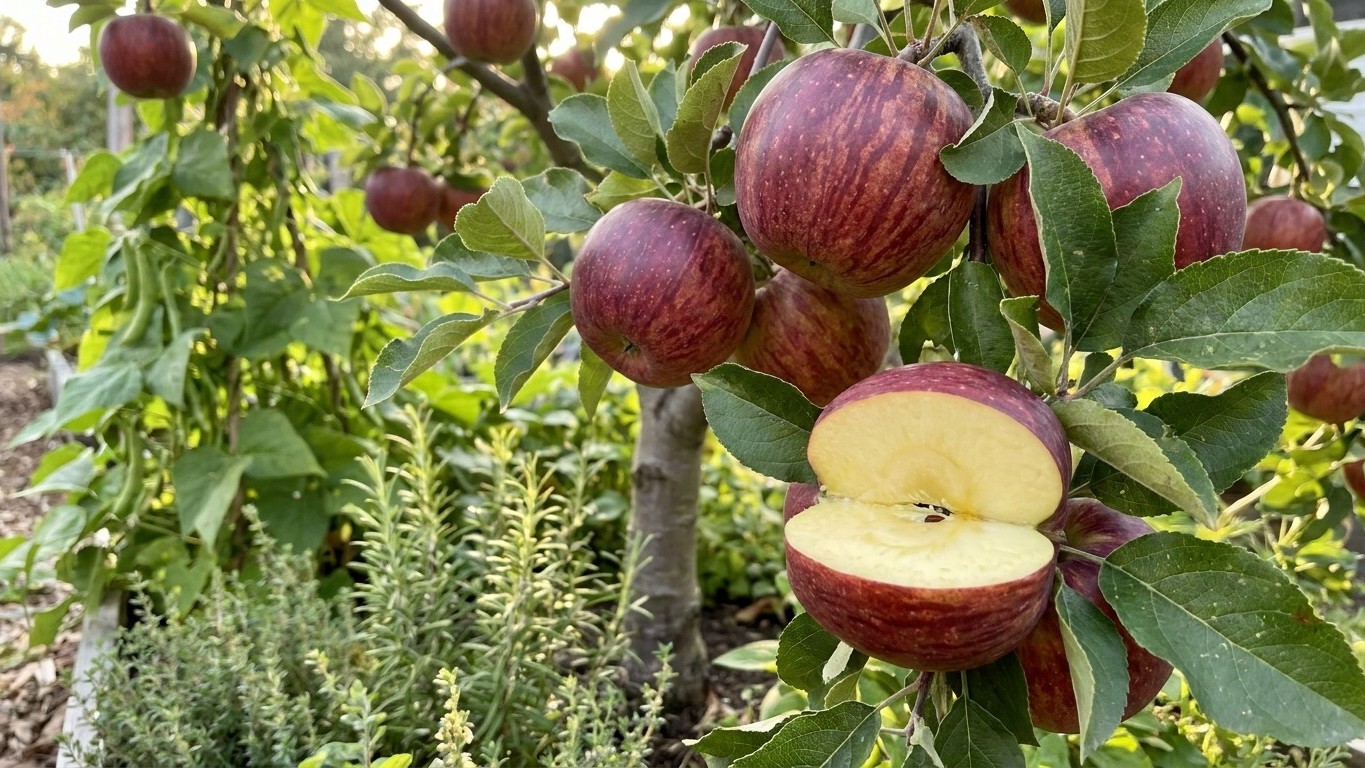

Crimson Crisp ripens in mid September, carries a sprightly, tart bite over dense, firm flesh, and holds its shape in the oven as well as it does in a lunch box. It grows in USDA zones 4 through 7. What follows covers whether your climate suits it, what to plant next to it, and how to tell when it is actually ready to pick.
What Crimson Crisp actually is

A grower picking this variety gets four things worth knowing before anything else:
- Ripening time: mid September
- Taste: sprightly and tart, with a spicy finish
- Best use: equally good fresh or baked
- Keeping: firm, dense flesh that holds structure
Utah State University Extension lists Crimson Crisp as a mid-September harvest apple in its guide to home orchard varieties, which puts it ahead of late-season keepers and behind the earliest summer apples that come off the tree in August. The eating experience is not subtle: this is a tart apple first, with firm, dense flesh that resists going mealy and a spicy edge on the finish rather than the simple sweetness of a dessert-only variety.
That tartness is also the reason the kitchen use matters more here than with many varieties. The acidity that makes a slice bracing to eat out of hand is the same acidity that survives heat without turning flat and sweet in a pie filling. Flesh that holds its shape when cooked means it doesn’t collapse into sauce the way a softer apple does, so a cook can slice it into a tart and expect the pieces to still look like pieces afterward. That combination, firm flesh plus acid that holds under heat, is what separates a baking apple from a fresh-eating one, and Crimson Crisp sits comfortably on both sides of that line rather than being pushed into one camp.
None of the sources used for this page mention Crimson Crisp being sold under a different market name, the way Mutsu sometimes appears as Crispin or Pink Lady as Cripps Pink. If a nursery tag near you uses different wording, it is worth asking directly whether it is the same variety before buying two trees you think are different and aren’t.
Will it grow where you are
Hardiness range
USU Extension places Crimson Crisp in USDA hardiness zones 4 through 7, a broad enough range to cover most of the northern two-thirds of the country as well as parts of the Mountain West. Zone 4 tolerates winter lows down around minus 30 degrees Fahrenheit; zone 7 rarely drops below zero. Treat this as a range, not a target, since a spot at the cold edge of zone 4 and a spot at the warm edge of zone 7 are managing very different winters even though both fall inside the published bracket.
Winter chill
Hardiness zone tells you whether the tree survives winter. It says nothing about whether the tree blooms properly the following spring, and that second question depends on winter chill, the accumulated hours of cold the tree needs before it can break dormancy on schedule. Apple varieties bred and tested through northern land-grant extension programs, which is where this variety’s documentation originates, tend to belong to the higher end of the chill-requirement spectrum common in apples generally. No chill-hour figure for Crimson Crisp specifically is published in the sources used for this page, so none is given here rather than guessed at.
What that means practically: a gardener in a mild-winter climate, coastal California or the Gulf South, for instance, should ask a local extension office whether Crimson Crisp reliably breaks dormancy in their specific winters before planting, since a hardiness zone rating alone won’t answer that question. A gardener in a cold-winter, cold-enough-in-fact climate has less to worry about on this front.
What to plant beside it
This is usually the reason someone lands on a variety page in the first place, and here the honest answer is a short one: no published list of pollination partners for Crimson Crisp turned up in the sources used for this page. Rather than name a partner at a guess, it’s better to say plainly that this detail isn’t documented here.
That gap doesn’t change the general rule that applies to nearly every apple tree sold. Nearly all varieties crop better with a compatible partner nearby, even when a given tree is described as partly self-fertile. Apple pollen doesn’t travel far or reliably on its own, and a second variety blooming at a matching time, or a crabapple planted as a pollinizer, is what turns light bloom into a full crop most years.
USU Extension does record that Crimson Crisp blooms in the mid season, which narrows the search: whatever partner ends up in the ground should also bloom mid-season, since apple varieties that flower weeks apart won’t overlap enough to pollinate each other even if both are otherwise compatible. A nursery that carries Crimson Crisp locally is also the most reliable place to confirm which specific mid-season varieties it has paired successfully in that climate, since bloom overlap can shift slightly by region.
One more rule worth carrying into that nursery conversation: two varieties flowering together is not automatically enough. A parent variety cannot pollinate its own seedling, so if Crimson Crisp descends from a known parent in its breeding line, that parent is excluded as a partner regardless of bloom timing. No such parentage detail is confirmed in the sources for this page, so no specific exclusion is named here, but it’s the kind of question worth asking a nursery directly before assuming any two mid-season trees will do the job for each other. For a fuller walkthrough of how apple pollination actually works, see our guide to apple pollination partners.
Growing it well
Fire blight
Two extension services rate this variety differently for fire blight, one calling it Susceptible and the other calling it Tolerant. That isn’t a contradiction to resolve by picking a side or splitting the difference. Fire blight is a bacterial disease that spreads fastest in warm, wet weather during bloom; a dry spring slows it down regardless of the variety, and a wet one pushes even a tolerant tree toward trouble. A published rating reflects what an observer saw in one region’s weather, not a fixed property of the tree itself.
For a gardener in a region with regularly wet spring weather, the safer move is to plant and manage Crimson Crisp as if it carried the more susceptible rating: avoid heavy nitrogen fertilizer that pushes soft new growth, prune out any blackened, wilted shoot tips as soon as they appear, and sterilize pruning tools between cuts. A disagreement between two credible sources is a reason for caution, not a reason to dismiss both ratings.
Habit and cropping pattern
The sources used for this page don’t publish specific detail on Crimson Crisp’s growth habit or its tendency toward biennial bearing, the pattern where a tree produces a heavy crop one year and a light one the next. In the absence of variety-specific data, the general practice that applies across most apple varieties still holds: thinning the young fruit down to one apple per cluster in a heavy-set year reduces stress on the tree and tends to even out production the following season, whether or not a given variety is known to swing hard between years.
Picking it and keeping it
USU Extension lists mid September as the harvest window for Crimson Crisp, but a date on a chart is a starting point for checking the tree, not a deadline. The reliable way to know an apple is actually ready runs through three checks, in order:
- Lift and twist: cup the apple and twist gently upward; a ripe apple separates from the spur with little resistance, while one that clings and has to be pulled or cut off isn’t there yet.
- Seed color: cut one test apple open; seeds that have turned brown indicate the fruit is mature, while pale or white seeds mean more time is needed.
- Ground color: check the background skin color, not the red blush; a shift from green toward yellow underneath the red is a sign of ripeness that the blush alone can hide.
Storage
No specific storage duration for Crimson Crisp is published in the sources used for this page, so none is stated here. What the sources do confirm is the flesh texture: firm and dense. As a general rule across apple varieties, that combination of firmness and the strong acidity Crimson Crisp is known for tends to hold up longer in cold storage than a soft, low-acid apple does, but a gardener wanting a firm number for their own storage room is better served checking with a local extension office than relying on a general pattern.
Common questions
Is Crimson Crisp self-pollinating?
No pollination-partner list is published for this variety in the sources used here, but nearly all apple varieties, including partly self-fertile ones, set a fuller crop with a compatible partner tree nearby than they do alone.
What zone is best for Crimson Crisp?
USU Extension places it in USDA hardiness zones 4 through 7, a range wide enough to include much of the northern and mid-latitude United States. Winter chill requirement isn’t published for this variety, so gardeners in mild-winter regions should confirm local performance with an extension office before planting.
Is Crimson Crisp resistant to fire blight?
Ratings conflict: one extension source calls it Susceptible, another calls it Tolerant. Since fire blight spreads fastest in warm, wet bloom-season weather, a gardener in a wet-spring climate should manage the tree as though it carries the more susceptible rating.
Is Crimson Crisp good for baking?
Yes. Its firm, dense flesh holds its shape under heat and its acidity doesn’t flatten out when cooked, which is what makes an apple work in pies and sauces rather than just fresh eating.
When should I pick Crimson Crisp apples?
Mid September is the general harvest window, but the reliable signal on any individual tree is the lift-and-twist test backed up by seed color and ground color, checked in that order, rather than the calendar alone.