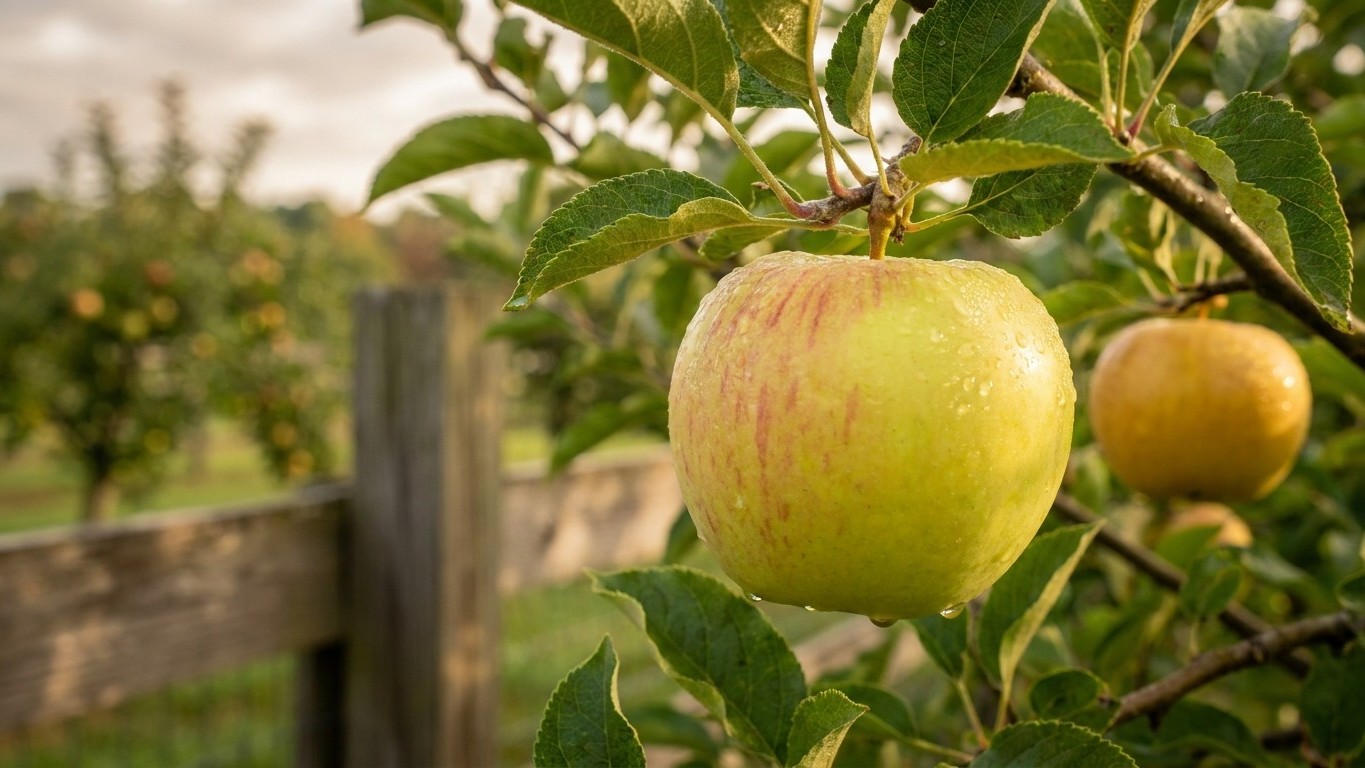

Priscilla is a dessert apple with crisp, mildly sub-acid flesh, and it needs help from another tree to set a real crop. Clemson Cooperative Extension places it in bloom group C, and its pollen partners are on record: Arkansas Black, Golden Delicious, Ozark Gold, and Rome Beauty. Two varieties that flower right alongside it, Jonagold and Stayman, can’t do the job. Here’s what that means for your yard.
What Priscilla actually is

- When it ripens: not specified in the sourced Clemson/UGA data reviewed for this page
- What it tastes like: crisp flesh, mildly sub-acid
- What it’s good for: dessert eating, fresh off the tree
- How long it keeps: not specified in the sourced data reviewed for this page
The taste profile is the one fact growers can rely on here, and it comes straight from Clemson Cooperative Extension’s HGIC 1350 variety table: crisp flesh, mild sub-acid balance. That’s a meaningful combination. An apple that leans sub-acid rather than tart won’t punch through the sugar in a pie filling the way a sharper variety does, and it won’t hold much shape once heat breaks down its cell walls if the flesh is soft to begin with. Clemson’s own table lists Priscilla’s kitchen use as dessert, not baking, and that lines up with the physical reality: this is an apple built for eating out of hand, not for a lattice-top pie.
If you’ve grown or bought Priscilla before, you likely knew it simply as an eating apple recommended for home orchards in the Southeast, since both Clemson (South Carolina) and the University of Georgia list it in their variety guides. Unlike some older varieties, there’s no widely used alternate market name attached to Priscilla the way Mutsu sometimes ships as Crispin or Pink Lady sells as Cripps Pink. What you see on the tag is what you get.
Because the sourced material doesn’t publish a ripening date or a storage window for this variety, don’t rely on a calendar date alone. The ripeness tests later in this article (lift-and-twist, seed color, ground color) will tell you more than any generic date range would, since bloom and harvest timing shift with elevation, latitude, and the particular spring you get.
Will it grow where you are
Hardiness
No USDA hardiness zone range for Priscilla appears in the Clemson HGIC or UGA sources reviewed for this page, so nothing specific is given here rather than a guessed number. What is worth flagging: apple varieties generally described in Southeastern extension variety tables, as Priscilla is, tend to be varieties that tolerate the region’s mild, humid winters and hot, humid summers reasonably well, which is a different climate profile than the short, cold-winter zones further north and west. If you’re outside the Southeast, check with your local extension office before ordering, since a variety’s presence on a Southeastern list doesn’t rule out other regions but doesn’t confirm them either.
Winter chill
Winter chill, the number of cold hours a tree needs before it will break dormancy properly in spring, is not published for Priscilla in the sourced material. That gap matters more than it sounds. Two trees can share the same USDA hardiness zone and still perform completely differently if one needs far more accumulated cold than the other; a tree planted where winters are too mild for its chill requirement will leaf out unevenly and bloom sporadically, even if it survives the cold just fine on paper. Given that Priscilla shows up specifically in Clemson (South Carolina) and University of Georgia extension guidance, both states with moderate winter chill by national standards, it’s reasonable to expect it belongs on the lower-chill end of the spectrum rather than the high-chill end favored by varieties bred for the northern tier. That’s an inference from where it’s recommended, not a published number, so treat it as a starting point for a conversation with your local extension office, not a substitute for one.
What to plant beside it
Nearly all apple varieties crop better with a compatible partner nearby, and Priscilla is no exception. Clemson HGIC 1350 lists it in bloom group C along with its pollen partners, and the list is specific:
- Arkansas Black
- Golden Delicious
- Ozark Gold
- Rome Beauty
Any one of these, planted within pollinating range and blooming at the same time, should supply Priscilla with the pollen it needs to set a full crop. Golden Delicious in particular is a workhorse pollinizer across many bloom groups, which makes it a common default choice for growers who want one tree to cover multiple varieties in a small yard.
The trap is Jonagold and Stayman. Both flower at the same time as Priscilla, in the same bloom group, and a quick glance at a bloom chart would suggest either one should work fine as a partner. It won’t. Jonagold and Stayman are triploid varieties, which means their pollen is sterile: they can receive pollen from a diploid variety and produce fruit, but they cannot supply usable pollen to anything else. Plant Priscilla next to only Jonagold or only Stayman and you’ll get flowers on schedule and little or no fruit, because timing lined up but the pollen itself never could.
| Variety | Role for Priscilla | Why |
|---|---|---|
| Arkansas Black | Compatible pollinizer | Diploid, blooms in group C, listed by Clemson |
| Golden Delicious | Compatible pollinizer | Diploid, widely compatible pollinizer |
| Ozark Gold | Compatible pollinizer | Diploid, blooms in group C, listed by Clemson |
| Rome Beauty | Compatible pollinizer | Diploid, blooms in group C, listed by Clemson |
| Jonagold | Excluded despite matching bloom time | Triploid, sterile pollen, needs its own second pollinizer |
| Stayman | Excluded despite matching bloom time | Triploid, sterile pollen, needs its own second pollinizer |
If a nursery layout leaves you choosing between only Jonagold and Stayman as neighbors for Priscilla, add a third, diploid tree from the compatible list above. Without it, both trees will bloom beautifully and produce very little. For a broader look at how bloom groups and sterile-pollen varieties interact across the whole orchard, see our apple pollination guide.
Growing it well
Disease pressure
No fire blight rating for Priscilla is published in the Clemson or UGA sources reviewed here, so none is given rather than an assumed one. In general, fire blight shows up as blackened, scorched-looking shoot tips that curl over like a shepherd’s crook, spreading fastest during warm, wet bloom periods, and any apple grower in a humid climate should scout for it during and just after flowering regardless of the variety’s reputation. Since specific data on Priscilla’s susceptibility isn’t available, treat routine bloom-period scouting as standard practice rather than a variety-specific precaution.
Habit and bearing pattern
The sourced material doesn’t publish details on Priscilla’s growth habit, whether it tends toward biennial bearing (heavy crop one year, light the next), or specific thinning recommendations. Those gaps mean a grower should apply general apple orchard practice rather than variety-specific instructions here: check young fruit clusters in late spring, and if a tree is setting more apples than its branches can comfortably support, that’s a sign to thin regardless of what variety is on the label. Overloaded branches in one year are a common trigger for the following year’s light crop, so thinning is cheap insurance against a boom-and-bust cycle even without variety-specific data to confirm Priscilla’s tendency toward it.
Rootstock, not the variety itself, determines how large the tree ultimately gets and how it should be spaced and staked. Since no rootstock is specified in the sourced material for this page, don’t assume a mature height until you know which rootstock a given nursery tree is grafted onto; that single detail changes spacing, staking needs, and years to first fruit more than the variety name does.
Picking it and keeping it
With no published harvest date for Priscilla, the physical ripeness tests matter more than a calendar guess. Work through them in order on a sample apple before picking the whole tree:
- Lift and twist the apple gently with the stem still attached; a ripe apple separates from the spur easily, while one that resists and has to be pulled or torn off usually isn’t ready yet.
- Cut one apple open and check the seeds; pale or greenish seeds mean more time is needed, while brown to dark brown seeds are a strong signal of ripeness.
- Look at the ground color, the base color of the skin behind any red blush; a shift from green toward a yellow or cream undertone typically tracks with the fruit approaching full maturity.
Storage
No specific storage duration for Priscilla is published in the sourced material, so don’t rely on a number that isn’t attributed to this variety. As a general apple-storage practice, fruit destined for longer keeping does best in a cold, humid environment, close to refrigerator temperature, stored away from ethylene-sensitive produce, since apples release ethylene gas that speeds ripening and can shorten the storage life of whatever sits near them. Check stored fruit periodically and pull any apple showing soft spots or bruising, since one deteriorating apple can hasten spoilage in the ones around it.
Common questions
Can Priscilla pollinate other apple varieties, or does it only receive pollen?
The sourced material lists which varieties can pollinate Priscilla, but doesn’t identify it as pollen-sterile itself. Unless a source specifically flags it as sterile, treat it as capable of contributing pollen to compatible bloom-group partners as well as receiving it.
Is one Golden Delicious enough to pollinate a Priscilla tree?
Yes, according to Clemson’s variety list, Golden Delicious is a named compatible pollinizer for Priscilla, provided the trees are close enough for bees to move between them and bloom overlaps.
Why can’t Jonagold pollinate Priscilla even though they bloom together?
Jonagold is a triploid variety with sterile pollen. It can accept pollen from a diploid tree and fruit normally, but it cannot supply pollen to Priscilla or any other variety, regardless of how well the bloom timing lines up.
Is Priscilla a good pie apple?
Clemson’s variety table lists its kitchen use as dessert, and its crisp, mildly sub-acid flesh fits eating fresh better than baking, since pie fillings generally benefit from firmer flesh and stronger acidity that hold up under heat.
How do I know if Priscilla will survive winter in my area?
No hardiness zone range or chill-hour figure for Priscilla appears in the sourced Clemson or UGA material, so check with your local cooperative extension office, which can match regional winter conditions against varieties known to perform well nearby.