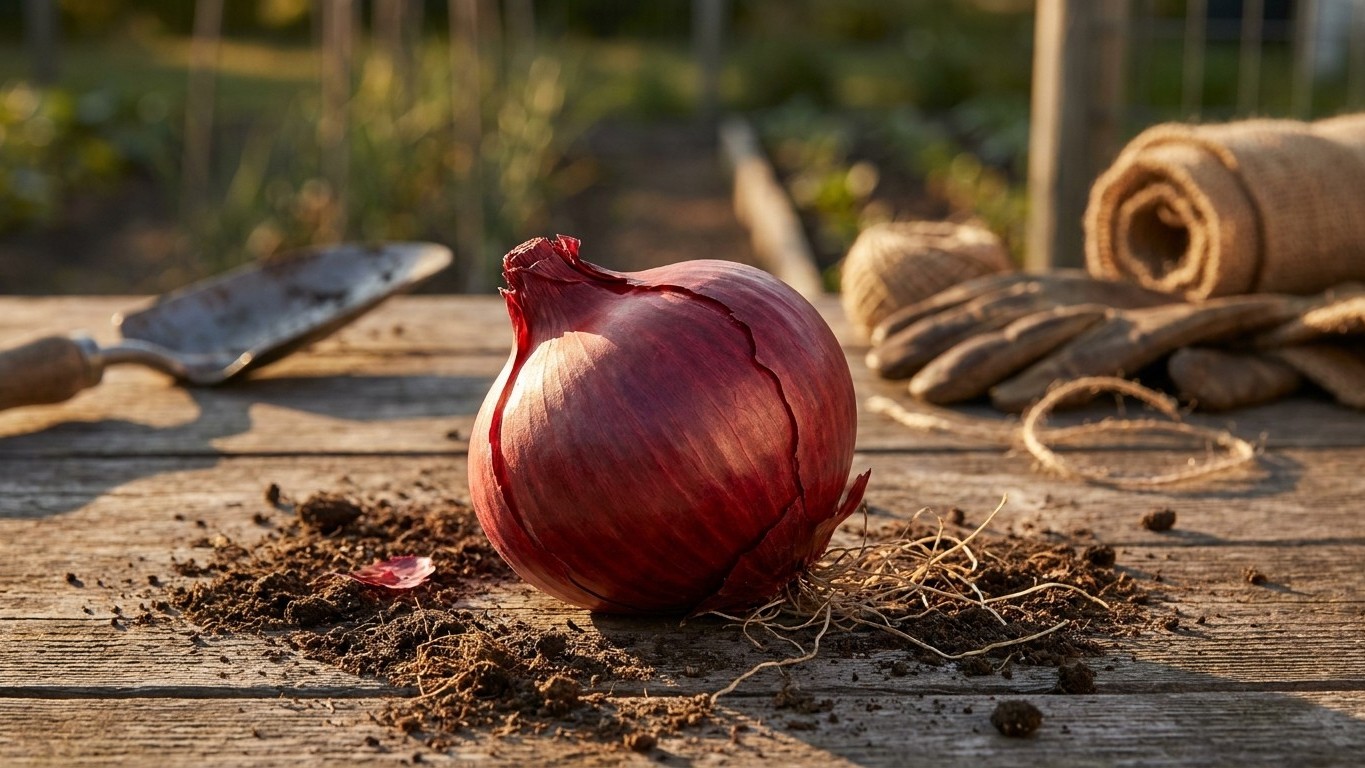

Red Carpet is a long-day onion that bulbs reliably between 40 and 45 degrees north latitude, matures in about 115 days from transplant, and produces a red, sharp-flavored bulb built to keep for 6 months or more. That combination of facts answers the two questions that matter most: whether this onion will even form a bulb in your garden, and whether it’s worth growing at all if it does. The rest comes down to timing and a little patience during harvest.
Will Red Carpet bulb where you are

Red Carpet belongs to the long-day group, and it bulbs correctly between 40 and 45 degrees north latitude. That band runs roughly through the northern half of the country, from places like Denver and Columbus up through the Canadian border states. Outside that range, this variety does not simply make a smaller onion. It makes no bulb at all. What you get instead is a plant that keeps pushing out leaves, never swells at the base, and eventually rots in storage because there’s no real bulb to cure.
The mechanism behind this runs against most people’s intuition. Onions don’t bulb because of heat or soil temperature. They bulb in response to day length, the number of daylight hours the plant experiences as the season progresses. Long-day varieties like Red Carpet need 14 to 16 hours of daylight before they’ll switch from making leaves to making a bulb. That kind of daylight only shows up in the northern half of the country during late spring and summer, which is exactly why long-day onions are bred for northern gardens and short-day onions are bred for the Gulf Coast and the Deep South. The far north gets more summer daylight than the south does, not less, and that’s the whole reason the map works the way it does.
If you’re gardening well within the 40 to 45 degree band, plant Red Carpet with confidence. If you’re south of 40 degrees, in a state like Tennessee, North Carolina, or Oklahoma, this variety is a poor match, and you’ll likely end up with a bed of scallion-like plants that never bulb. Gardeners sitting right at the edges, say northern Virginia, southern Colorado, or the lower edge of the Pacific Northwest, are in a blurred zone. The 40 to 45 degree range is a continuum, not a hard cutoff, and a variety can bulb a little beyond its stated bounds depending on the specific season, planting date, and local microclimate. Nobody can promise a yes or no from a latitude number alone in that zone. The honest answer for a reader near the edge is to try a small test bed the first year and watch what the plants do in early summer, rather than assume either success or failure.
What Red Carpet is like
Assuming the latitude checks out, here’s what the catalogue data says a grower can expect to pull out of the ground:
- Color: Red
- Days to maturity: 115 days from transplant
- Flavor: Sharp
- Storage life: 6+ months
The flavor and the storage life aren’t separate traits that happen to show up together. They’re the same trait, described from two angles. The sulfur compounds that make an onion bite your tongue and sting your eyes when you slice it are the same compounds that protect the bulb’s tissue from breaking down in storage. A sharp onion is loaded with those compounds; a sweet onion has bred most of them out. That’s why the sweetest onions you’ll find at a farmers market in early summer are also the ones that turn soft and slimy in your pantry by August, while a sharp keeper like Red Carpet can sit in a cool, dry spot from fall harvest until the following spring without much fuss.
Don’t expect Red Carpet to taste like something you’d eat raw on a burger straight out of the garden. It’s built to be a pantry onion, the kind you reach for in soups, stews, and sautés through the winter months, not a mild slicing onion for salads. If you want both sweetness and long storage in the same bulb, that onion doesn’t exist. The trade-off is built into the chemistry, and no variety gets around it.
When to plant it
Planting timing for onions follows the day-length group, and it flips depending on where you garden, which trips up a lot of first-time growers who assume every onion goes in the ground at the same time of year. In mild-winter regions, short-day onions are planted in autumn and harvested the following late spring, taking advantage of a long, cool growing season before the short summer daylight there ever triggers bulbing. Long-day onions like Red Carpet work on the opposite schedule. They go into the ground in late winter to early spring, as soon as the soil can be worked, so the plant has enough time to build size before the long days of early summer arrive and flip the switch to bulb formation.
The date on a calendar matters less than a simpler test: is the plant big enough by the time day length reaches the trigger point? Bulbing in onions isn’t gradual. Once the daylight hours hit the threshold for the variety, the plant redirects its energy from leaf growth to bulb growth, and it does so whether the plant is a scrawny seedling or a robust, leafy transplant. Whatever size the top growth has reached at that moment essentially sets a ceiling on how big the bulb can get. A plant with only three or four thin leaves when bulbing kicks in will produce a small bulb no matter how good the rest of the season turns out to be.
That’s the real argument for planting long-day onions like Red Carpet as early as the ground allows in late winter or early spring. Every extra week of leaf growth before the daylight trigger arrives translates into a bigger bulb later. Gardeners who plant late, waiting for warmer weather out of habit, are often the ones disappointed by small onions come harvest, even though the variety and the latitude were both right for the job.
Growing it well
Onions have a shallow, sparse root system, and they don’t compete well against weeds or dry soil the way a lot of vegetables can. That’s not a minor detail. It shows up directly in bulb size at harvest. A bed choked with weeds or left to dry out during the weeks when the bulb is sizing up won’t just produce a stunted-looking plant; it produces bulbs that are noticeably smaller, sometimes half the size they’d otherwise reach, because the plant spent its limited root reach fighting for water and nutrients instead of pushing them into the bulb. Keeping the bed weeded and the soil consistently moist through the growing season matters more for onions than for most crops in the garden.
Bolting is the other thing to watch for. A plant that sends up a flower stalk before harvest has redirected its energy into reproduction rather than bulb storage, and the bulb it produces will not keep well. Once an onion bolts, the tissue around the developing flower stem tends to break down faster in storage, so any bolted plants should be pulled and used first, within days or weeks, rather than tucked away with the rest of the crop for winter storage. Bolting shows up most often after a cold snap early in the season followed by a warm stretch, which confuses the plant into thinking it’s already been through a full winter and spring.
Beyond consistent moisture, weed control, and pulling any bolted plants promptly, there’s not much extra Red Carpet asks for compared to other long-day onions. It’s a straightforward crop as long as the basics of watering and weeding are kept up through the season, since the plant simply has no reserve capacity to compensate for neglect the way a deeper-rooted vegetable might.
Harvesting and keeping it
The signal that Red Carpet is ready has nothing to do with a date circled on a calendar. It’s the plant itself. Onion tops fall over on their own when the bulb has finished sizing up and the plant has shifted into its final stage, and that collapse is the cue to harvest, not a guess based on how many days have passed since transplanting. Watching the bed for that visual change, rather than pulling onions early out of impatience, is the difference between a bulb that’s actually finished growing and one pulled too soon.
Curing is the step most home gardeners skip, and it’s the single biggest reason homegrown onions rot in storage within weeks instead of lasting the winter. A freshly pulled onion still has a moist neck, and that moisture is an open door for rot organisms once the bulb goes into a bin or a mesh bag. The neck has to dry down until it’s papery and tight before the onion goes into long-term storage. Skipping this step, or rushing it, undoes all the benefit of growing a variety bred to keep for 6 months or more.
The full sequence, start to finish, looks like this:
- Watch the bed until most of the tops have fallen over on their own.
- Pull the bulbs and let them cure in a warm, dry, well-ventilated spot out of direct sun, tops still attached, for two to three weeks.
- Check the neck of each bulb; it should feel dry and papery, not soft or moist, before moving on.
- Trim the dried tops and roots, and brush off loose soil without washing the bulbs.
- Store the cured onions in a cool, dry, dark spot with good airflow, such as a mesh bag or slatted crate.
What that 6-month figure means in practical terms is that a properly cured batch of Red Carpet, harvested in mid-summer and stored well, can still be feeding the household in soups and stews come the following spring. That’s a very different outcome from a sweet variety that keeps for only two or three months and needs to be eaten up through the fall. If the goal is a pantry onion that carries a household through winter without a trip to the store, the sharp bite of Red Carpet is the trade you’re making for that shelf life, and it’s a trade worth understanding before the seeds ever go in the ground.