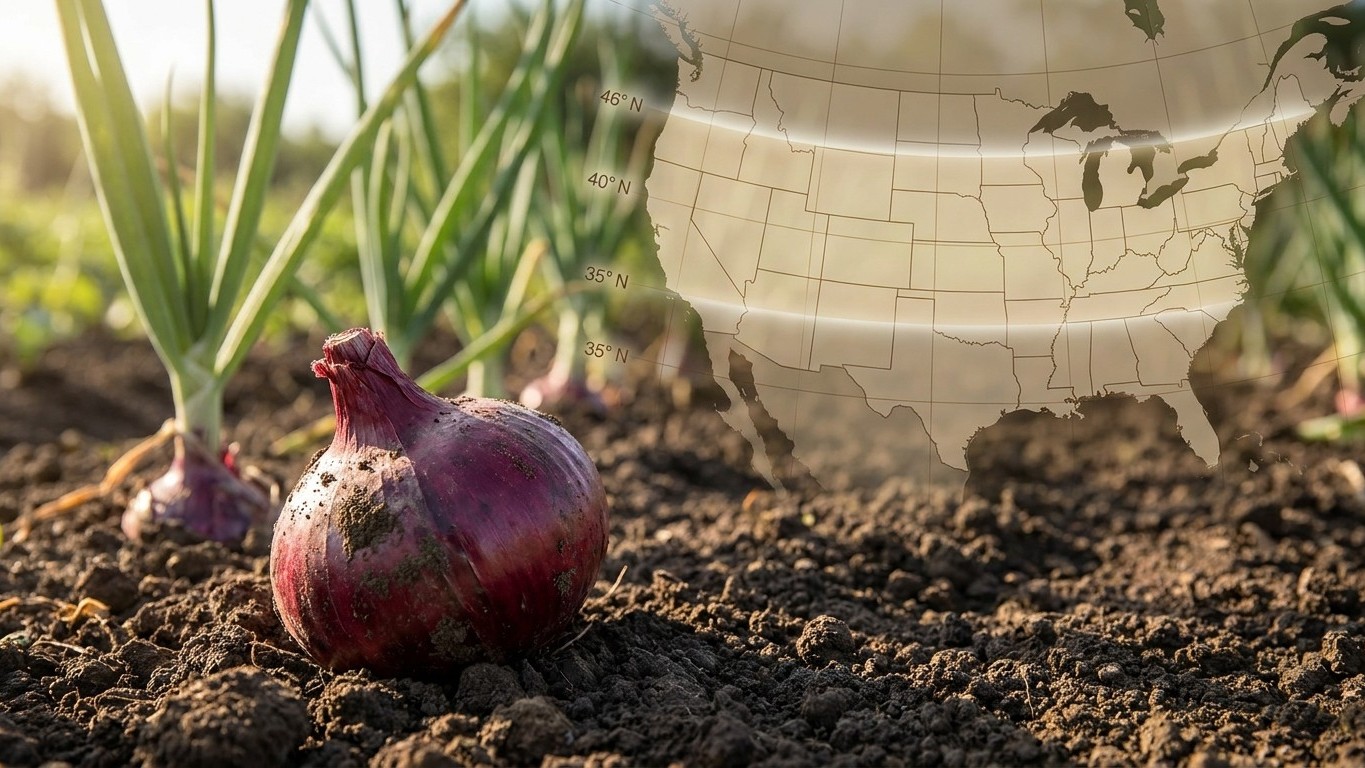

Monastrell is an intermediate-day onion, which means it needs roughly 12 to 14 hours of daylight to trigger bulbing. That puts its reliable range between 35 and 46 degrees north latitude, a band that covers most of the middle third of the United States. Inside that zone, expect a red bulb ready in about 106 days from transplant. Outside it, the plant may never bulb at all, no matter how well you feed and water it.
Will Monastrell bulb where you are

Latitude decides this before soil, water, or fertilizer ever get a vote. Monastrell falls into the intermediate-day group, meaning it starts forming a bulb once daylight stretches to somewhere between 12 and 14 hours. That threshold lines up with a band roughly 35 to 46 degrees north, a swath that runs from around the Tennessee-Georgia line up through the Dakotas and into the northern tier of states bordering Canada.
Here’s the part that trips up a lot of gardeners: bulbing has nothing to do with heat. It’s triggered by hours of light hitting the leaves, a signal the plant reads like a clock. That’s also why long-day onions, the ones needing 14 to 16 hours, are grown in places like Minnesota and Maine rather than Georgia or Texas. Northern summers deliver more daylight hours than southern ones do, even though southern summers feel hotter. An onion planted in Texas will get plenty of warmth but never enough daylight to satisfy a long-day variety’s requirement. The reverse problem hits short-day onions planted too far north.
Plant Monastrell well outside its 35 to 46 degree band and the result isn’t a smaller onion. It’s no onion. The plant reads the wrong daylight signal, keeps pushing out leaves instead of swelling a bulb, and by the time frost or harvest forces the issue, you’re left with a fat green top and a thin, unformed base that won’t survive a week in storage. Growers sometimes describe this as the plant “bolting to greens” rather than bulbing, and it’s a common reason a variety that performed fine in a seed catalog photo fails completely in the wrong garden.
If your location sits near one of those edges, say northern Georgia close to 35 degrees, or the Canadian border pushing past 46, treat the range as a soft line rather than a hard cutoff. Onions can bulb a bit beyond their published range, sometimes producing smaller or less consistent bulbs. That’s not a guarantee, and it’s not a failure either. It’s a genuinely blurred zone, and the honest answer for a reader sitting right on that boundary is to trial a short row before committing a full bed to it.
What Monastrell is like
Once it does bulb, here’s what a grower is working with. The catalog data for this variety is straightforward, and none of it comes with a brand name attached, it’s simply what the plant produces:
- Color: Red
- Days to maturity from transplant: 106
What isn’t published for Monastrell is flavor or storage life, and rather than guess, it’s worth explaining why those two traits are linked in every onion variety, this one included. The sulfur compounds responsible for a sharp, eye-watering bite are the same compounds that act as a natural preservative in storage. More sulfur means more pungency and a longer shelf life. Less sulfur means a milder, sweeter onion that spoils faster.
Day-length group offers a rough hint here, even without a published number. Short-day varieties, grown mostly in the Deep South, tend to run sweeter and softer, and they’re generally eaten within a few months rather than stored through winter. Long-day varieties, grown in northern states, tend to run sharper and keep considerably longer, often into late winter or spring. Monastrell sits in the intermediate-day middle, which typically lands it somewhere between those two extremes in both bite and shelf life, but that’s a tendency based on its day-length classification, not a fact specific to this variety. No flavor or storage rating has been published for Monastrell, and it would be a disservice to invent one just to fill space. Mild and long-keeping is not a combination any onion variety honestly offers, and it’s worth being skeptical of any source that claims otherwise.
When to plant it
Timing follows the day-length group, and it flips depending on where you garden, which catches a lot of first-time growers off guard. Short-day onions go into the ground in fall across mild-winter regions, spend the cold months as small plants, and get pulled in late spring. Long-day onions go in during late winter or early spring across northern states, growing through a long summer before daylight triggers bulbing.
Monastrell, as an intermediate-day type, generally splits the difference and is planted in either early spring across most of its range, or in fall in the milder southern edges of its 35 to 46 degree band, where winters stay gentle enough for young plants to overwinter without freezing out. The exact calendar date matters less than what’s happening to the plant when daylight hours climb past that 12 to 14 hour trigger point.
That’s the real test to apply, and it matters more than any date printed on a seed packet. An onion plant needs to build a substantial set of leaves before day length flips the switch to bulbing, because the size of the top at that exact moment sets a ceiling on how big the bulb below it can grow. A spindly plant with three or four thin leaves at the trigger point will produce a small bulb no matter how much time is left in the season, because the plant simply doesn’t have enough leaf area to keep feeding growth once bulbing starts. A robust plant with eight or more solid leaves at that same moment has the resources to swell a much larger bulb.
That means planting Monastrell too late, whether in fall or spring, works against the crop even if the calendar still leaves plenty of days before the average maturity window closes. Get transplants or sets in early enough that the plant has weeks to bulk up its foliage before daylight reaches that 12 to 14 hour mark for your latitude.
Growing it well
Onions are shallow-rooted, with most of the working root system sitting in the top few inches of soil. That makes them poor competitors against weeds, which crowd out light and pull moisture from that same shallow zone. A weedy row doesn’t just look messy, it directly shrinks bulb size, because every bit of water and nutrient a weed takes is water and nutrient the onion’s thin roots can’t reach. Keeping the bed clean, especially early on while plants are small, pays off later as bigger bulbs rather than a tidier photo.
Water works the same way. Because the root system is so shallow, onions dry out faster than deeper-rooted vegetables planted in the same bed, and a dry spell during bulb formation shows up later as a smaller, sometimes misshapen harvest rather than an obvious wilted plant in the moment. Consistent moisture through the bulbing window matters more than any single heavy watering.
Bolting is the other issue worth watching for. A plant that sends up a flower stalk has redirected its energy toward reproduction rather than bulb storage, and the bulb underneath a bolted plant will not keep well no matter how carefully it’s cured afterward. Cold snaps after transplanting, or an unusually long stretch of cool weather early in the season, tend to trigger bolting more than anything the gardener did wrong. Once you spot a flower stalk forming, mark that plant and use its bulb first, since it’s already on a shorter clock than the rest of the row.
Harvesting and keeping it
The plant tells you when it’s ready, and the signal is unmistakable once you’ve seen it: the hollow green tops flop over and lie flat against the soil on their own. That’s a physical response to the neck softening as the bulb finishes maturing, and it’s a far more reliable cue than counting days on a calendar, since weather and planting date can shift the actual maturity window by a week or two in either direction.
From that point, curing is the step that decides whether the harvest makes it through storage or rots in a bag within a month, and it’s the step most home gardeners either skip or rush. The process moves in a fairly fixed order:
- Wait for the majority of tops in the row to fall over naturally, rather than pulling bulbs the moment the first few tip.
- Lift the bulbs carefully, avoiding bruises or cuts to the outer skin, since damaged spots are where rot starts first.
- Spread bulbs in a single layer somewhere dry, shaded, and well ventilated, tops still attached.
- Let them sit for two to three weeks, checking the neck, the point where the top meets the bulb, until it’s dried down to a papery, tight texture rather than soft and green.
- Trim tops and roots, brush off loose soil without washing, and move cured bulbs into mesh bags or open crates for storage.
No storage duration has been published for Monastrell specifically, but the general pattern across onion varieties is worth knowing when planning meals around the harvest. A variety that keeps six months carries a household through the coldest part of winter and into early spring before the pantry runs out. A variety that keeps only two or three months gets eaten steadily through fall, with none left by the time the next crop is going into the ground. Given its intermediate-day classification, Monastrell likely falls somewhere in the middle of that spectrum rather than at either extreme, though that’s a reasonable expectation drawn from its category, not a number anyone has actually measured and published for this variety.