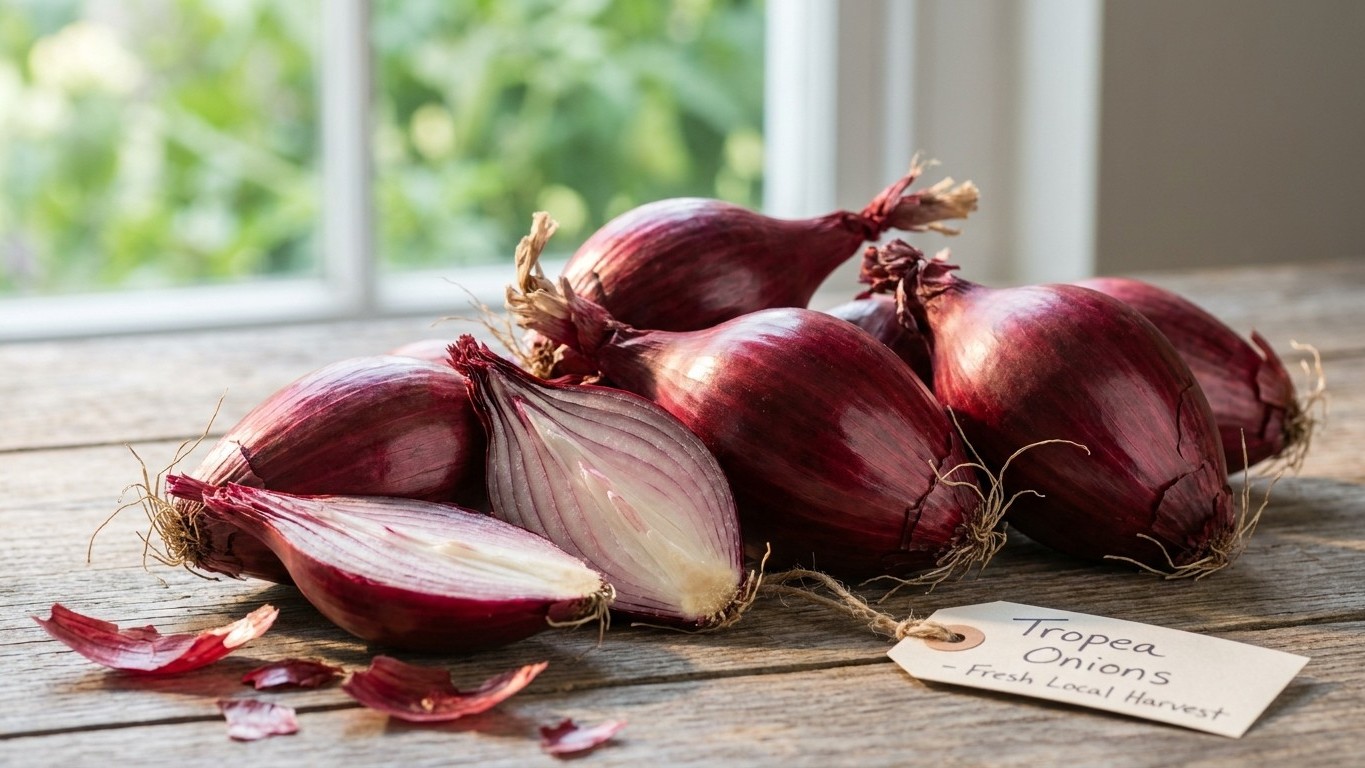

Red Long of Tropea is an intermediate-day onion that bulbs reliably between 35 and 48 degrees N latitude, matures about 90 days after transplant, and stores for roughly one month before it starts to soften. That short keeping window comes from a real chemical trade-off: this is a sweet, low-sulfur onion, and sulfur is exactly what protects a bulb in storage. Here is where it grows, how it behaves in the ground, and what that one-month clock means for your kitchen.
Will Red Long of Tropea bulb where you are

This is the fact that decides everything else. Red Long of Tropea belongs to the intermediate-day group, which bulbs correctly between 35 and 48 degrees N latitude. That band covers most of the continental United States, from roughly the northern edge of Georgia and Texas up through the Great Lakes and southern Canada border states. If your garden sits inside that range, the onion has what it needs to form a bulb. If it sits well outside, the plant will not simply make a smaller onion. It will make no bulb at all: just leaves, followed by rot once you try to store it.
The mechanism behind this runs against most gardeners’ instincts. Onions do not bulb because the weather turns warm. They bulb because the number of daylight hours crosses a threshold that the variety is genetically set to respond to. Warmth affects growth speed, not the bulbing signal itself. That is why day length, not the calendar or the thermometer, is the real trigger.
It also explains a fact that surprises a lot of new growers: the far north gets more summer daylight than the south, not less. In June, a garden in Minnesota sees noticeably more daylight per day than one in southern Texas. Long-day onions are built for that northern light schedule. Short-day onions are built for the shorter summer days closer to the Gulf Coast. Intermediate-day varieties like Red Long of Tropea sit in the middle band, which is exactly why the 35 to 48 degree window matters so much here.
If your garden falls near one of those two edges, at 34 or 35 degrees, or up near 48 or 49, you are in a blurred zone. The variety may bulb, or it may bulb weakly, and local microclimate, planting date, and even the specific summer’s weather pattern can tip it either way. Nobody can promise you a yes or a no from a map alone. The honest answer for a border-zone garden is to try a small trial row before committing a full bed to it, and to compare notes with your local extension office, which will know how the crop has performed in your county in past seasons.
What Red Long of Tropea is like
Assuming your latitude cooperates, here is what actually shows up in the garden bed and on the cutting board. This is catalogue-level information, the kind that describes the plant rather than the experience of growing it, but it is the data most gardeners look up before they commit a row to any variety.
- Color: Red skin and flesh, typical of the Tropea onion lineage.
- Days to maturity: About 90 days from transplant to harvest-ready bulb.
- Flavor: On the sweet side, with relatively few sulfur compounds compared to storage-type onions.
- Storage life: Roughly one month under normal keeping conditions.
The flavor and the storage life are not two separate facts. They are the same fact seen from two angles. Sulfur compounds are what make an onion sting your eyes and bite your tongue, and they are also what make the bulb chemically hostile to the bacteria and fungi that cause rot. A sharp, storage-type onion is loaded with those compounds. A sweet onion like this one has traded most of that protection away in exchange for a milder bite. That is not a flaw in this particular batch or a sign of poor growing conditions. It is how the variety is built.
Practically, that means you should not expect this onion to behave like a yellow storage onion pulled from a root cellar in February. It will not. What you get instead is a bulb that tastes noticeably better raw, sliced into a salad or layered on a sandwich, without the harshness that makes some onions unpleasant unless cooked. The trade is real in both directions, and no growing technique changes the underlying chemistry.
When to plant it
Planting timing follows the day-length group, and this is the detail that trips up gardeners who move from one region to another or who read planting advice written for the wrong zone. Short-day onions go into the ground in autumn across the mild-winter South and get harvested the following late spring. Long-day onions go in during late winter to early spring across the northern half of the country. Intermediate-day varieties, including Red Long of Tropea, generally follow the spring planting pattern used for long-day types in most of the range where they succeed, going in as early as the soil can be worked in late winter or early spring.
The exact date matters less than what your local frost dates and soil conditions allow, and this is where a call to your state’s cooperative extension office earns its keep. They track average last-frost dates and safe transplant windows down to the county level.
There is a test that matters more than any date on a calendar, though. The plant needs to reach a certain size in its leafy, vegetative stage before day length crosses the bulbing threshold. Once that trigger hits, the plant redirects its energy from leaf growth into bulb formation, and the size of the top growth at that exact moment sets a ceiling on how big the bulb can get. A small, stunted plant that gets triggered into bulbing produces a small bulb, no matter how good the soil is afterward. That is why early, healthy transplants matter more than late fertilizing. You are racing the calendar of daylight, not the calendar of the season.
Growing it well
Onions have a shallow, sparse root system, and that single fact explains most of what goes wrong in an onion bed. Weeds that a tomato plant would barely notice can choke an onion’s water and nutrient supply, because the onion’s roots simply do not reach far enough to compete. The visible result is not a dead plant, usually. It is a bulb that stops growing early and comes out of the ground noticeably smaller than it should have been. Keeping the bed weed-free, especially in the first several weeks after transplanting, protects bulb size directly rather than being a matter of tidiness.
The same logic applies to water. Onions do not tolerate long dry stretches well, and a plant that runs short on moisture during bulb development simply builds a smaller bulb rather than recovering later. Consistent moisture through the bulbing stage matters more than heavy watering at any single point.
Bolting is the other issue worth watching for. A plant that sends up a flower stalk has shifted its energy toward reproduction rather than bulb storage, and a bolted onion will not keep well no matter how it is cured afterward. If you spot a flower stalk forming, the practical move is to harvest that particular bulb and use it soon rather than trying to store it alongside the rest of the crop. It will still be perfectly edible. It just will not last.
Harvesting and keeping it
The signal that harvest time has arrived comes from the plant itself, not from a date circled on a calendar back in spring. When the green tops start falling over and yellowing on their own, that is the plant telling you it has finished bulking up the bulb below ground. Pulling onions before the tops fall over on their own usually means an underdeveloped bulb with a shorter storage life than it should have had.
Curing is the step most home gardeners skip, and it is the reason a lot of homegrown onions rot in storage within a few weeks despite looking fine at harvest. The neck of the onion, the point where the leaves meet the bulb, has to dry down until it feels papery and closed before the bulb goes into any long-term storage. A wet or soft neck is an open door for rot organisms.
- Watch for the tops to fall over and start yellowing naturally in the bed.
- Pull the bulbs, leaving the tops attached, and set them somewhere dry and out of direct sun.
- Let them cure for one to two weeks, checking that the necks dry down and feel papery, not soft.
- Trim the tops and roots once cured, and move the bulbs into a cool, dry storage spot with airflow.
Given the one-month keeping window on Red Long of Tropea, the practical takeaway is straightforward: treat this as a variety you eat in season rather than one you tuck away for winter. An onion that keeps six months can carry a household through to spring. This one is built for the weeks right after harvest, sliced raw into summer meals while its sweetness and mild bite are at their best. Plan your kitchen use around that window rather than expecting root-cellar longevity from a bulb that was never built for it.