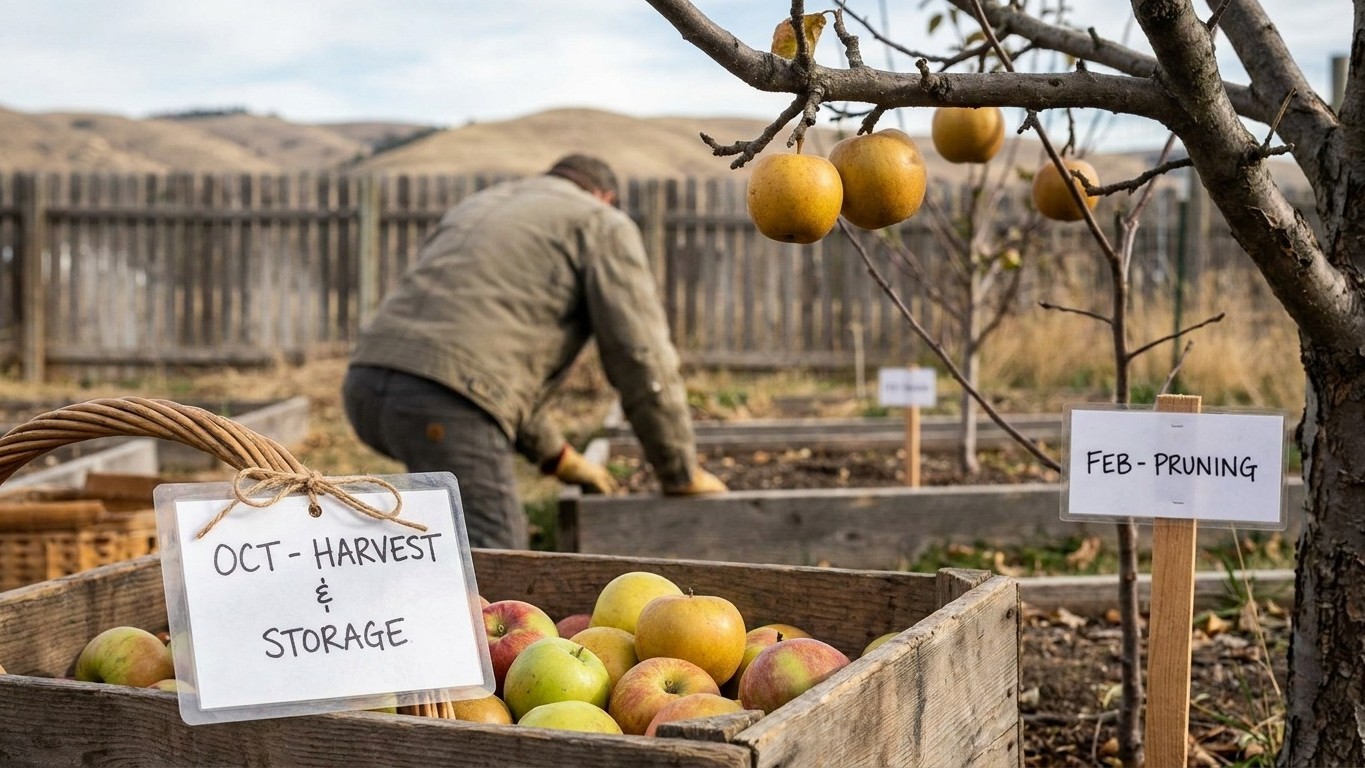

Idaho’s apple calendar runs on the tree’s stage, not the date on a feed store flyer. Around Boise, NOAA’s NCEI 1991-2020 climate normals put the last spring freeze between April 23 and May 7, and the first fall freeze between October 7 and October 21, which brackets the season most low-valley growers work inside. The action that follows: track bud stage against that spring window rather than the calendar, because a bloom that opens before the freeze risk has cleared is the single thing this climate punishes hardest.
The short answer for Idaho
Pink bud is the hinge the whole calendar swings on: it opens the season, and everything after it—full bloom, petal fall, the long wait for harvest—shifts with elevation. Boise’s own dates run mild, since the valley floor sits lower and warmer than most of the state; a bench orchard or high desert flat lags weeks behind, not days. Underneath those dates sit two separate filters, winter hardiness and winter chill, deciding whether the wood survives December and the flowers open right in April.
The answer changes with elevation more than with anything else. Boise sits low in its valley, and NOAA’s own note attached to this data is that most of Idaho is higher and colder, with a shorter season on both ends. A grower on a mountain bench or a high desert flat should expect the safe bloom window to arrive later in spring and close earlier in fall than the Boise figures suggest, sometimes by weeks rather than days.
What the answer depends on, beyond elevation, is the tree itself. Winter hardiness, and NOAA’s 1991-2020 normals put Boise’s coldest month at an average daily minimum of 24.0°F, decides whether the wood survives winter at all. Winter chill decides whether the flowers open properly and set fruit the following spring. Those are two separate filters, and a variety can pass one and fail the other. Before planting, or before second-guessing a graft that never bloomed right, it is worth reading The Best Apple Varieties for Idaho to see which cultivars are rated for both filters in this climate, not just one.
Working through it

Every apple season in Idaho moves through the same seven stages, and it is the stage, checked against the tree in front of you, that tells you whether to act. The calendar month is only a rough guess at where that stage will fall.
Dormancy

From leaf drop through late winter, the tree is fully dormant, bark bare and buds tight and closed. This is when to prune, since cuts made while the tree is asleep heal cleanest and the branch structure is easy to see without leaves in the way. Any dormant oil or copper application, if you use one, goes on now, before any green shows.
Green tip

Bud scales split and a wedge of green leaf tissue pushes through, usually well ahead of the last frost risk clearing at a given elevation. This is the stage to finish any delayed pruning and to get an early fungicide down if scab has been a problem on that tree before, since a split bud scale is an easy entry point for infection.
Pink

Flower clusters swell and show color through the still-closed petals, a stage that in the Boise area often falls close to or inside NOAA’s April 23 to May 7 last-frost window. A late cold snap at pink does more damage than the same cold at green tip, because the flower parts are more exposed and lose cold-hardiness with every day that passes toward bloom.
Bloom

Petals open fully and pollinators start working the orchard. This is the stage most exposed to frost loss in this climate, since an open flower is killed by a freeze a green bud would have shrugged off. Growers who watch NOAA’s spring frost window closely are watching it mainly for this reason: a variety whose bloom habit runs early relative to the local frost dates is gambling every single year that it flowers after the risk has passed.
Petal fall

Petals drop and the small ovary at the base of each flower begins to swell. This is when a light thinning starts to make sense on trees that set heavily, though most growers wait until fruit set to see how much fruit actually took before thinning hard.
Fruit set

Fruitlets reach marble size, still with the dried sepals attached at the tip. Codling moth timing is usually keyed to this stage rather than a fixed date, since the moths lay eggs once fruit is actually present to sting, not on a calendar schedule.
Harvest
Depending on the variety, harvest in the Boise area typically finishes well ahead of NOAA’s October 7 to October 21 first-fall-frost window, though a later-season cultivar can run close to it. The tree’s own readiness, not the frost date, decides harvest day: skin color change, ease of stem separation from the spur, and background color are the signals worth checking, all part of the groundwork covered in Growing Apples in Idaho.
What changes across Idaho
The Boise-area figures above come from a low valley station, and NOAA is explicit that most of the state sits higher and colder. Elevation is the biggest single variable: benches and foothill orchards even a few hundred feet above the valley floor cool faster at night and warm slower in spring, which pushes green tip, pink and bloom later and pulls the first fall frost earlier than the Boise dates describe.
Idaho’s mountain valleys add a second effect on top of elevation: cold air drains downhill overnight and pools in low basins, so an orchard sited on a valley floor can see a harder frost than one planted on the slope just above it, at the same elevation, in the same weather. This is why growers who terrace or bench their plantings on a hillside often report less frost damage at bloom than a neighbor on the flat below, growing the same varieties in the same spring.
The Snake River Plain, where Boise sits, is Idaho’s warmest and longest apple-growing ground, and it is the region the NOAA figures above actually describe. Farther north, in the panhandle around Coeur d’Alene and Sandpoint, and at higher elevations across the Camas Prairie and the mountain valleys of central Idaho, the growing season runs shorter on both ends. No figure in this piece is sourced for those locations specifically, and a grower there should treat the Boise dates as a rough outer bound rather than a working calendar, confirming local timing with the University of Idaho Extension office serving that county.
None of this rules apples out at higher elevation or farther north. It changes which cultivars make sense and how tightly a grower needs to time bloom against local frost risk, which is exactly why the tree’s stage matters more the farther a planting sits from the Snake River Plain.
The mistakes this climate punishes
Most apple losses in Idaho trace back to one of three mistakes, and all three show up at a specific stage rather than as a vague bad year.
- Planting an early-blooming variety in a late-frost location. A cultivar bred for a milder climate often blooms ahead of local frost risk here, and the loss shows at the pink or bloom stage, when an open or opening flower is killed by a freeze a dormant bud would have survived.
- Choosing a low-chill variety for a genuinely cold winter. A tree that needs less winter chill than it actually gets can break bud unevenly and bloom over an extended, ragged period, spreading the flowering window across more of the frost-risk period instead of concentrating it into one shorter, more predictable stretch.
- Feeding or watering heavily late in the season. Nitrogen or irrigation pushed into the tree in late summer keeps new growth soft and unhardened, and that soft tissue is the first thing killed when temperatures drop toward NOAA’s October 7 to October 21 first-fall-frost window around Boise, or earlier at higher elevation.
The first mistake is the hardest to fix after the fact, since it is baked into the cultivar’s bloom timing and reappears every year the spring runs even slightly cooler than average. The second shows up as a lighter, spread-out fruit set rather than one dramatic loss, which makes it easy to blame on pollination or weather instead of on the variety’s chill requirement. The third is the most avoidable of the three: stopping nitrogen and easing off irrigation by late summer gives new growth time to harden before the first hard cold arrives, and it is a management decision, not a variety choice. All three are diagnosed the same way, by checking which stage the tree was actually in when the damage happened, then working backward to the cause instead of blaming the month on the calendar.
Checking this against your county
The dates and thresholds above are Boise numbers, and Idaho’s counties vary enough in elevation and cold-air drainage that a neighboring valley can run a full stage behind. Before locking in a bloom-timing or frost-protection plan, check current freeze data and variety recommendations for your specific county with the University of Idaho Extension, credited by USDA NIFA as the state’s land-grant extension service. County offices track local frost records and can confirm whether a given stage typically lands ahead of or behind the Boise figures used here.
Common questions
When’s the best time to plant a new apple tree in Idaho?
Plant while the tree is still dormant, either in early spring once the soil can be worked and before green tip shows, or in fall after leaf drop in milder locations. The exact window shifts with elevation and local soil conditions, so confirm timing with your county extension office rather than relying on a fixed calendar date.
Do I need two different apple varieties to get fruit?
Most apple varieties need pollen from a different variety blooming at an overlapping time, since a single tree usually cannot pollinate itself reliably. A flowering crabapple planted nearby works as a pollinizer for almost any apple variety if there isn’t room for a second full-size tree.
How do I protect blossoms if a late frost is forecast at bloom?
Covering small trees with frost cloth or old sheets overnight, running orchard sprinklers to coat buds in an insulating layer of ice, and holding off on any pruning cuts right before a predicted freeze all reduce bloom loss. None of these fixes a variety that simply blooms too early for the site. That’s a planting decision, not something to solve on a cold night.
Can apples handle the mountain valleys, not just the Boise area?
Yes, with the right cultivar. Hardier, earlier-ripening varieties suited to a short season and a cold winter can produce well in higher, colder parts of the state, though no source used in this piece documents specific frost dates for those locations. Check with your local University of Idaho Extension office for the frost data and variety recommendations for your elevation.