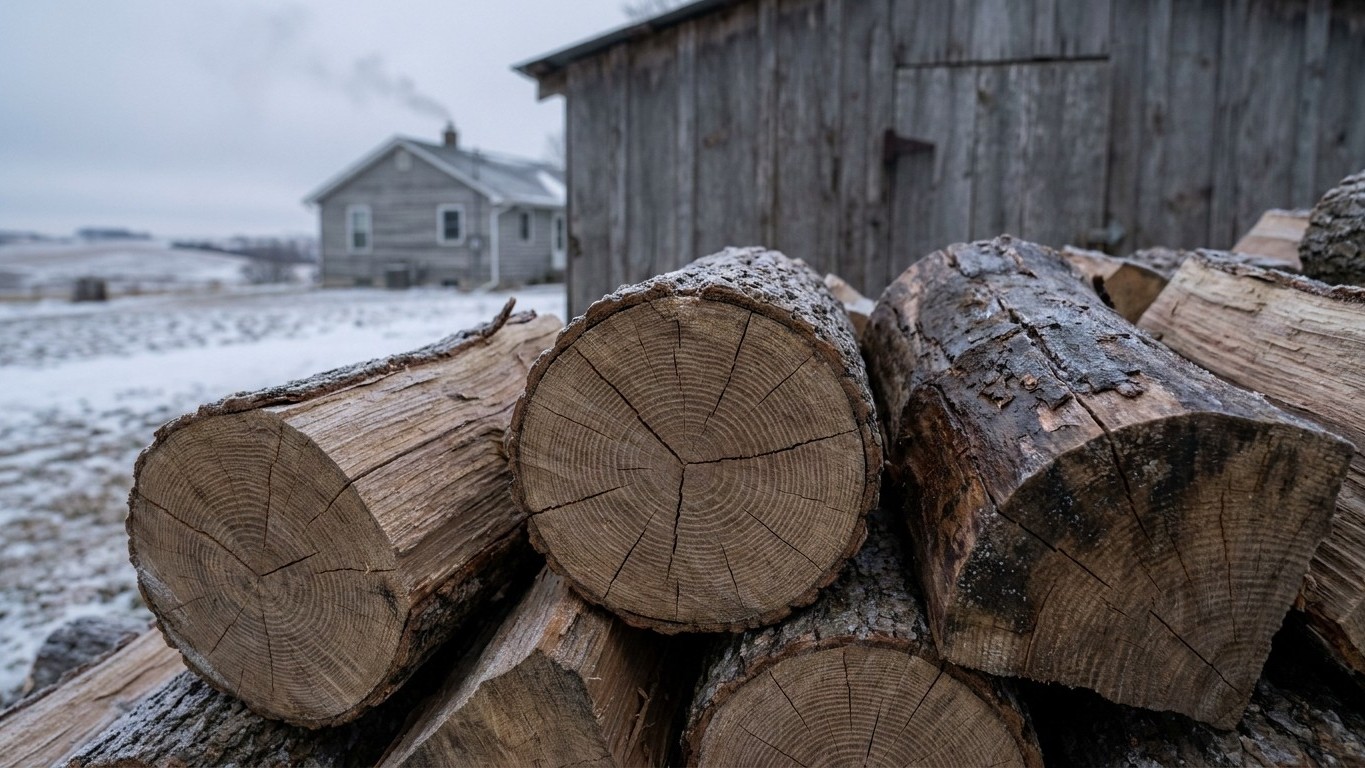

The wood that gets a Kansas home through January isn’t the one that smells nicest at a roadside stand. It’s the dense, properly seasoned hardwood that can survive a mean daily low of 22.5°F and still throw real heat at 2 a.m. This page walks through what that cold figure demands, how to judge a load of firewood against it, and why the wood cut last spring might not be ready to burn yet.
How cold it actually gets here
At the reference station in Wichita, the average daily low during the coldest month sits at 22.5°F, according to NOAA’s 1991-2020 Climate Normals. That’s not the record low that makes the evening news. It’s the ordinary, night-after-night temperature a Kansas home has to answer for through the heart of winter, and it’s the number that should drive every decision about firewood in this state.
Twenty-two and a half degrees is comfortably below freezing, night after night, for weeks at a stretch. That rules out treating firewood as a nice-to-have. In parts of the country where the coldest month barely dips below 40°F, a wood stove is mostly about atmosphere, a backup for a power outage or a cozy evening. Kansas isn’t that state. A stove or insert running through a Kansas winter is doing real structural work: keeping pipes from freezing, keeping a back bedroom livable, in some homes carrying the whole heating load.
That distinction changes how much a household should think about wood quality. In a climate where firewood is decorative, a middling load of half-seasoned wood is a minor annoyance. Here, the same load means a colder house on the coldest night of the year, more trips to the woodpile at midnight, and a stove that struggles to hold a bed of coals until morning. The cold figure is also why the rest of this guide leans so hard on density and seasoning instead of treating firewood as interchangeable cordwood.
What 22.5°F means for a stove
A stove has to work harder as outdoor temperature drops, simply because the gap between indoor and outdoor air widens. At a low of 22.5°F, that gap is roughly 50 degrees if a home is held at 70°F indoors. Closing that gap night after night, for the length of a Kansas winter, is the actual job firewood is doing here, and it’s why the density of what’s in the woodpile matters more than it would somewhere milder.
Which woods are worth the effort here
A cord is a fixed volume, a stack measuring 4 feet by 4 feet by 8 feet, or 128 cubic feet, whether it’s packed with a dense hardwood or a light one. What isn’t fixed is how much wood, and how much energy, fits inside that volume. According to Michigan State University Extension, a cord of well-seasoned hardwood carries about 20 million BTU, roughly the heat equivalent of 145 gallons of #2 fuel oil or 215 gallons of LP gas. That average is the baseline every Kansas woodpile should be measured against.
The word “average” is doing real work in that sentence, and it’s worth taking seriously before shopping for a load. Species density and moisture content both move that number, sometimes by a lot, which is why a supplier’s word for “hardwood” isn’t a guarantee of heat. Green, unseasoned wood is the bigger problem: MSU notes it can carry over 60 percent moisture, and every bit of that water has to be boiled off inside the firebox before the wood releases any usable heat. A load that looks identical to a seasoned one on the truck can perform far worse in the stove.
Red oak gets a specific mention from MSU for a different reason. Its cell structure makes it dry more slowly than other hardwoods, so a red oak load needs more time under cover than a typical hardwood before it reaches the 20 percent moisture target that makes it burn well. That’s not a knock on the wood itself, which seasons into a solid, long-burning fuel. It’s a scheduling problem: a red oak load bought in late summer for a Kansas winter starting in November may simply not be ready yet.
Availability matters as much as the chart
None of this density math helps if the wood in question isn’t sitting seasoned and available from a local supplier. A theoretically superior species that can only be found green, or not at all, is worse for a Kansas winter than a modest hardwood a household can actually get dry and stacked before the cold sets in. Ask a supplier directly how long a given load has been split and stacked, not just what species it is.
| Category | BTU per cord (approx.) | Moisture content | Practical note |
|---|---|---|---|
| Well-seasoned hardwood | About 20 million BTU | 20% or less | Comparable to 145 gal. fuel oil or 215 gal. LP gas |
| Green (unseasoned) hardwood | Well below 20 million BTU | Can exceed 60% | Energy lost boiling off water; smokier, cooler burn |
| Red oak specifically | Same potential once fully dried | Slow to reach 20% | Needs extra months under cover before burning |
How much wood a winter takes
Any published number claiming to tell a Kansas household exactly how many cords a winter requires is guessing, because the real answer depends on three things specific to that house, not to the state. The 22.5°F cold figure sets the baseline demand. But how well a house holds onto heat, and whether wood is carrying the whole load or just supplementing a furnace, can swing that baseline by a wide margin.
A poorly insulated older farmhouse in a hard Kansas winter can burn through roughly double what a tightly sealed, well-insulated home uses in that same climate, simply because so much of the heat generated is leaking straight back outside through walls, windows, and an uninsulated attic. That’s the mechanism that makes a flat “X cords per winter” figure close to meaningless without knowing the house behind it.
The practical move is to run the estimate for a specific home rather than borrow someone else’s number:
- The cold figure: a 22.5°F average low sets a real, sustained heating demand, not an occasional cold snap.
- House tightness: insulation, air sealing, and window quality decide how much of the heat generated actually stays inside.
- Wood’s role: whether it’s the primary heat source or a supplement to a furnace changes the total load by a lot, not a little.
Working down that list against an actual home, rather than a statewide average, gets closer to a usable number than any chart can.
Drying wood in this climate
Seasoning matters more than species almost everywhere, and Kansas is no exception. The target, per Michigan State University Extension, is 20 percent moisture or less before wood goes in the stove, down from a green moisture content that can top 60 percent. What actually dries wood is airflow and time working together, not sunlight, which is why wood tossed in an uncovered pile in full sun can still be wet inside come November.
Reaching that 20 percent target generally takes one full summer of wood that’s been split and stacked so air can move through the pile, not left in rounds where the bark seals in moisture. Kansas summers, hot and often humid, aren’t the fastest drying conditions in the country, but they’re workable if the wood is properly split, stacked off the ground, and given room to breathe on all sides rather than crammed into a tight pile.
This is where the 22.5°F cold figure connects directly to a scheduling mistake that shows up every year. Wood cut and split in spring 2026 is very often not ready for the winter that starts a few months later, because it hasn’t had a full season stacked and drying. That’s especially true for red oak, which MSU flags as slower to season than other hardwoods because of its cell structure. The wood a household burns this winter should, ideally, have been split and stacked the summer before, not the same year it’s needed.