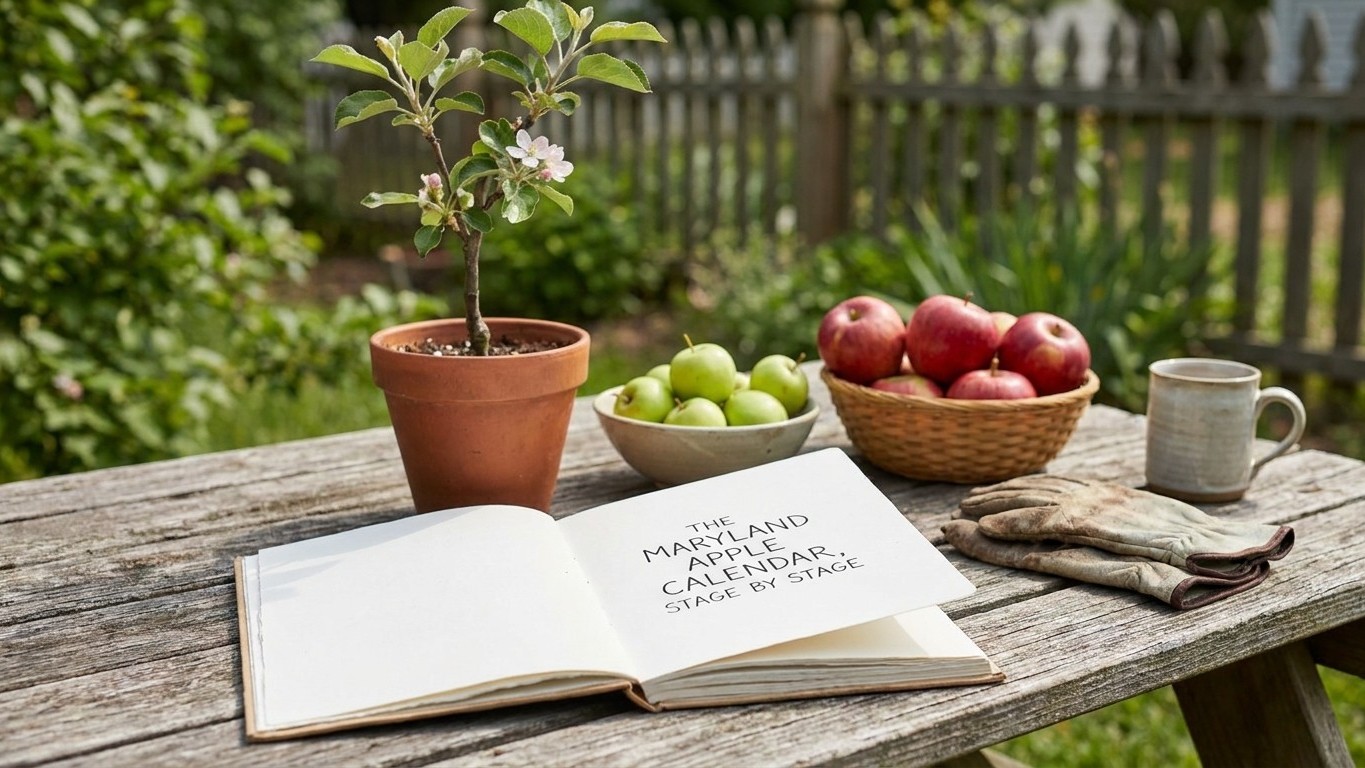

Maryland’s apple calendar runs on frost, not on the month printed on the wall. Near Baltimore, NOAA’s NCEI 1991-2020 climate normals put the last spring freeze between April 3 and April 16, and the first fall freeze between October 26 and November 5, and every stage from green tip to harvest gets timed against that window rather than a fixed date. The action that follows from this: track your trees’ actual bud stage against those two windows this year, because a warm March or a slow April can shift bloom into frost risk even when the calendar looks normal.
The short answer for Maryland
Maryland’s apple bloom answers to one thing: the Baltimore-area last freeze, which lands between April 3 and April 16. That’s the window pink bud and bloom have to survive, and it’s why “it’s April, so we’re fine” gets orchards burned. So today, before you read another word: walk out and check what stage your buds are actually at against that date range — dormant is safe, pink or bloom inside that window is not, and that gap is the whole calendar.
Baltimore’s coldest month averages a daily minimum of 24.4°F, per the same NOAA NCEI normals, cold enough that a marginal rootstock or an unhardy cultivar can lose wood in an ordinary winter, not just a severe one. The full answer to “when” depends on three separate things: how early the cultivar blooms relative to April 3-16, whether the winter delivers enough chill hours for that cultivar to flower cleanly, and how many frost-free weeks it needs to ripen before the fall window closes. None of that is answered by a single date. It is answered by watching the tree and reading it against the two ranges above. If you have not yet picked a site, a rootstock, or a first cultivar, that groundwork belongs in Growing Apples in Maryland before the calendar below is useful to you.
Working through it

Apple trees move through the same seven stages everywhere. What changes state to state is where each stage lands relative to that region’s own frost dates, and in Maryland that means reading everything against Baltimore’s April 3-16 spring window and October 26-November 5 fall window, adjusted for where you actually are.
| Stage | Where it falls against the Baltimore frost windows | Frost risk | What to do |
|---|---|---|---|
| Dormancy | Ends as the season warms toward the spring window | Low, wood is fully hardened | Prune, apply dormant oil |
| Green tip | Often begins before or right at the start of April 3-16 | Low to moderate | Watch forecasts, hold nitrogen |
| Pink | Frequently lands inside the April 3-16 window | High | Have frost cloth or overhead irrigation ready |
| Bloom | Often at or just past the close of the window | Highest | Protect flowers, avoid pollinator-toxic sprays |
| Petal fall | Shortly after bloom, usually clear of the window | Moderate | Begin thinning fruitlets |
| Fruit set | Weeks after frost risk has passed | Low | Prop heavy limbs, watch for pests |
| Harvest | Before the October 26-November 5 fall window | None until frost approaches | Pick and check storage plan |
Dormancy

The tree is fully hardened and this is when structural pruning does the least damage. Baltimore’s coldest-month minimum of 24.4°F, from NOAA NCEI, is the figure that determines whether a given rootstock or cultivar even survives the winter here, separate from anything to do with bloom timing.
Green tip

Buds swell and show a sliver of green. This usually starts before or right around the opening of the April 3-16 window, so tissue is still relatively frost-tolerant at this point. Hold off on nitrogen here. Feeding too early pushes soft growth right as the risk window opens.
Pink

The bud shows color but has not opened. This stage often falls squarely inside the April 3-16 window, and it is measurably more frost-tender than green tip. This is the point to have some form of frost protection, cloth, overhead water, or at minimum a plan, ready to go on short notice.
Bloom

Open flowers are the most frost-sensitive tissue on the tree, and full bloom commonly lands at or just after the tail end of Baltimore’s spring window. A freeze during bloom does not just damage the tree, it can wipe out the year’s crop outright. This is also the stage where spray choices matter most, since pollinators are working the open flowers.
Petal fall

Petals drop and the fruitlet is visible at the base of the flower. By now the tree is usually clear of serious frost risk. This is the window to start thinning, since fruit count set now determines size and quality later.
Fruit set

Fruitlets size up through late spring into early summer, well past the frost window. The tree’s job here is carrying weight, and yours is watching for the pests that show up once the crop is established.
Harvest
Ripening dates depend entirely on cultivar, and the deciding constraint is getting the crop off before the October 26-November 5 fall freeze window closes. A cultivar with a long days-to-maturity count needs to go in early enough that its ripening date, counted from bloom, still clears that window with room to spare. If you have not settled on cultivars yet, The Best Apple Varieties for Maryland lays out days-to-maturity and chill needs for the ones that actually work in this climate.
What changes across Maryland
Baltimore’s frost windows are a starting point, not a statewide fact. Western Maryland, the mountainous counties of Garrett and Allegany, sits at higher elevation and runs its last spring frost and first fall frost weeks later and earlier than Baltimore’s normals, which compresses the whole calendar above. Every stage in the table above shifts later in spring and the harvest window closes sooner in fall, so a cultivar that ripens comfortably near Baltimore may run out of season up there.
The Eastern Shore, moderated by the Chesapeake Bay, tends to run milder than Baltimore on both ends of the season. That generally opens more room at the back end of the calendar for later-ripening cultivars, though the exact dates for any specific Eastern Shore location are not the same figure as Baltimore’s and should be checked locally rather than assumed.
Elevation and terrain matter within small distances too. Low ground that pools cold air on a still night, a hollow, the bottom of a slope, a spot near a creek, will read colder at bloom time than a spot a few hundred feet away on a slight rise, even within the same county. If you are choosing where on your property to plant, air drainage matters as much as sun exposure once bloom-stage frost is the thing you are trying to dodge.
The mistakes this climate punishes
The most common failure in this state is planting an early-blooming cultivar and treating Baltimore’s April 3-16 window as a hard stop rather than a probability band. Frost still has a real chance of arriving inside and even just after that range, and a cultivar that blooms at the early edge of the pack is exposed to exactly the years the window is measuring. This shows up as a season with full bloom and almost no fruit.
The second is choosing a very long-chill cultivar and then getting a mild winter. Chill and hardiness are not the same filter. Hardiness is about whether the wood survives the cold, which Baltimore’s coldest-month minimum of 24.4°F, from NOAA NCEI, generally supports for zone 6-hardy stock. Chill is about whether the tree has banked enough cold hours to flower evenly the following spring, and a mild winter that still clears the hardiness bar can still fall short on chill for a cultivar bred for a much colder climate. The result is patchy, delayed, or uneven bloom rather than a killed tree.
The third is feeding nitrogen too late in the season. Growth pushed by a late summer feeding is soft and unhardened, and it is exactly that soft tissue that gets hit hardest when the first fall freeze arrives, somewhere in Baltimore’s October 26-November 5 window or the equivalent window for your part of the state. This shows up as blackened shoot tips and dieback right at the point where the tree should be shutting down cleanly for winter, not as a dramatic loss of the crop itself but as weakened wood heading into the next season.
- Early-blooming cultivar planted where spring frost risk runs late
- Long-chill cultivar chosen without checking a typical winter’s chill hours locally
- Nitrogen applied close to the fall freeze window instead of tapering off in summer
- Marginal rootstock planted below its rated hardiness for the coldest-month minimum
Checking this against your county
Every figure above is measured at or near Baltimore, and every part of the state stated to differ in the notes above does so by more than a rounding error. Before you commit a planting date, a cultivar, or a frost-protection plan to paper, check it against your own county through the University of Maryland Extension, which tracks local conditions county by county rather than relying on a single reference station. That single check is worth more than any generic calendar, including this one.
Common questions
When should I actually prune my apple trees in Maryland?
Prune during dormancy, before green tip shows, while the wood is fully hardened and the structure of the tree is easiest to see without leaves in the way. Doing it later, once sap is moving, invites more disease pressure through open cuts.
Can I still get a harvest if a late frost hits during bloom?
Sometimes, but expect a reduced crop rather than a total loss in most years, since not every flower opens on exactly the same day and a partial bloom can survive a light freeze even when the fully open flowers do not. A hard freeze across a fully open bloom is the scenario that wipes out the year.
Do I need more than one apple tree to get fruit at all?
Most apple cultivars need a different cultivar blooming at the same time nearby for pollination, since a single tree of one cultivar usually will not set a reliable crop on its own. Check the pollination compatibility listed for whatever cultivars you choose before committing to just one tree.
Why did my tree bloom heavily but set almost no fruit?
This is usually either a frost that damaged the open flowers without killing the whole bloom, a lack of pollinator activity during a cold or rainy bloom period, or a missing pollination partner cultivar nearby. It is rarely a fertility problem with the soil.