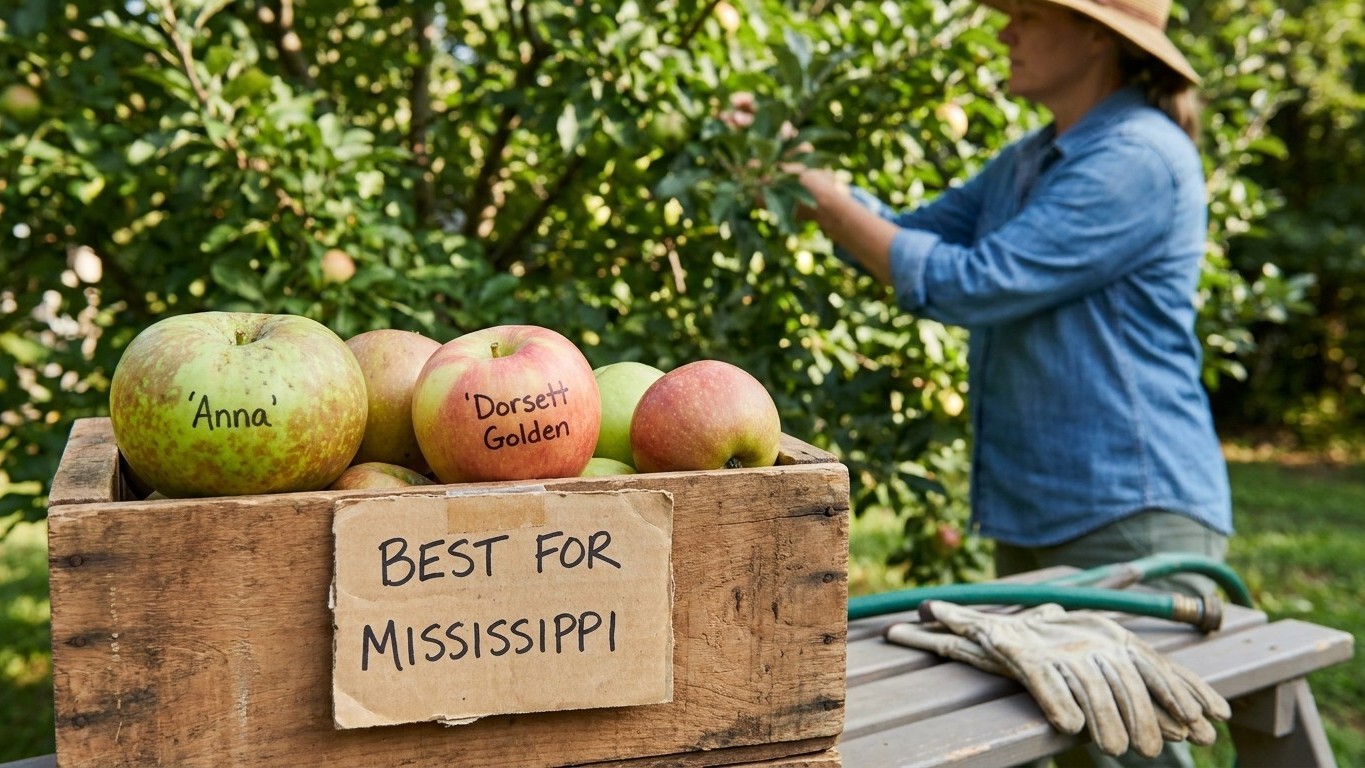

Honeycrisp trees will survive a Mississippi winter without complaint, which is exactly why so many orchards here end up disappointing. Cold hardiness was never the obstacle — the wood shrugs off frost that would kill a peach. The real gatekeeper is winter chill, the tally of cold hours a tree needs before it will bloom on schedule. Jackson’s coldest month averages a low of just 35.3°F, nowhere near enough to satisfy the high-chill varieties bred for New England or the upper Midwest.
The short answer for Mississippi
The short answer: apples can be grown across most of Mississippi, but only if the tree’s winter chill requirement and its cold hardiness are matched to what this state’s winters actually deliver. For most of the state, that means starting from low-chill selections rather than the varieties sold in northern nursery catalogs. NOAA’s 1991-2020 Climate Normals put the coldest month’s average low at Jackson at 35.3°F, a mild figure that rules out the high-chill apples bred for New England, the upper Midwest, or the mountains of the Pacific Northwest. It does not rule out apples altogether.
Every apple variety has to clear two separate filters before it belongs in a Mississippi orchard:
- Winter chill: the number of cold hours the tree needs over winter to break dormancy and bloom on schedule.
- Cold hardiness: the coldest temperature the wood and buds can survive without dying back.
In Mississippi, hardiness is rarely the problem. Apples as a species tolerate far colder winters than this state produces, so a tree that came from a nursery several states north will not freeze to death here. Chill is the filter that actually eliminates varieties. A tree that never accumulates enough cold hours will leaf out unevenly, bloom late and thin, or skip bloom entirely in a mild year.
How that answer plays out also depends on where in the state you are planting, which is worth settling before you commit to a variety. If you haven’t worked through site and rootstock basics yet, that groundwork is covered in Growing Apples in Mississippi.
Working through it

Chill category is the first cut
Apple varieties are classified in the nursery trade by how many hours of winter chill, roughly the time spent below 45°F over the dormant season, they need before they’ll break dormancy and bloom evenly. That classification doesn’t change from one state to the next, which makes it the first filter to apply before you even open a catalog.
| Chill category | Typical chill hours needed | Realistic in Mississippi |
|---|---|---|
| Low-chill | Under about 500 hours | Best fit statewide, including the Delta and the Gulf Coast |
| Moderate-chill | Roughly 500 to 800 hours | Workable in the higher, cooler hill country of northeast Mississippi in most winters |
| High-chill | Over about 1,000 hours | Not a realistic bet anywhere in the state given how mild the coldest month runs |
Given how mild the coldest month runs at the Jackson reference station, moderate-chill and high-chill types are a gamble outside the coolest corners of the state, and a low-chill selection is the safer starting point almost everywhere else.
What each choice costs
Low-chill apples were mostly bred for climates like the Deep South, Texas, and parts of California, and that breeding came with tradeoffs. Many ripen earlier and store for a shorter time off the tree than the high-chill dessert apples sold in northern grocery stores, and the flavor and texture lean softer and sweeter rather than crisp and tart. That is the price of a tree that will actually flower here.
Moderate-chill types ask for more sustained cold than the Delta or the Gulf Coast reliably deliver, but they are a realistic bet in the state’s higher, cooler hill country, where the winter runs colder than Jackson’s own climate record. Choosing one of these outside that cooler ground is a bet against the coldest month’s own average.
Rootstock and disease pressure
Mississippi’s long, humid growing season is harder on apple foliage and bark than its winters ever are. Fire blight and cedar apple rust are both regular problems in the Southeast’s wet springs, and neither is decided by chill or hardiness. Ask your nursery and MSU Extension which selections and rootstocks currently show resistance in state trials, since that list changes as new cultivars are tested and older ones drop off it.
Once you’ve matched a variety to your chill zone, the next decision is timing. Bloom, frost risk, and thinning all run off the tree’s own stage rather than the calendar month, and that sequence is laid out in The Mississippi Apple Calendar, Stage by Stage.
What changes across Mississippi
Mississippi is not one climate for apple purposes, and the Jackson figures above are a reference point, not a state-wide guarantee. NOAA is explicit that its normals come from the airport station in Jackson, and that other parts of the state run measurably warmer or colder.
The Mississippi Delta, in the northwest of the state, sits low and flat, and its winters run mild even by the state’s own standard, which pushes it further toward the low-chill end of the table above. Its long, humid growing season also raises disease pressure on apple foliage more than the winter cold ever will.
The Gulf Coast counties in the south are milder still, moderated by the Gulf of Mexico itself, and are the least likely part of the state to deliver even a moderate-chill winter in most years.
The hill country of northeast Mississippi, at higher elevation than the Jackson reference station, tends to run cooler in winter and is the part of the state where a moderate-chill selection has its best realistic shot. It’s also where a late cold front arriving after an early bloom does the most damage, since a colder winter followed by a mild spell is exactly the pattern that fools a tree into blooming early.
Whatever your county, treat the March 6 to March 22 last-frost window and the November 7 to November 22 first-frost window that NOAA’s 1991-2020 Climate Normals report for Jackson as a starting estimate only. Rural and suburban sites often see frost a week or two later in spring and earlier in fall than the airport station does.
The mistakes this climate punishes
Three mistakes come up again and again in this climate, and each one shows up at a specific, predictable point in the season rather than as a vague poor harvest.
Planting a variety with too little chill
An ultra-low-chill tree can break dormancy during any warm spell in January or February, long before Jackson’s last spring frost window of March 6 to March 22 has closed, according to NOAA’s 1991-2020 Climate Normals. Open blossoms are far more frost-tender than a dormant bud, and a cold front behind that warm spell will take the whole crop with it. This shows up as a heavy, apparently healthy bloom followed by no fruit at all.
Planting a variety with too much chill
The opposite mistake costs less drama but the same result. A high-chill or moderate-chill selection planted where the winter doesn’t deliver its required cold, given how mild Jackson’s own coldest-month average runs, breaks bud unevenly and over a longer window than it should. Bloom gets strung out, pollination overlap between flowers drops, and the eventual set is thin rather than absent.
Feeding too late into summer
Nitrogen applied after midsummer pushes soft, leafy new growth that hasn’t had time to harden off before the first fall frost arrives, which NOAA’s 1991-2020 Climate Normals put at November 7 to November 22 for the Jackson area. That soft growth is what browns and dies back first, and it’s often mistaken for a disease problem rather than a feeding-timing mistake. Stop nitrogen well before that fall frost window, not after it.
Checking this against your county
Every figure above comes from one reference station in Jackson, and chill accumulation especially can vary from one county to the next based on elevation and how close you are to the coast. Before you commit to a variety, check with MSU Extension for the chill-hour and cultivar guidance it publishes for your specific county, since that list is updated as new trials come in and older recommendations are dropped.
The Mississippi State University Extension Service is the right first call, and most county offices can also tell you which nearby orchards are already growing apples successfully, which tells you more than any climate normal can.
Common questions
Can I grow a high-chill apple like the ones sold in northern nurseries if I pick a cold spot in my yard?
No. Winter chill accumulates over the whole dormant season across an entire region, not in a single frost pocket the size of a backyard. A shady or low-lying spot might shave a little off the daily temperature, but it will never add up to the hundreds of missing chill hours a high-chill variety needs.
Do I need two apple trees to get fruit?
Most apple varieties are not self-fertile, so plan on two different varieties that bloom at overlapping times, or confirm there’s a neighboring tree or crabapple within range for cross-pollination. A single isolated tree often blooms reliably but sets little or no fruit.
How long before a new apple tree actually starts producing fruit here?
Most apple trees, whatever the variety, take a few years after planting before they carry a full crop, and choosing a low-chill selection suited to Mississippi doesn’t shorten that timeline. Rootstock has more influence on how fast a young tree bears than chill category does.
Will an apple tree even survive a Mississippi summer, not just the winter?
Heat itself rarely kills an apple tree here. What actually stresses trees through a Mississippi summer is humidity-driven disease pressure, especially fire blight and cedar apple rust, along with drought stress on shallow-rooted young trees. Watering consistently and staying on top of disease management matter more than one hot week ever will.