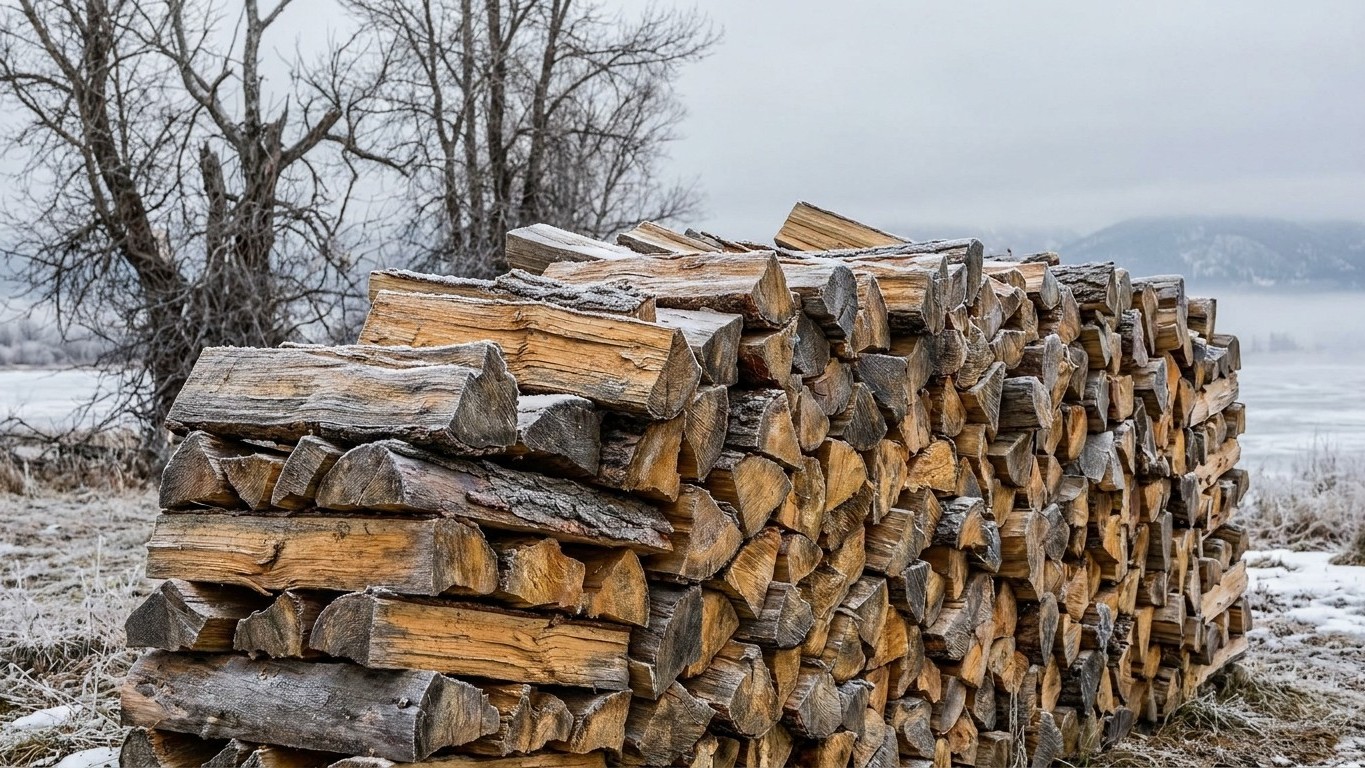

Winter in Montana isn’t polite about it: temperatures fall fast, stay down for months, and demand a heating plan that actually works. Firewood here is a serious utility, not a weekend hobby, and the wood you choose, how much you stack, and how dry it gets before the cold hits all decide whether February is manageable or miserable.
How cold it actually gets here
The average low for the coldest month in Billings sits at 17.9°F, according to NOAA’s 1991-2020 Climate Normals. That’s not the record low, and it’s not some abstract yearly average pulled from a warm afternoon in July mixed with a cold night in January. It’s the typical overnight bottom during the worst month of the year, and that number is what a heating plan has to survive, night after night, for weeks at a stretch.
At 17.9°F, wood heat in Montana crosses out of the “nice ambiance” category and into the “keep the pipes from freezing” category. This is not a place where a small bundle of split logs on Christmas Eve counts as your firewood plan. A stretch of nights near 18°F, sometimes lower depending on the specific winter, means a stove or fireplace insert running long overnight burns, repeatedly, for months. The margin for error is smaller than in milder climates, because a fire that dies at 3 a.m. in a Montana January isn’t just uncomfortable, it can mean frozen pipes or a house that takes days to recover its heat.
What this means practically: the wood has to hold a coal bed through the night, the stack has to be big enough to survive a run of hard weather without a resupply trip in a snowstorm, and the seasoning has to be finished well before the first hard freeze, not still in progress. None of that is optional decoration. A homeowner in a milder climate can treat firewood as supplemental warmth and call it a day if the fire goes out. In Billings, and across most of Montana, wood heat is frequently doing real structural work in keeping a house livable, whether it’s the sole heat source or backup for a furnace that struggles on the coldest nights or during a power outage.
That’s the frame for every choice below. The density of the wood, the size of the woodpile, and how thoroughly it’s dried before burning all get judged against one question: will this get a house through a night that bottoms out at 17.9°F, and does it again the night after, and the night after that.
Which woods are worth the effort here
Cold like this rewards density. A cord is a fixed volume, a stack measuring 4 feet by 4 feet by 8 feet, or 128 cubic feet, whatever wood fills it. But that same volume can carry very different amounts of actual fuel depending on how dense the wood is. A cord of well-seasoned hardwood delivers roughly 20 million BTU, according to Michigan State University Extension, which puts one cord in the same range as about 145 gallons of #2 fuel oil or 215 gallons of LP gas. That’s the number that matters more than any species name: it’s an average for hardwood generally, and moisture content moves it a lot, so it should never be read as the exact output of any specific load sitting in a specific backyard.
In a climate that bottoms out near 18°F, that density difference is not a minor preference, it’s the difference between a stove that holds coals until morning and one that needs feeding at 2 a.m. Denser hardwood is what you want stacked closest to the door for the worst nights of January, because it burns slower and leaves a longer-lasting bed of coals. Lighter, softer woods still earn their place in the shed, just for different jobs: getting a cold stove lit quickly in the morning, filling in during the mild stretches of October or April, or feeding a fire that only needs to run a few hours in the evening rather than all night.
Montana’s own forests lean heavily softwood, ponderosa pine, Douglas fir, lodgepole pine, along with cottonwood and aspen in river bottoms. These burn hot and fast, throw more sparks, and produce more resinous smoke than hardwood, which is exactly why they’re better suited to kindling, quick daytime fires, and shoulder-season heat than to an all-night January burn. Hardwood species, when they can be sourced locally or hauled in, are the ones worth prioritizing for overnight coals.
| Wood category | Typical role | Smoke | Sparks |
|---|---|---|---|
| Dense hardwood (when available) | Overnight burns, coldest nights, longest coal retention | Lower, cleaner burn once seasoned | Fewer |
| Ponderosa pine, Douglas fir | Kindling, quick heat, shoulder season | More resinous smoke | More frequent |
| Cottonwood, aspen | Fast-starting fires, mild days, not for holding a fire | Light but doesn’t last | Moderate |
None of this matters if you can’t actually get the wood dry. A dense species you buy green and can’t season in time is worse than a lighter, locally abundant wood that’s properly cured and ready when the cold arrives. Availability, and the seller’s honesty about moisture, decides as much as the table above.
How much wood a winter takes
There’s no honest single number for “cords per winter” that applies across Montana, and any guide that hands you one flat figure is skipping the math. What decides it are three separate things layered on top of each other, and the estimate only means something once you’ve walked through all three for your own house.
- The cold figure itself. A winter that regularly bottoms near 17.9°F, as Billings does, demands more fuel per week than a milder stretch, and a run of unusually hard weeks (a Montana specialty) pushes it higher still.
- How well the house holds heat. Insulation, air sealing, window quality, even how the stove is placed relative to the rooms it needs to heat, all change how much wood turns into usable warmth versus how much escapes through walls and drafts.
- Whether wood is the primary heat source or a supplement. A house relying on wood as its only heat burns through vastly more than one using a stove to take the edge off a furnace on the coldest nights.
The mechanism that makes these variables swing so hard: a poorly insulated house sitting through a hard Montana winter can burn roughly double what a tight, well-sealed house uses in that same climate, sometimes more. That’s not a small rounding error, that’s the difference between three cords and six. Two households a mile apart, facing the identical 17.9°F average low, can end up with wildly different woodpiles by March simply because one house leaks heat out of an old attic hatch and drafty single-pane windows while the other doesn’t.
The practical move is to run your own numbers down that list rather than trust a published average. Start with how cold your specific area gets, be honest about your house’s insulation, and be clear about whether the stove is doing the whole job or just backing up a furnace. Track what you actually burn through one full winter, and you’ll have a number that means something for your house, which a generic figure never will.
Drying wood in this climate
Seasoning decides more about a fire’s performance than species does, and Montana’s dry summers actually work in a woodpile’s favor. The target, regardless of where you live, is 20 percent moisture or less. Green wood fresh off the saw can sit above 60 percent moisture, according to Michigan State University Extension, and every bit of that water has to boil off inside the firebox before the wood releases usable heat, which is why a green log hisses, smokes, and refuses to throw real warmth even while it’s technically burning.
Split, stacked wood with airflow around it usually reaches that 20 percent mark after one full summer of drying, but the stacking matters as much as the season. Rounds left whole, or wood piled in a tight, airless heap, dry far slower than the same wood split and stacked with gaps for air to move through. Sun helps a little with surface drying, but it’s air movement and time that actually pull the moisture out of the wood’s interior, which is why a covered, breezy woodshed beats a sunny spot against a solid wall.
Red oak is the named exception worth remembering if hardwood of that type comes your way: MSU notes its cell structure makes it dry more slowly than most other species, so it needs extra time beyond a single summer, not less.
Tie this back to the cold figure at Billings, and the timing problem becomes obvious. Wood cut and split in spring for the winter that follows is, in most cases, not ready. A single summer often isn’t enough runway if the splitting happens late, the stacking is poor, or the species is a slow dryer like red oak. The most common mistake across Montana woodpiles isn’t choosing the wrong species, it’s assuming this year’s spring-cut wood will be fine for this year’s January, when the honest answer is that wood for this winter should have been split and stacked before last summer even started.