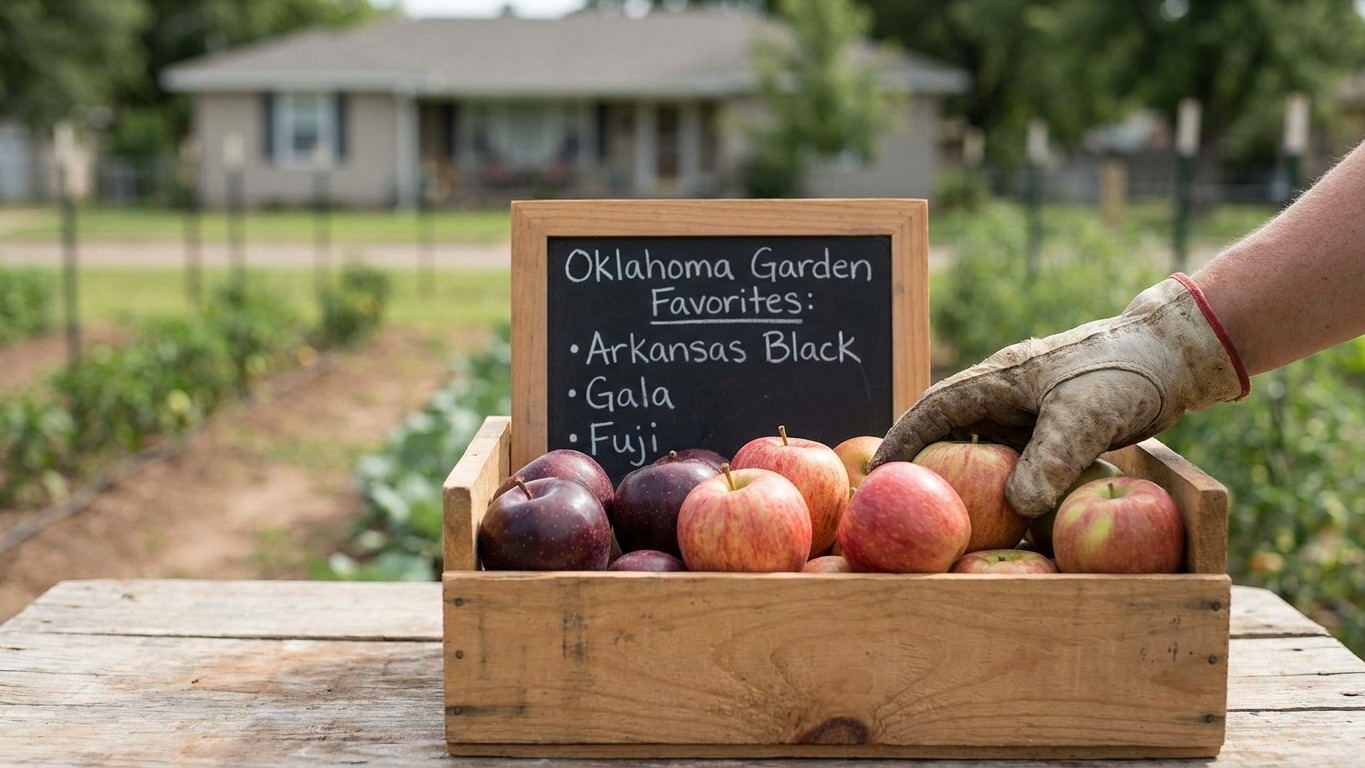

Oklahoma doesn’t have one best apple — it has one deciding question: does this tree bloom late enough to miss the freeze that shows up here between late March and early April. Winter cold is the easy filter; almost anything sold at a nursery survives an Oklahoma winter. The freeze during bloom is what actually wipes out your crop. So before you pick a variety, pull your own county’s last frost date and compare it against that cultivar’s published bloom timing — not the state average, your ground.
The short answer for Oklahoma
Two thresholds, not one variety
Every apple tree sold in this state has to clear two separate filters, and they are not the same test. The first is cold hardiness: can the wood and the graft union survive a winter where the coldest month averages a low of 28.8°F at the Oklahoma City station, per NOAA’s 1991-2020 normals, with occasional nights well below that average. The second is bloom timing: does the tree flower late enough to dodge the March 28 to April 10 window when a freeze is still a real possibility there.
A tree can pass one filter and fail the other. A cultivar bred for northern winters might shrug off deep cold but push bloom in early spring, right into that frost window, and lose the year’s crop to a single 28°F night. A cultivar that blooms safely late might come from a nursery line that was never selected for cold tolerance at all. This is why a name alone tells you nothing. What matters is the published bloom timing and hardiness rating for the specific cultivar and rootstock combination, checked against your own county’s frost dates rather than Oklahoma City’s.
For named cultivars that OSU Extension has actually field tested in Oklahoma conditions, its horticulture program is the right first call, and that step belongs before you order a tree, not after.
Working through it

Bloom timing against the frost window
Rank any apple tree you are considering by how early it blooms, because that single trait decides more outcomes here than any other. An early-blooming tree opens its flowers before the March 28 to April 10 window has passed at the Oklahoma City reference station, and every open flower caught by a freeze in that stretch is a flower that will not set fruit. A late-blooming tree waits until the frost risk has mostly cleared, at the cost of a shorter run into summer heat, which can stress fruit set in its own way. There is no cultivar that avoids both trade-offs. You are choosing which risk you would rather manage.
Winter chill and cold hardiness are different filters
Hardiness tells you whether the tree survives winter. Chill hours tell you whether it flowers properly the following spring, and the two do not move together. A tree that needs a long, cold winter to break dormancy correctly can sit through an Oklahoma winter that never gets cold enough for long enough, and respond with patchy, delayed, or uneven bloom the next year, which shows up as a light or lopsided crop rather than a dead tree. A tree with too short a chill requirement can break dormancy during a warm stretch in January or February and then get hit by the next hard freeze. Both failures look similar from a distance: a tree that leafs out fine but never fruits well. They come from opposite causes, so treat them as two separate questions when you read a catalogue description, not one.
What rootstock choice costs you
The graft union, where the fruiting variety meets its rootstock, is often the coldest-hardy tree’s weakest point. A dwarfing rootstock keeps a tree small and brings it into bearing earlier, but the graft union sits low and close to ground level, where cold air pools on a clear winter night, so it takes the brunt of the coldest air in the yard. A standard or seedling rootstock roots deeper, tolerates that cold better, and grows a tougher union, at the cost of a taller tree that takes longer to bear its first real crop and needs more room to grow into.
| Rootstock class | Typical mature size | Cold exposure at graft union | What you trade |
|---|---|---|---|
| Dwarf | Small, often staked | Highest, sits low to the ground | Earlier bearing, less hardy union |
| Semi-dwarf | Moderate | Moderate | Balance of size and hardiness |
| Standard or seedling | Large, full-size tree | Lowest, deepest and toughest union | Slower to bear, needs more space |
The broader climate calendar this decision sits inside, from dormancy through petal fall to harvest, is laid out stage by stage in The Oklahoma Apple Calendar, Stage by Stage, which is worth reading before you commit to a rootstock and a bloom-timing category together.
What changes across Oklahoma
Elevation and region shift the picture
The Oklahoma Panhandle sits at meaningfully higher elevation than the rest of the state, and higher ground cools faster in the fall and holds onto cold longer into spring than the Oklahoma City normals suggest. A tree that blooms safely against Oklahoma City’s March 28 to April 10 frost window might still get caught in the Panhandle, where the effective frost season runs longer. If you garden up there, treat the Oklahoma City dates as an earlier and milder baseline than what you will actually see, and lean toward the later end of any bloom-timing range.
Eastern Oklahoma, toward the Ozark foothills, runs warmer and considerably wetter than the western part of the state. That extra humidity raises pressure from fire blight and cedar apple rust, two diseases that spread fastest in warm, wet conditions during bloom and early fruit set. A cultivar with strong disease resistance ratings for those two problems matters more east of the state than it does out west, where drier air keeps the same diseases in check on its own.
Low-lying spots anywhere in the state, valley bottoms and hollows where cold air settles overnight, run colder at ground level than the open, elevated ground nearby, sometimes by several degrees on a still, clear night. If your planting site sits in one of those pockets, it behaves more like a colder climate than the regional normals suggest, regardless of which part of the state you are in. Air drainage, not just latitude, decides how cold your specific tree actually gets.
The mistakes this climate punishes
Early bloom meeting a late frost
The single most expensive mistake in this state is planting a cultivar selected for an early, showy bloom without checking it against the local frost window. That mistake shows up every few years, not every year, which is exactly what makes it easy to miss: a tree can bloom early and still get lucky for two or three seasons before a normal late freeze during the March 28 to April 10 window at Oklahoma City, or later at higher elevation, wipes out the whole crop in one night.
Feeding too late in the season
Nitrogen applied in late summer pushes soft, leafy new growth right when the tree should be hardening off for winter. That new growth has not had time to toughen before the first fall freeze arrives, and NOAA’s 1991-2020 normals put that first freeze at Oklahoma City between October 29 and November 8, earlier at higher elevation or in a cold-air pocket. Soft wood caught by an early freeze dies back, and dieback at the tips is exactly where next year’s fruiting wood would have formed.
Ignoring the chill requirement in a mild winter
A winter that never gets cold enough, for long enough, leaves a high-chill cultivar in a kind of limbo, where bloom is delayed, uneven, or partial the following spring. Growers who see this for the first time often assume disease, poor pollination, or a nutrient problem, and spend a season chasing the wrong fix, when the real cause was a chill requirement that the winter simply did not meet.
- Buying on bloom appearance alone without checking the published bloom-timing category
- Skipping the rootstock decision and letting the nursery choose by default
- Fertilizing after midsummer in a state where the first fall freeze can arrive by late October
- Planting a single tree of a variety that needs a pollinizer partner nearby
Checking this against your county
Oklahoma City normals and general orchard mechanics are the baseline, and your county can differ from both in ways that matter. Before you plant, get the specific frost dates and any cultivar trial results your local office has for apples, through OSU Extension, and cross them against the bloom-timing and chill guidance above rather than against the Oklahoma City figures alone.
The same office can also confirm current disease pressure in your part of the state, since fire blight and cedar apple rust risk shifts with the wetter east and drier west of Oklahoma described above. That conversation is worth having before you order a tree, not after it arrives bare-root in spring. Site selection and the crop as a whole are laid out in more depth in Growing Apples in Oklahoma.
Common questions
Can I even grow apples in Oklahoma with our summer heat?
Yes, apples are grown successfully across the state, though summer heat stress on fruit set is a real factor east and west alike. The bigger local constraints are the spring frost window and winter chill accumulation covered above, not the summer heat itself.
What USDA hardiness zone is Oklahoma?
Zone alone would not answer the bloom-timing question anyway. Use the coldest-month minimum and frost dates above as your working numbers, and confirm your specific zone through OSU Extension.
Do I need two apple trees to get fruit?
Many apple cultivars need a compatible pollinizer nearby to set fruit reliably, though not all do. Check the specific cultivar’s pollination requirement before you plant a single tree and expect a full crop from it alone.
How do I know if a nursery tree is actually hardy enough for my winter?
Ask for the cultivar’s published cold hardiness rating and compare it against your area’s coldest-month minimum, not just the catalog’s general hardiness zone claim. A nursery selling nationally may rate a tree for zones that include much colder winters than Oklahoma typically sees, which tells you little about how it performs against Oklahoma’s specific bloom-timing and chill conditions.