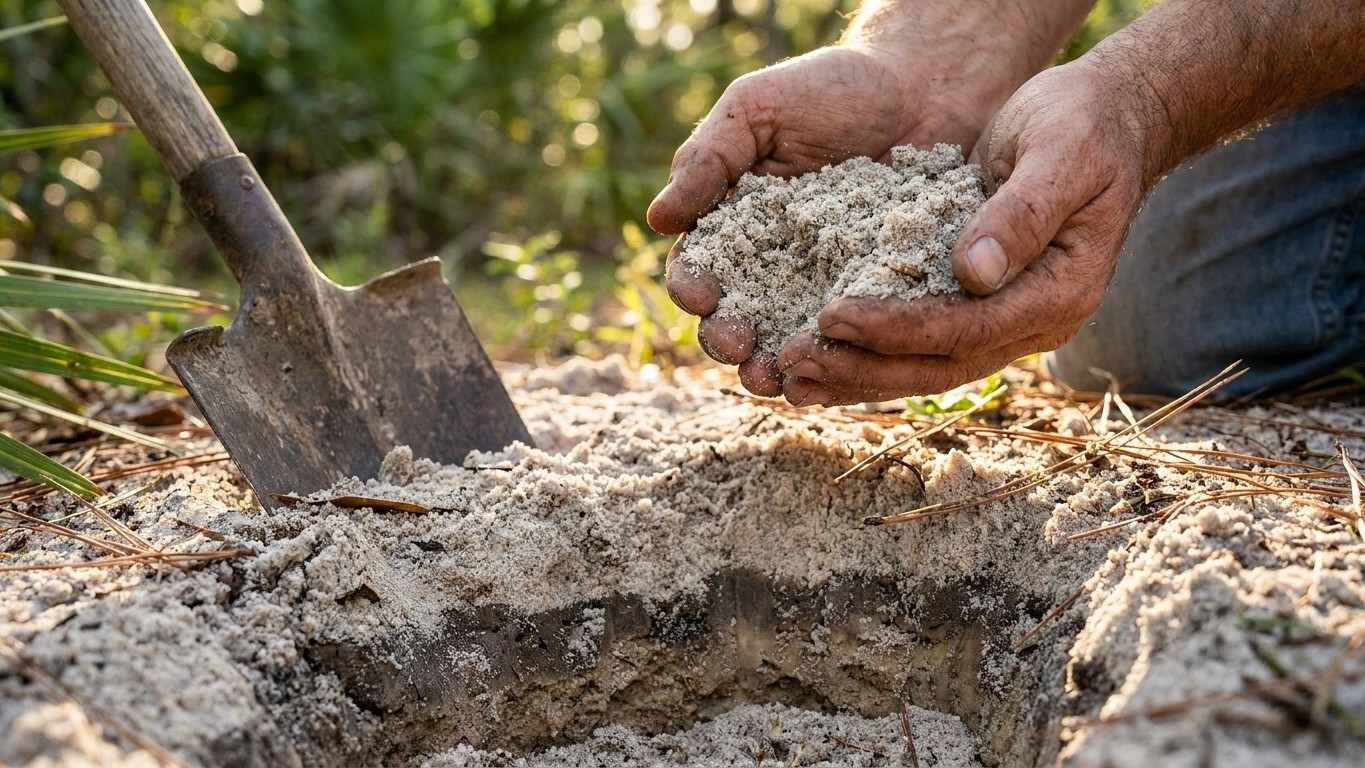

Florida’s official state soil is the Myakka series, a sandy, acid, poorly drained Spodosol that sits under pine flatwoods across much of the peninsula. Knowing its numbers won’t tell you what’s in your own yard, but it will tell you what to test for and why.
What is under your garden

The Myakka series became Florida’s legally designated state soil in 1989, and it’s a fitting choice: it covers vast stretches of flatwoods soil across the state, the kind that forms under longleaf pine and saw palmetto on nearly flat land. A Spodosol, Myakka forms through a leaching process where organic matter and aluminum wash down through sand and cement into a dark subsurface layer called a spodic horizon. If you’ve ever dug a hole in central Florida and hit a hard, almost black band a foot or two down, you’ve probably met that layer firsthand.
The numbers from USDA’s official survey data are specific, and worth sitting with before you touch a shovel. Surface pH runs about 5.1, which counts as strongly acid. The surface texture is almost pure sand: 97 percent sand, 2 percent clay, 1 percent silt. Organic matter sits around 2.0 percent. Drainage is classified as poor. Put together, that’s a soil that’s acidic, structureless, low in the organic material that holds nutrients, and slow to shed standing water despite being made of sand, because the compacted spodic layer underneath blocks the drainage the sand alone would otherwise provide.
| Reading | Value |
|---|---|
| Surface pH | about 5.1 (strongly acid) |
| Sand | 97 percent |
| Clay | 2 percent |
| Silt | 1 percent |
| Organic matter | about 2.0 percent |
| Drainage class | poorly drained |
Here’s the honest caveat: this is the soil that represents the state on paper, not the soil in your particular garden bed. Florida holds hundreds of mapped soil series, from marl flats in the Everglades to river-bottom loams up near the Georgia line. And any lot a builder graded, filled, or scraped for a slab has soil history that has nothing to do with what nature put there originally. Fill dirt trucked in from a borrow pit could be almost anything.
Read your own dirt in five minutes
Two quick checks tell you more than staring at the ground ever will. First, the ribbon test: wet a small handful of soil until it’s moldable, then squeeze it out between thumb and forefinger to form a ribbon. Sandy soil won’t hold a ribbon at all, it just crumbles. Clay-heavy soil forms a long, slick ribbon that holds its shape. Second, the jar test: fill a clear jar a third full of soil, top it with water, shake hard, and let it sit overnight. Sand settles first and forms the bottom layer, silt settles next, and clay stays suspended longest, forming the top layer. What separates out, and in what proportion, is your own soil talking back to you.
Testing before you amend
Guessing at soil amendments is one of the more expensive habits a home gardener can pick up. Lime, sulfur, and fertilizer all cost money, and applying the wrong one, or the right one at the wrong rate, can set a bed back a full growing season. A lab test costs a fraction of what a bag of amendment does, and it tells you things your eyes simply can’t: exact pH, phosphorus and potassium levels, and often organic matter content.
Given the state soil’s pH near 5.1, it’s reasonable to expect acidic ground in much of Florida, especially in flatwoods and sandy upland areas. But expecting isn’t knowing. Urban lots with imported topsoil, areas near limestone outcrops, and coastal ground with shell fragments can swing well above neutral. Only a test on your own bed settles it.
Taking a sample correctly matters as much as sending it in at all. A single scoop from one spot can mislead you if that spot happens to sit on an old brush pile or a compacted path.
- Pick 8 to 10 spots scattered across the bed or lawn area you’re testing, avoiding unusual spots like old fire pits or fence lines.
- At each spot, dig a small core 6 to 8 inches deep, which is roughly where most vegetable and turf roots actually feed.
- Drop each core into a clean bucket, breaking up clumps and removing rocks, roots, and mulch as you go.
- Mix the combined cores thoroughly by hand.
- Pull out about a pint of the mixed soil, let it air dry on a tray if it’s wet, and bag it for submission.
- Label the bag with the bed’s location and what you plan to grow there, since recommendations differ for lawns, vegetables, and ornamentals.
When results arrive, the pH number tells you which direction to correct in, and the nutrient levels tell you whether you actually need fertilizer or you’re just adding to a surplus that’s already sitting there unused.
Amending it
Correcting Florida ground means working with what the numbers actually say, not applying a generic garden-center routine. With a state soil pH around 5.1, the lever most gardeners need is lime, not sulfur. Acid ground that strong locks up phosphorus, making it unavailable to roots even when soil tests show plenty in the ground, and it stunts brassicas like broccoli and cabbage, which struggle badly below pH 6.0.
Lime for acid ground
If your test comes back below about 5.5, lime is the correction, applied according to your test’s recommended rate rather than a blanket bag-per-square-foot guess. Lime doesn’t work fast. It reacts with soil moisture and existing acidity over a full season or more, so don’t expect a pH shift after one rain. Test again the following year before adding more. Sulfur has no place here; adding it to already-acid soil only pushes the problem further in the wrong direction.
Sulfur for alkaline ground
Some Florida lots, particularly those near limestone or with shell-based fill, test above 7.3. On that ground, lime must never go down, full stop. Elemental sulfur, worked in gradually along with organic matter, is the slow and honest route back toward neutral. High pH also locks iron out of reach for plant roots, which is exactly what yellow leaves with dark green veins, a condition called iron chlorosis, are telling you. A chelated iron spray treats the symptom short-term; sulfur and organic matter treat the cause over a couple of seasons.
Organic matter for sandy ground
With the state soil sitting at 97 percent sand and only 2.0 percent organic matter, water and nutrients wash through before roots can use them. Compost, aged manure, and leaf mold worked into the top several inches build the organic fraction that holds both moisture and nutrients. Because sand drains so fast, shorter and more frequent watering beats a deep soak once a week, which just runs straight past the root zone.
What never to do with clay
Where you do run into heavier ground, whether it’s fill dirt or a pocket of natural clay, organic matter is still the fix. Never add sand to clay, since the combination can set up almost like concrete. And never work clay soil while it’s wet; that compacts it into clods that take a season or more to break back down.
Sandy corrections show results within one growing season. pH corrections, especially lime on strongly acid ground, take two to three seasons to fully shift.
Drainage and compaction
The state soil’s poor drainage rating sounds like a contradiction given it’s 97 percent sand, but the compacted spodic layer underneath acts like a shelf, holding water above it after heavy rain even while the surface itself feels dry and sandy to the touch. That’s why so many Florida yards go from bone-dry to standing water within the same afternoon during summer storm season.
A simple percolation test settles the question for your own ground. Dig a hole about a foot deep and a foot across, fill it with water, and let it drain completely once to saturate the surrounding soil. Fill it again and time how fast the water level drops. A drop of an inch or more per hour drains reasonably well for most garden plants. Under half an inch per hour signals a drainage problem serious enough to plan around rather than fight.
Compaction compounds the issue, whether from foot traffic, parked equipment, or construction machinery that rolled over the lot before the house was even finished. Double digging, once the standard fix, has fallen out of favor because it disturbs soil biology and often doesn’t hold up past a single season, especially in sandy ground that recompacts quickly under its own weight.
- Do: build raised beds when a percolation test shows slow drainage; six to twelve inches of good soil above grade solves what years of amending the native ground might not.
- Do: keep foot traffic off garden beds by using defined paths, since compacted paths are far easier to fix than a compacted root zone.
- Avoid: planting anything with sensitive roots, like most fruit trees, directly into ground that showed under half an inch per hour drainage without a raised mound or bed.
- Plant elsewhere: Florida-native wetland species, which are built for exactly the seasonal wet conditions that frustrate vegetable gardens.
On ground that combines poor drainage with a hard spodic layer, a raised bed is often the honest answer rather than three years of chasing a fix that fights the soil’s basic structure.
Local help
The University of Florida’s IFAS Extension runs soil testing through its county offices statewide, and a county agent will walk through your results with you rather than just mailing back a printout. Find your local office and testing details through the Florida IFAS Extension directory. Bring your sample in person if you can; the office can also help interpret readings for the specific crop or lawn you’re planning.
Common questions
Is all Florida soil sandy?
Much of it leans sandy, especially in flatwoods regions where the Myakka series and similar soils dominate, but river bottoms, coastal marl areas, and imported fill can all differ sharply from that pattern.
Why does my yard flood if it’s mostly sand?
Sand alone drains fast, but many Florida soils sit above a compacted subsurface layer that blocks water from moving further down, so it backs up near the surface after rain even though the topsoil itself feels sandy and loose.
How often should I retest my soil?
Every one to two years for an active vegetable garden, and after any major amendment like a lime application, to confirm the correction actually moved the pH the direction you expected.
Can I just add lime every spring as routine maintenance?
No. Lime should only go down based on a current test result; applying it without testing on ground that’s already neutral or alkaline pushes pH in the wrong direction and can lock out iron and other micronutrients.